Digital Music Instruments i developed - Messiah King RKY (Ronen Kolton Yehuda) — Digital and Hybrid Musical Instruments Catalogue

Messiah King RKY (Ronen Kolton Yehuda) — Musical Instruments Catalogue
Catalogue of Instruments
1. Villan Smart String Instrument
- Type: Hybrid (Physical and Digital Strings)
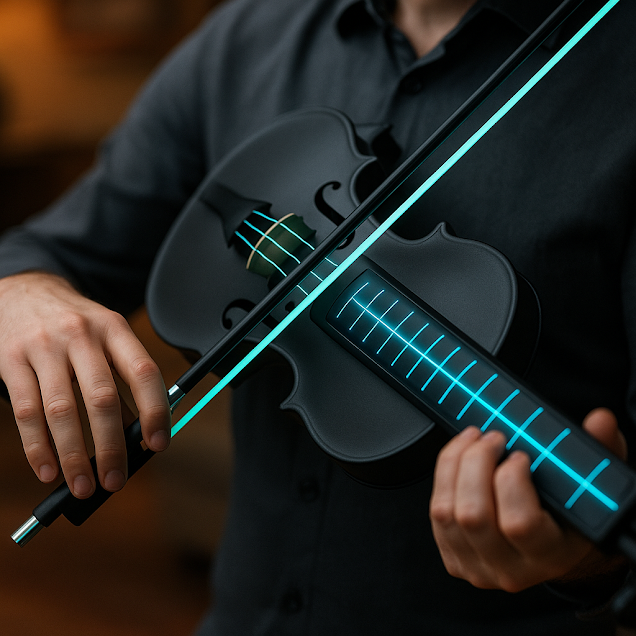
- Description:Traditional stringed instrument + digital innovation.Physical strings mounted above a touchscreen neck, enabling real touch sensation without tuning (digital calibration).
- Features:
- Digital stickers/fret markers (optional)
- Touchscreen fretboard with note guidance
- AI teaching system (fingering, posture, vibrato)
- Bluetooth/MIDI/USB-C connection
- Silent mode, amplified mode, programmable tones
2. Villan Laser String Instrument
- Type: Fully Digital (Laser Beams)
- Description:A next-generation violin, guitar, or bass using laser beams to replace physical strings.
- Features:
- Laser "strings" react to finger proximity and pressure
- Tactile feedback via haptic response
- Programmable tunings and sounds
- No need for physical strings or maintenance
- Silent or speaker output
- Light-emitting bow (for bowed instruments)
3. Villan Touchscreen Keyboard
- Type: Digital
- Description:A keyboard with a fully touchscreen surface, customizable layouts, and built-in AI learning.
- Features:
- Dynamic key size, style, and sound
- Light guidance system for learning
- AI fingering tutor
- MIDI, Bluetooth, and audio output
- Option for Laser Display Projection instead of physical keyboard (see below)
4. Villan Laser Pad Keyboard (XXL and Portable Versions)
- Type: Digital (Laser Beams)
- Description:A full-size or compact laser-projected keyboard pad using beams instead of keys.
- Features:
- Projects a full-color virtual keyboard onto a surface
- Touch-sensitive laser fields
- Haptic and sound feedback
- Lightweight, portable
- Full-size stage version available (XXL model)
5. Villan Digital Laser Drum Kit
- Type: Digital (Laser and Beam Sensors)
- Description:A futuristic drum kit using laser beams or invisible beam sensors instead of physical pads.
- Features:
- Realistic drum mapping
- Sensitive to hit intensity and location
- Programmable drum sounds
- Silent or amplified practice
- AI tutor for rhythm and coordination
6. Villan Digital Wind Instrument
- Type: Hybrid Digital
- Description:A digital wind instrument that simulates breath and finger techniques with sensors and airflow detection.
- Features:
- Adjustable airflow sensitivity
- Breath modulation with tone shaping
- Programmable woodwind, brass, or synth sounds
- Bluetooth, MIDI, and speaker output
- AI tutor for embouchure and breathing exercises
7. Villan Digital Bow (for Strings)
- Type: Digital (Laser or Beam-Based)
- Description:A bow of light that simulates traditional bowing with tactile feedback and sound modulation.
- Features:
- Laser beam or optical sensor bow
- Adjustable resistance simulation
- Integrated MIDI or acoustic triggering
- AI bowing technique tutor
8. Villan AI Learning Neck (Universal)
- Type: Accessory Module
- Description:A smart digital neck module that can attach to any string instrument (traditional or digital) for learning and playing assistance.
- Features:
- Touchscreen and light guidance
- Speakers embedded
- AI fingering, posture, and song tutorials
- Expandable to any instrument: guitar, violin, bass



Future Developments (Already Proposed / In Progress)
- Villan VR/AR Instruments: Fully playable virtual instruments for VR/AR platforms.
- Villan Beam Orchestras: Entire orchestras controlled by laser or beam-based instruments.
- Villan Wearable Instruments: Instruments embedded into wearables (shoes, gloves, suits).
- Villan Modular Smart Instruments: Mix & match modules (strings, wind, drums) into one hybrid unit.
Key Technological Themes Across the Catalogue
- Laser and Beam Technology (for strings, keyboards, drums)
- Touchscreen and Digital Neck Innovations
- AI Music Learning Systems (intuitive for all levels)
- Wireless Connectivity (Bluetooth, MIDI, Wi-Fi)
- Silent Mode & Amplification Options
- Customization (tuning, scales, instrument type switching)
Closing


Digital Musical Instruments Developed by Ronen Kolton Yehuda (Messiah King RKY)
Introduction
These instruments combine smart sensors, beam technology, digital touch interfaces, and AI interaction — offering new forms of expression beyond traditional acoustic boundaries.
Instruments I Developed:
1. Smart String Instrument
A radical evolution of the traditional fretted instrument, merging physical play with sensor-based digital precision.
-
Motion Sensors: Embedded in the body to track hand, finger, and posture movements, enabling dynamic expression like vibrato, slides, and bends.
-
Digital Neck:
-
Touch-sensitive frets for exact finger placement detection.
-
Optional fretless mode for glides and microtonal playing.
-
Illuminated finger guidance to display notes, chords, and improvisation prompts.
-
-
Chord Recognition: Real-time chord shape detection for advanced playing and MIDI control.
-
Wireless Connectivity: Bluetooth, USB-C, MIDI output for connecting with software, synthesizers, and recording setups.
-
Haptic Feedback: Optional vibrations for note confirmation, learning assistance, or error correction.
➡️ An instrument that feels natural, responds intelligently, and expands the possibilities of musical expression.
2. Beam-Based Digital String Instruments
An entirely new instrument category, replacing traditional strings with light and motion sensors.
-
Infrared and Laser Beams: Detect finger positioning, pluck intensity, and movement across virtual "strings."
-
Motion Detection: IMU, gyroscope, and accelerometers interpret body gestures for expressive sound control.
-
Modular Interface: Ability to digitally switch between guitar, harp, zither, or other string formats.
-
Silent or Amplified Play: Perfect for practice, studio, or performance without physical string noise.
-
No Tuning Required: Always in tune, with customizable scales and tunings.
➡️ Strings made of light. Music born from movement.

3. Digital Wind Instruments
A futuristic interpretation of classical wind instruments, designed for breath-driven digital sound control.
-
Breath and Pressure Sensors: Accurately simulate the natural dynamics of traditional wind playing.
-
Touch and Motion Surfaces: Virtual keys and body movement detection replace mechanical parts.
-
Customizable Sound Engines: Play multiple voices (saxophone, trumpet, synthesizer) from one instrument.
-
Silent Practice: Play with headphones without disturbing others.
-
Live and Studio Integration: Full compatibility with digital audio workstations (DAWs), MIDI systems, and sound libraries.
➡️ Breath becomes music. Movement becomes melody.
4. Touchscreen Digital Keyboards
A portable, intuitive solution for piano and synthesizer performance using touchscreen devices.
-
Full-Size Virtual Keyboards: Multi-touch capable for realistic chord and melody playing.
-
Velocity and Pressure Sensitivity: Responsive to touch strength and dynamics.
-
Built-In Learning Tools: Scales, chord guides, and real-time feedback assist education and composition.
-
MIDI and App Connectivity: Seamlessly integrates with mobile, desktop, and studio environments.


➡️ An entire musical instrument at your fingertips, anywhere you go.
Conclusion

Digital Musical Instruments
Invented and Developed by Ronen Kolton Yehuda (Messiah King RKY)


The Rise of Digital Musical Instruments
Touch, Screen, Sound – Reinventing How We Play
By Ronen Kolton Yehuda (Messiah King RKY)
Introduction
From piano keyboards on touchscreens to sensor-enhanced string simulators, digital instruments have become central to a new era of accessible and intelligent sound creation.
What Is a Digital Musical Instrument?
Examples include:
-
Virtual keyboards on smartphones and tablets
-
Touch-sensitive string necks or wind instruments
-
MIDI pads with pressure and velocity detection
-
Hybrid acoustic-electric instruments with internal chips and displays

Key Features and Capabilities
🎛️ Touch and Visual Interfaces
-
Virtual keyboards simulate traditional pianos with visual feedback
-
Screen-based sliders, buttons, and chord pads for easy interaction
🔊 Integrated Speakers
Many versions now include built-in stereo speakers, turning tablets or digital instruments into standalone sound sources — ideal for practice, performance, and portable jamming.
🎧 MIDI and App Integration
-
Full support for MIDI, Bluetooth, or USB-C to connect with DAWs and sound libraries
-
Integration with notation apps, recording suites, or even AI-powered learning platforms

📱 Portability and Modularity
-
Run on mobile phones, tablets, foldable laptops, or dedicated devices
-
Instruments can now fit in a backpack, sync with other Villan devices, and adapt to different skill levels

Use Cases
🎼 Education
-
Visual learning with finger placement, note labeling, and real-time feedback
-
No tuning required — instant playability
🧠 Therapy and Accessibility
-
Sound interfaces for non-musicians, elderly, or neurodivergent individuals
-
Instruments can adapt pitch, rhythm, and resistance based on user feedback
🎹 Composition on the Go
-
Compose and record full pieces while traveling
-
Sketch chord progressions, melodies, or beats with one finger
🎤 Live Performance
-
Used by DJs, electronic artists, and hybrid bands
-
Supports effects control, loop layers, and touchscreen solos

Villan’s Role in DMI Innovation
At Villan, our digital instrument systems are integrated into our SmartSole, SmartScreen, and +Device product lines — with native support for:
-
Digital Piano Touch Apps
-
DV Language Composing Tools
-
Sensor-Based Performance Systems
-
Augmented Reality Visualization for Music
From the sealed AR piano inside a building window, to the hybrid string instrument with sensors, Villan redefines every element of how an instrument can be built and played.
Conclusion
They represent a musical future that is smarter, more accessible, and more personal than ever before.
Digital drums with laser beam pad or other beams sensors
Villan Smart String Instrument
Digitally Enhanced Traditional Instrument with Motion Sensors and Interactive Neck
Introduction
The Villan Smart String Instrument is a radical reinvention of traditional fretted instruments — combining the expressive power of analog performance with the precision and versatility of digital systems. Designed to feel familiar to musicians while unlocking new dimensions of interaction, this instrument introduces a sensor-rich body, an interactive digital neck, and real-time connectivity to apps, processors, and AR/VR systems.
Built for live performers, composers, educators, and technologists, it supports both traditional and futuristic musical workflows — making it one of the most advanced string instruments ever created.
Core Features
🧠 Smart Sensor Integration
-
Body Motion SensorsHigh-resolution motion-tracking sensors embedded into the instrument’s body detect finger, hand, arm, and posture movement — interpreting fretting, picking, sliding, vibrato, and expressive gestures.
-
Gyro and Pressure SensorsDetect subtle angle changes, finger pressure, and hand orientation for dynamics, pitch bends, and expression mapping.
-
Haptic FeedbackOptional vibration responses based on note confirmation, effects, or error prevention in practice mode.
🎸 Digital Interactive Neck
-
Touch-Sensitive FretsCapacitive or pressure-sensitive touch panels in place of or underneath physical fret markers allow for exact finger placement detection.
-
Fretless ModeThe digital neck can simulate fretless glides, microtonal scales, or custom tuning systems with high accuracy.
-
LED-Illuminated Finger GuidanceProgrammable fingerboard lights to show notes, chords, scale positions, or real-time improvisation prompts — useful for beginners, live performance, or education.
-
Chord Recognition EngineDetects complete chord shapes in real time, allowing for MIDI mapping, effect triggering, or visual display of chord names.
🔗 Connectivity and Control
-
Bluetooth & USB-CFor connection to DAWs, digital processors, mobile apps, and stage gear.
-
MIDI Output / OSC ControlSend note, chord, pressure, and movement data to any synth, sampler, or visualizer.
-
Villan V1 OS IntegrationSync with SmartSoles, SmartScreen, AR Glasses, and DV Language-based music notation interfaces.
-
Wireless Charging and Battery EfficiencyLong-life internal battery optimized for performance scenarios, with fast charging and wireless dock option.
Use Cases
-
🎵 Live PerformanceReal-time gesture-based modulation, effects control via movement, visualized AR stage projection.
-
🎓 Education and PracticeFinger guidance lighting, haptic feedback, progress tracking, and interactive tutorials.
-
🎧 Studio CompositionMIDI and expression capture directly into DAWs — with tactile realism and digitally enhanced control.
-
🧪 Experimental Sound DesignCustom tunings, microtonal scales, mapped gestures to synth filters, or VR interaction through body motion.
Technical Materials
-
Neck and Fingerboard:Carbon fiber + pressure-sensitive capacitive layer with glass-polymer overlay.
-
Body:Lightweight acoustic-composite with internal shock-resistant sensor array.
-
Bridge & Strings:Physical or hybrid (electro-acoustic or magnetic) depending on model — compatible with traditional string play.
-
Embedded AI Processor:For local gesture-to-MIDI conversion, onboard effects processing, and real-time DSP.
Expansion Modules
-
🔌 Effect Slot for Pedalboard ExpansionDirect control of digital pedalchains via finger gestures or fretting combinations.
-
🎥 Camera Mount (Optional)For visual tracking of hand position or AR projection.
-
🧱 Modular PanelCustomizable input/output bay for performance-specific extensions (loopers, harmonizers, DAW controls).
| Conclusion |
|---|

Digital Strings 🎻 Digital Strings & Bow
Introduction
Fusing laser string systems, touchscreen fingerboards, and AI-enhanced laser bows, Villan instruments transform traditional acoustic playing into a modular, intelligent, and futuristic experience.
Key Technologies
🎼 1. Laser Strings System
All Villan Digital String Instruments replace traditional strings with invisible light beams:
-
Responsive laser or IR beams simulate real string interaction
-
Haptic feedback + speaker output replicates resonance
-
No breakage, wear, or tuning — ever
-
Multiple tuning systems, alternate scales, and synthesized string types
-
Silent mode + amplification-ready for any environment
Each instrument can be tuned for classical, experimental, or global music formats, with real-time switching.
🖐 2. Touchscreen Fingerboard
Across the violin, viola, cello, and double bass sizes, Villan uses advanced multi-touch fingerboard displays:
-
Real-time finger tracking: slides, vibrato, pressure, and speed
-
LED-illuminated notes, DV Language overlays, or custom visualizations
-
Instant fret remapping: from standard tuning to microtonal, Indian, or modal scales
-
Studio-ready output: record, edit, and stream from the instrument directly
Each display syncs with Villan OS, FoldBook, and SmartScreen for total control.
🪄 3. Laser Bow Technology
Each instrument comes with a matching Villan Laser Bow, designed to simulate natural bowing using modulated beams.
-
Angle, arc, and velocity recognition
-
Configurable width and tone texture
-
Compatible with violin, viola, cello, contrabass, erhu, rebab, and more
-
Gesture-controlled articulation (spiccato, pizzicato, ricochet, etc.)
-
Wireless, rechargeable, and customizable in feel
Play in air — or in silence. Either way, the bow becomes your brush.
Smart Features
-
🎧 Silent Mode – Practice anywhere, anytime
-
🎚 MIDI & DAW Output – Use as controller or instrument in digital setups
-
🌐 Wireless Sync – Seamless connection to SmartWear, SmartSole™, FoldBook, or SmartBracelet
-
🤖 AI Feedback System – Live intonation, posture, tone, and rhythm analysis
-
💡 DV Language Compatible – Native support for Villan’s revolutionary music notation system


Instruments in the Series
| Instrument | Range | Status |
|---|---|---|
| 🎻 Violin | Treble | Core Model |
| 🎻 Viola | Alto | Expanded Model |
| 🎻 Cello | Tenor/Bass | Full Body Model |
| 🎻 Contrabass | Bass/Double Bass | Studio & Stage |
| 🎻 Mini Strings | Custom Sizes | Children & Travel |
| 🎻 World Strings | Erhu, Kamancheh, Rebab, etc. | Culturally Adaptive Models |
Use Cases
Why It Matters
They offer:
-
Zero tuning overhead
-
Zero friction in learning
-
Full integration with modern creative workflows
-
And infinite adaptability in sound, function, and design
Conclusion
Every note is felt, visualized, and transformed.


Smart String Instrument
Introduction
Built for live performers, composers, educators, and technologists, it supports both traditional and futuristic musical workflows — making it one of the most advanced string instruments ever conceived.
Core Features
🧠 Smart Sensor Integration
-
Body Motion Sensors:High-resolution sensors embedded into the instrument’s body detect finger, hand, arm, and posture movement — interpreting fretting, picking, sliding, vibrato, and expressive gestures.
-
Gyro and Pressure Sensors:Capture subtle angle changes, finger pressure, and hand orientation for dynamic control of pitch bends, vibrato depth, and expressive mapping.
-
Haptic Feedback:Optional vibration responses provide feedback for note confirmation, effects triggering, or learning support during practice.
🎸 Digital Interactive Neck
-
Touch-Sensitive Frets:Capacitive or pressure-sensitive panels beneath or instead of physical frets allow precise finger placement detection.
-
Fretless Mode:Switchable functionality enables fretless gliding, microtonal scales, or custom tunings with high accuracy.
-
LED-Illuminated Finger Guidance:Integrated lights display notes, chord shapes, scale positions, or improvisation prompts — ideal for learning, stage performance, or advanced improvisation.
-
Chord Recognition Engine:Detects complete chord shapes in real time for MIDI control, digital effects, or visual feedback.
🔗 Connectivity and Control
-
Bluetooth & USB-C:Connects directly to digital audio workstations (DAWs), mobile applications, synthesizers, and processing units.
-
MIDI Output / OSC Control:Sends real-time note, chord, expression, and movement data to any compatible sound engine or visualizer.
-
Wireless Charging and Battery Efficiency:Optimized for extended performance time, with fast-charging and wireless dock options.
Use Cases
🎵 Live Performance
-
Real-time gesture modulation and effects control.
-
Integration with AR/VR stage projections.
🎓 Education and Practice
-
Visual finger guidance, adaptive learning feedback, and haptic reinforcement.
-
Progress tracking and real-time tutorial compatibility.
🎧 Studio Composition
-
Capture highly expressive MIDI performances.
-
Integrate dynamic gestural expression into electronic and orchestral production.
🧪 Experimental Sound Design
-
Custom tunings, mapped gestures to sound filters, interaction with VR/AR environments.
Technical Materials
-
Neck and Fingerboard:Carbon fiber structure combined with a pressure-sensitive capacitive glass-polymer overlay.
-
Body:Lightweight acoustic-composite shell with an internal shock-resistant sensor array.
-
Bridge and Strings:Traditional physical strings, hybrid electro-acoustic models, or optional magnetic-string configurations depending on model variation.
-
Embedded AI Processor:Local processing for gesture-to-MIDI conversion, onboard effects, and dynamic sound shaping.
Expansion Modules
-
🔌 Effect Slot for Pedalboard Expansion:Fretting and finger combinations can directly control digital effect chains.
-
🎥 Camera Mount (Optional):For optical tracking of hand positions, enabling visual interaction or augmented reality integration.
-
🧱 Modular I/O Panel:Customizable input/output bay supporting looper stations, harmonizers, external DAW controls, and more.
Important Note:
Conclusion
🎸🎶
Perfect — you want the digital string instrument with touchscreen neck to now include:
- Physical strings (real, touchable)
- Digital "stickers" (virtual frets/notes on touchscreen neck)
- No need for tuning (strings mainly for tactile feel, sensors capture finger positions)
Here’s a structured and clear version for the updated concept:
Hybrid Physical-Digital String Instrument with Touchscreen Neck and Digital Stickers
Overview
This next-generation string instrument combines:
- Physical strings for real tactile feedback (no tuning needed)
- Digital strings using beams or sensors
- Touchscreen neck with dynamic digital stickers showing notes, frets, chords
- Fully smart sound generation, independent of string tuning
It offers the authentic feel of strings without the maintenance burden, while opening a world of digital customization and learning support.
Main Components
1. Physical Strings (No-Tuning Required)
- Real strings stretched across the instrument
- Tactile only: They provide the feeling of resistance, sliding, and bending
- Sensors detect finger pressure and position (not relying on acoustic tuning)
- Piezo or optical sensors inside the bridge and neck read vibrations/finger touches
- Optional "tuned feel" simulation via string tension settings (manual or semi-automatic)
No need to tune the instrument manually! Sound generation is digital.
2. Digital Strings (Laser or Sensor Beams)
- Invisible or visible digital beams parallel to physical strings
- Detect proximity, pluck, bow, or finger movements
- Allow silent mode, alternate tunings, and custom sounds
3. Touchscreen Neck with Digital Stickers
- Full neck is a touch-sensitive touchscreen
- Digital stickers display:
- Fret numbers
- Notes
- Chord shapes
- Scales
- Practice exercises
- Visual guides can change dynamically depending on:
- Selected key
- Song
- Difficulty level
- Practice mode
Key Features
- Tactile Feel: Real strings simulate real playing, even without tuning
- Infinite Tunings: Software defines the pitch, mode, and scales instantly
- Self-Teaching Mode: Light-up stickers guide the player
- Silent Practice Option: Play without making external sound
- Performance Flexibility: Easily switch between classical, electric, synthetic, or experimental sounds
- Customizable Settings: Adjust string tension feel, touchscreen sensitivity, sticker designs, and beam strength
Optional Additions
- Haptic feedback in the touchscreen neck for realistic vibrations
- Built-in speakers for direct sound output
- MIDI/USB connection for DAW recording and effects
- Wireless app control for preset management
Invented and Developed by
Ronen Kolton Yehuda (Messiah King RKY)

Digital Wind Instruments: The Future of Breath-Driven Music
In an age where music meets innovation, digital wind instruments (DWIs) are redefining how we play, compose, and interact with sound. These instruments preserve the expressive control and physicality of traditional wind instruments, while introducing smart features, expanded sound capabilities, and advanced connectivity.
Core Features:
- Breath & Pressure Sensors: Mimic the dynamics of acoustic play.
- Touch Panels or Virtual Keys: Replace mechanical keys with sensitive input zones.
- Sound Engines: Built-in or app-connected systems that offer a library of instrument voices or synthesized tones.
- MIDI/USB/Bluetooth Output: Connects to DAWs, computers, tablets, and smart devices for composition, live performance, or recording.
- LED Feedback or Visual Interfaces: Provide feedback, tuning indicators, or virtual fingering guides.
Benefits Over Traditional Instruments:
- Silent Practice Mode: Headphone-compatible playing for quiet environments.
- Multitimbral Output: Play a saxophone, trumpet, or synthesizer — all from one instrument.
- Portability: Lightweight, often modular or foldable.
- Accessibility: Easier for beginners or individuals with limited hand mobility.
- Data Integration: Compatible with notation software, recording tools, and music education apps.
Use Cases:
- Education: Intuitive for music students in schools and digital classrooms.
- Live Performance: Enables a single performer to control multiple voices.
- Studio Work: Integrates directly into music production environments.
- Therapeutic Applications: Used in breathing exercises or music therapy.


Digital Keyboards on Touchscreens
The Rise of Virtual Instruments in Modern Music
In today’s world of mobile creativity, digital keyboard apps on touchscreen devices have redefined how musicians compose, practice, and perform.
Whether it's a tablet, smartphone, or hybrid touchscreen device, these apps allow users to access a full piano or synth keyboard layout directly from their screen — no physical instrument required. They're lightweight, portable, and responsive, making them ideal for both beginners and professional producers.
Key Features:
-
🎹 Multi-Touch Input – Supports chords, slides, and velocity sensitivity depending on screen tech
-
🧠 Built-in Scales and Chord Guides – Assists with learning and composing
-
🎧 MIDI and App Integration – Connects to DAWs or sound libraries via USB, Bluetooth, or Wi-Fi
-
🌍 Cloud Syncing and Recording – Compose on the go and export to your studio setup
Why It Matters
Touchscreen keyboards are part of a larger shift toward accessible, digital-first music tools. They empower musicians without gear, students without space, and producers who travel. From mobile beatmakers to AR/VR music classrooms, these virtual keyboards help bridge traditional technique and modern creativity.

Digital Musical Instruments Developed by Ronen Kolton Yehuda (Messiah King RKY)
Introduction
These instruments combine smart sensors, beam technologies, touch interfaces, breath control, and AI integration — offering new forms of musical expression beyond traditional acoustic boundaries.
Instruments I Developed:
1. Smart String Instrument
A radical evolution of the traditional fretted instrument, merging physical play with sensor-based digital precision.
-
Motion Sensors: Embedded sensors track hand, finger, and posture movements, enabling dynamic expressions such as vibrato, slides, and bends.
-
Digital Neck:
-
Touch-sensitive frets for exact finger placement detection.
-
Optional fretless mode for glides and microtonal playing.
-
Illuminated finger guidance showing notes, chords, and improvisation prompts.
-
-
Chord Recognition: Real-time chord detection for advanced playing, notation, or MIDI control.
-
Wireless Connectivity: Bluetooth, USB-C, and MIDI output for seamless software and studio integration.
-
Haptic Feedback: Optional vibrations to confirm correct notes or assist in learning.
➡️ An instrument that feels natural, responds intelligently, and expands musical expression.
2. Beam-Based Digital String Instruments
A revolutionary category that replaces physical strings with light and motion detection.
-
Infrared and Laser Beams: Precisely detect finger positioning, pluck intensity, and movement without physical strings.
-
Motion Detection: Using IMU, gyroscopes, and accelerometers to interpret hand and body gestures.
-
Modular Interface: Switch easily between guitar, harp, sitar, or other digital formats.
-
Silent or Amplified Play: Perform silently for practice or with full amplification on stage.
-
No Tuning Required: Always perfectly in tune, with customizable scales and tunings.
➡️ Strings made of light. Music born from pure movement.
3. Digital Wind Instruments
A futuristic interpretation of classical wind instruments, combining breath-driven play with smart technology.
-
Breath and Pressure Sensors: Capture authentic dynamics of traditional wind instruments.
-
Touch and Motion Surfaces: Replace mechanical keys with highly responsive digital input.
-
Customizable Sound Engines: Play multiple voices (saxophone, trumpet, synth) from a single device.
-
Silent Practice: Use headphones for quiet sessions without sound leakage.
-
Studio and Stage Integration: Full MIDI, Bluetooth, and USB compatibility for live or recorded music.
➡️ Breath becomes music. Movement becomes melody.


4. Touchscreen Digital Keyboards
A full piano or synthesizer experience brought to touchscreen devices.
-
Full-Size Virtual Keyboards: Multi-touch support for chords, glides, and expressive dynamics.
-
Built-In Learning Tools: Scales, chords, and real-time visual feedback assist composition and practice.
-
Velocity and Pressure Sensitivity: Responsive to touch strength and nuance.
-
MIDI and App Connectivity: Instant connection to DAWs, synthesizers, and music creation apps.
-
Cloud Sync and Recording: Compose anywhere and save directly to digital platforms.
➡️ A complete musical instrument at your fingertips — anywhere, anytime.
What Is a Digital Musical Instrument (DMI)?
A Digital Musical Instrument (DMI) is any musical interface that generates or manipulates sound digitally, typically using software, sensors, and smart technology instead of purely acoustic components.
Examples include:
-
Virtual keyboards on smartphones and tablets.
-
MIDI-enabled string or wind instruments.
-
Touch and motion-controlled musical surfaces.
-
Hybrid electronic-acoustic instruments.
Key Features and Capabilities of My Developed Instruments:
Applications and Benefits:
🎼 Education
-
Visual and interactive music learning.
-
Real-time note feedback, tuning-free play.
🧠 Therapy and Accessibility
-
Adaptive interfaces for non-musicians, elderly, or neurodivergent users.
-
Breath and movement-based music interaction.
🎹 Composition on the Go
-
Full creative workflows from any device, anywhere.
🎤 Live Performance
-
Touch, gesture, and breath-controlled modulation for expressive stage performances.
The Future of Digital Musical Instruments
Conclusion
Here’s the clear and technical explanation of the laser pad illustration you just got:
Laser Pad: How It Works (Explained)
1. Laser Beams
- Thin, straight laser beams are projected horizontally.
- These beams act like "virtual strings" or "keys" or "drum zones."
- They are perfectly aligned above a touch-sensitive surface (flat or slightly curved).
2. Hand Interaction
-
When your hand or finger approaches or touches the beams:
- It interrupts the laser beam path.
- This signals the instrument that a note or event must be triggered.
-
Depth of interaction matters too:
- Hovering slightly = softer sound
- Deeper push = louder or stronger expression
3. Touch-Sensitive Surface
- Below the laser beams, there is a smart surface that:
- Detects pressure (how hard you touch down)
- Detects dynamics (speed, direction, motion)
- This allows realistic musical techniques like:
- Dynamics (soft vs loud)
- Slides
- Vibrato
- Rolls (for drums)
4. Sensors and Processing
- Optical Sensors constantly monitor the laser beams.
- Proximity Sensors read how close your hand is.
- Pressure Sensors detect any physical pressure on the touch surface.
All this information is processed instantly.
5. Sound Generation and Output
- After the system processes your hand’s action:
- It generates the corresponding sound (a note, drum hit, pluck, etc.).
- Sends the sound out via speakers, headphones, or digital output (MIDI/USB).
Summary of Each Part in the Illustration
Key Advantages
- No mechanical parts to break (compared to real keys, strings, or drums).
- Highly expressive, even without physical contact.
- Customizable layout: beams can form different instruments digitally.
- Ultra-fast detection: perfect for professional performances.
Here’s the clear and technical explanation of the laser pad illustration you just got:
Laser Pad: How It Works (Explained)
1. Laser Beams
- Thin, straight laser beams are projected horizontally.
- These beams act like "virtual strings" or "keys" or "drum zones."
- They are perfectly aligned above a touch-sensitive surface (flat or slightly curved).
2. Hand Interaction
-
When your hand or finger approaches or touches the beams:
- It interrupts the laser beam path.
- This signals the instrument that a note or event must be triggered.
-
Depth of interaction matters too:
- Hovering slightly = softer sound
- Deeper push = louder or stronger expression
3. Touch-Sensitive Surface
- Below the laser beams, there is a smart surface that:
- Detects pressure (how hard you touch down)
- Detects dynamics (speed, direction, motion)
- This allows realistic musical techniques like:
- Dynamics (soft vs loud)
- Slides
- Vibrato
- Rolls (for drums)
4. Sensors and Processing
- Optical Sensors constantly monitor the laser beams.
- Proximity Sensors read how close your hand is.
- Pressure Sensors detect any physical pressure on the touch surface.
All this information is processed instantly.
5. Sound Generation and Output
- After the system processes your hand’s action:
- It generates the corresponding sound (a note, drum hit, pluck, etc.).
- Sends the sound out via speakers, headphones, or digital output (MIDI/USB).
Summary of Each Part in the Illustration
Key Advantages
- No mechanical parts to break (compared to real keys, strings, or drums).
- Highly expressive, even without physical contact.
- Customizable layout: beams can form different instruments digitally.
- Ultra-fast detection: perfect for professional performances.
Digital Musical Instruments
Invented and Developed by Ronen Kolton Yehuda (Messiah King RKY)
Would you like me to prepare it? 🚀🎵


The Future of Percussion:
Digital Drums with Laser Beam Pads and Sensor Technology
By Ronen Kolton Yehuda
How It Works
The core technology includes:
- Laser/infrared/optical beams positioned to form "air pads."
- High-precision motion sensors detecting strikes, speed, and intensity.
- Smart module converting actions into high-quality sampled or synthesized drum sounds.
- Adjustable sensitivity to personalize playing styles, from soft touches to powerful hits.
- Optional visual feedback (e.g., beams flashing colors when triggered).
The drums can be played with or without traditional sticks, making them ideal for classic drummers, electronic musicians, performers, and even motion artists.
Key Features
-
No Physical Wear and TearNo skins or hardware to replace. No physical surfaces to degrade. Pure beam-based percussion.
-
Silent Practice ModePlay silently with headphones, perfect for late-night practice without disturbing others.
-
Portability and Lightweight DesignEntire drum set can fit in a small case — ideal for travel and stage performances.
-
Customizable Drum LayoutsChange the type and position of drums digitally via the control module or app.
-
Seamless Integration with DAWs and MIDIConnects wirelessly or via USB/MIDI for use in studios, live performances, and recording environments.
-
Visual and Performance Art PossibilitiesDrummers can create visually stunning performances by interacting with beams of light — ideal for concerts, stage shows, and multimedia events.
Applications
-
Professional DrummingA futuristic alternative for electronic drum sets.
-
Music EducationTeach rhythm and timing in an interactive, engaging way.
-
Therapy and RehabilitationBeam drums can help patients or children improve motor skills without needing physical strength.
-
Live Performance and Visual ArtCombining music and movement for next-generation shows.
A New Standard for Percussion
The future of drumming is here — and it plays with light.
AI-Enhanced Learning Neck: Teaching Music Through the Instrument
In the next generation of digital musical instruments, the neck becomes far more than just a surface to place your fingers — it becomes your personal music teacher.
By embedding AI technology and integrated speakers directly into the neck, this revolutionary system can teach users how to play music step-by-step. Whether it's a guitar, violin, or any fretted or stringed digital instrument, the AI guides the player in real time, turning every practice session into an interactive learning experience.
The AI analyzes finger positions, pressure, timing, and rhythm, offering instant corrections and encouraging feedback through both audio and visual cues. The embedded speakers provide immediate sound responses, demonstrating correct techniques, playing along with the user, or delivering spoken instructions. For beginners, it acts like a personal tutor; for advanced players, it offers masterclass-level refinement.
The system is capable of adapting to the user's skill level — from teaching the first simple notes to helping musicians master complex compositions. Lessons are personalized dynamically, ensuring every learner progresses at their ideal pace.
With the AI-Enhanced Learning Neck, musical education becomes accessible, personalized, and built directly into the instrument — no additional screens, teachers, or apps needed. It redefines music learning for a new generation, making practice not only easier, but smarter, more intuitive, and more inspiring.
AI-Enhanced Learning Instruments: The Future of Musical Education
Instruments Redesigned for Learning:
-
Stringed Instruments (Guitar, Violin, Harp, Bass):The neck is upgraded with smart sensors, touchscreens, and embedded speakers.It tracks finger positioning, pressure, timing, and gesture movements.The AI reacts in real time, offering audio prompts, visual indicators, and interactive practice modes.
-
Touchscreen Keyboards and Pianos:The entire surface of the keyboard acts as a dynamic learning platform.Smart lighting, pressure sensors, and haptic feedback guide each finger across the right notes.The AI adjusts difficulty, demonstrates correct fingering, and even plays duets with the learner through the built-in speakers.
Each instrument becomes a self-contained school, capable of teaching complete beginners or advancing skilled musicians — without any external apps, screens, or additional devices. Lessons are dynamic, adaptive, and customized to each user's pace and musical goals.
A New Era for Musical Learning
The AI-Enhanced Learning System makes music more accessible than ever:
- No need for private tutors or endless online videos.
- No complicated setups or additional purchases.
- No barriers between you and your musical dreams.
Whether you're picking up an instrument for the first time or perfecting your technique after years of playing, the instrument itself becomes your teacher, coach, and musical partner.
With AI-Enhanced Learning Instruments, music is not just learned — it’s lived.


The New Era of Musical Instruments: AI-Enhanced, Laser-Enabled, and Fully Interactive
Introduction
Today, the instrument itself becomes the teacher, the coach, the bandmate, and the stage.
AI and Laser-Enhanced Stringed Instruments
Guitars, violins, harps, basses — traditional string instruments — are redefined with laser and beam-based innovations:
-
Laser or Infrared Beam Strings:Instead of physical strings, players interact with invisible or visible laser beams, simulating the tactile and sonic characteristics of traditional strings.Interrupting the beams triggers precise musical notes, with pressure sensitivity, gesture dynamics, and haptic feedback.
-
Touchscreen Fingerboards:Neck surfaces are replaced or augmented with touch-responsive screens, detecting finger positions, pressure, and gestures, guiding the user visually and physically.
-
AI-Enhanced Digital Bow:String players use a smart digital bow made of laser light or infrared emissions, which detects bowing speed, pressure, angle, and bow path.The AI analyzes and provides real-time coaching, improving bowing technique, articulation, and musical expression.
This technology makes stringed instruments lighter, maintenance-free (no broken strings), programmable, and extremely expressive.
AI-Enhanced Digital Drums and Percussion Pads
Percussion enters a new dimension with beam-driven digital drums:
-
Laser Grid and Motion Sensor Pads:Drummers interact with invisible grids or infrared motion-sensitive pads, striking through the air or onto specialized surfaces.
-
Velocity and Angle Detection:Systems detect impact strength, direction, and dynamics, offering incredible realism without physical skins.
-
Built-in AI Rhythm Coach:Instruments offer timing correction, rhythm exercises, tempo training, and even ensemble simulations, helping players improve their skills organically.
These setups allow silent practice, instant sound switching, and endless drumming creativity.
AI-Enhanced Keyboards and Smart Touchscreen Pianos
Keyboards and pianos are redesigned as dynamic learning surfaces:
-
Full Touchscreen Keyboards:Each "key" or area is a live visual display that illuminates notes, chords, finger placements, and playing instructions.
-
Pressure-Sensitive Surfaces:AI detects how hard, fast, and precisely a key is played, offering dynamic feedback and corrective exercises.
-
Adaptive Learning:As players improve, the keyboard adjusts difficulty automatically, teaching scales, pieces, improvisation, and technique step-by-step.
AI-Enhanced Digital Wind Instruments
For the first time, wind instruments — such as flutes, clarinets, trumpets, and saxophones — are transformed with AI and smart sensors:
-
Motion and Breath Sensors:Instruments detect airflow, pressure, lip placement, embouchure, fingering, and even articulation patterns.
-
Realistic Simulation:Although lightweight and electronic, digital wind instruments can replicate or extend the tonal qualities of traditional instruments — and much more.
-
Embedded AI Guidance:Players receive real-time coaching on breath control, pitch accuracy, phrasing, and dynamics — all built into the instrument, no external app required.
-
Silent Practice and Expanded Creativity:Play with headphones, switch between instrument sounds instantly, or explore new tone models created digitally.
A Complete Intelligent Music Ecosystem
Together, these advancements mean:
- Self-teaching, intelligent instruments
- Laser, infrared, motion, and pressure-sensing interfaces
- AI-powered real-time feedback and personalization
- Total freedom to learn, practice, and perform — anywhere, anytime
Musicians at every level — from complete beginners to seasoned professionals — can grow faster, explore deeper creativity, and eliminate barriers previously tied to traditional instruction.
Conclusion
In this new era, music isn’t just played — it is experienced, lived, and shared in ways the world has never seen before.
The New Era of Musical Instruments: AI-Enhanced, Laser-Enabled, and Fully Interactive
Introduction
Today, the instrument itself becomes the teacher, the coach, the bandmate, and the stage.
AI and Laser-Enhanced Stringed Instruments
Guitars, violins, harps, basses — traditional string instruments — are redefined with laser and beam-based innovations:
-
Laser or Infrared Beam Strings:Instead of physical strings, players interact with invisible or visible laser beams, simulating the tactile and sonic characteristics of traditional strings.Interrupting the beams triggers precise musical notes, with pressure sensitivity, gesture dynamics, and haptic feedback.
-
Touchscreen Fingerboards:Neck surfaces are replaced or augmented with touch-responsive screens, detecting finger positions, pressure, and gestures, guiding the user visually and physically.
-
AI-Enhanced Digital Bow:String players use a smart digital bow made of laser light or infrared emissions, which detects bowing speed, pressure, angle, and bow path.The AI analyzes and provides real-time coaching, improving bowing technique, articulation, and musical expression.
This technology makes stringed instruments lighter, maintenance-free (no broken strings), programmable, and extremely expressive.
AI-Enhanced Digital Drums and Percussion Pads
Percussion enters a new dimension with beam-driven digital drums:
-
Laser Grid and Motion Sensor Pads:Drummers interact with invisible grids or infrared motion-sensitive pads, striking through the air or onto specialized surfaces.
-
Velocity and Angle Detection:Systems detect impact strength, direction, and dynamics, offering incredible realism without physical skins.
-
Built-in AI Rhythm Coach:Instruments offer timing correction, rhythm exercises, tempo training, and even ensemble simulations, helping players improve their skills organically.
These setups allow silent practice, instant sound switching, and endless drumming creativity.
AI-Enhanced Keyboards and Smart Touchscreen Pianos
Keyboards and pianos are redesigned as dynamic learning surfaces:
-
Full Touchscreen Keyboards:Each "key" or area is a live visual display that illuminates notes, chords, finger placements, and playing instructions.
-
Pressure-Sensitive Surfaces:AI detects how hard, fast, and precisely a key is played, offering dynamic feedback and corrective exercises.
-
Adaptive Learning:As players improve, the keyboard adjusts difficulty automatically, teaching scales, pieces, improvisation, and technique step-by-step.
AI-Enhanced Digital Wind Instruments
For the first time, wind instruments — such as flutes, clarinets, trumpets, and saxophones — are transformed with AI and smart sensors:
-
Motion and Breath Sensors:Instruments detect airflow, pressure, lip placement, embouchure, fingering, and even articulation patterns.
-
Realistic Simulation:Although lightweight and electronic, digital wind instruments can replicate or extend the tonal qualities of traditional instruments — and much more.
-
Embedded AI Guidance:Players receive real-time coaching on breath control, pitch accuracy, phrasing, and dynamics — all built into the instrument, no external app required.
-
Silent Practice and Expanded Creativity:Play with headphones, switch between instrument sounds instantly, or explore new tone models created digitally.
A Complete Intelligent Music Ecosystem
Together, these advancements mean:
- Self-teaching, intelligent instruments
- Laser, infrared, motion, and pressure-sensing interfaces
- AI-powered real-time feedback and personalization
- Total freedom to learn, practice, and perform — anywhere, anytime
Musicians at every level — from complete beginners to seasoned professionals — can grow faster, explore deeper creativity, and eliminate barriers previously tied to traditional instruction.
Conclusion
In this new era, music isn’t just played — it is experienced, lived, and shared in ways the world has never seen before.

How AI-Enhanced Digital Instruments Teach Musicians
Here’s how each type of AI-enhanced digital instrument helps musicians master their skills:
Laser/Beam String Instruments (Guitar, Violin, Harp, Bass)
- Visually indicates correct finger placements with illuminated guidance directly on the neck or virtual frets.
- Analyzes fingering, notes, chord shapes, and bowing movements in real time.
- Corrects mistakes by lighting up the correct finger positions or giving immediate sound feedback.
- Adapts lesson difficulty based on player progress, offering increasingly complex exercises.
Through a seamless combination of visual, tactile, and audio feedback, the instrument teaches proper technique without the need for external instruction.
AI-Enhanced Digital Bow (for Stringed Instruments)
The digital bow emits a controlled beam or light arc instead of traditional horsehair.
- Sensors track bowing speed, pressure, angle, and smoothness.
- AI detects inaccuracies in bowing technique — whether too much pressure, uneven bow paths, or bad string crossings.
- Real-time feedback through vibration cues, visual corrections, or spoken guidance helps players instantly adjust their movements.
- Customized bowing exercises adapt as the player's precision improves.
This allows violinists, cellists, and harpists to perfect their bow control faster and more intuitively than ever before.
Laser/Infrared Beam Digital Drums and Pads
Instead of traditional drum heads, players interact with laser grids and smart sensor pads.
- Timing, rhythm, and strike force are measured instantly.
- Immediate cues (such as color flashes, sound adjustments, or metronome changes) correct mistakes like off-beat strikes or uneven dynamics.
- Adaptive rhythm exercises become progressively more challenging as the player improves.
- Silent practice is possible while still receiving real-time corrections.
Drummers can now develop accuracy, consistency, and expressive timing with a system that adjusts to their personal rhythm style.
Touchscreen Keyboards and Smart Pianos
Modern digital keyboards feature touch-sensitive, illuminated surfaces that actively guide hand and finger placement.
- Live light indicators show which keys to press.
- Pressure sensors detect how hard or soft a note is played, helping develop expressive dynamics.
- Real-time fingering corrections and posture suggestions improve ergonomic playing.
- Instant progression tracking helps the system automatically propose new exercises or pieces to study.
Through visual learning, touch response, and smart adaptation, players can build strong piano techniques quickly and naturally.
AI-Enhanced Digital Wind Instruments (Flute, Clarinet, Saxophone, Trumpet, etc.)
Digital wind instruments integrate breath sensors, motion detection, and smart fingering feedback.
- AI monitors airflow, embouchure (mouth shape), and fingerings.
- Breath pressure and articulation training is provided instantly through visual or audio cues.
- Real-time analysis identifies when breathing is too weak, fingers are incorrectly placed, or articulation is sloppy.
- Dynamic difficulty adjustment ensures that as players improve, the exercises evolve accordingly.
Wind players develop proper breathing technique, tone control, and finger dexterity directly through their instrument — without needing external feedback or private tutors.
Conclusion
AI-enhanced digital instruments have turned music learning into a smart, interactive experience.
By combining laser technologies, pressure sensors, touchscreens, motion detection, and artificial intelligence, these instruments adapt to the player, offering personalized lessons, instant correction, and progress tracking — all without the need for a separate teacher.
The future of music education is built into the very instruments we play, making learning more accessible, faster, and more inspiring than ever before.

Got it — you’re describing a digital laser pad for keyboards and necks, similar to the laser beam pads already used for digital drums, right?
Here’s the concept clearly:
Digital Laser Pad for Keyboards and Necks
(Concept Overview)
For Keyboards:
- Horizontal laser pads replace physical keys.
- Each key (or zone) has a corresponding laser beam.
- Touch, hover, or interrupting the beam triggers a note.
- Velocity-sensitive: distance or speed of hand movement can modify volume/expression.
- Multi-touch and chord recognition: play multiple beams at once.
- Programmable layouts: user can reassign keys (e.g., switch between piano, organ, synth settings).
- Visual feedback: beams can change color or pulse based on dynamics.
For Necks (Guitar, Bass, Violin, etc.):
- Fretboard-shaped laser/sensor pad replaces frets.
- Each fret position and string line is represented by a laser/sensor grid.
- Touch or hover triggers the note or fretting action.
- String bending, vibrato, slides, and pressure sensitivity are detected via motion and distance.
- Can emulate multiple stringed instruments and tunings instantly.
- Silent mode for practice or amplified mode for performance.
- Dynamic lighting effects for easier learning and stage visuals.
Technologies Used:
- Infrared laser or optical beams
- Motion detection sensors
- Haptic feedback modules (optional)
- Pressure-sensitive matrices
- Embedded speakers or output ports
- Battery-powered with optional wired power
Advantages:
- No physical wear (no string or key damage)
- Ultra-lightweight
- Customizable instruments on one device
- Silent practice and wireless connectivity
- Compact for transport
- Expandable — can update sounds, layouts, and styles via software
Would you like me to also:
- Create a realistic illustration for it?
- Write a full technical article expanding this into an official Villan Music Instruments product?
- Design an interface showing how it would look on a keyboard/neck?
- Suggest a catchy name for this product (like “BeamKeys” or “LightNeck”)?

Of course — here’s a technical article covering the full system, including keyboard, neck/fretboard, strings, and digital drums — all based on laser/sensor pads:
Villan Music Instruments: The Digital Laser Pad System
Technical Overview
By Ronen Kolton Yehuda (Messiah King RKY)
Introduction
Core Technologies
- Laser Projection Lines: Virtual "strings" and "keys" generated by stable light or infrared beams.
- Optical Sensors: Detect interruptions, proximity, velocity, and pressure of fingers.
- Pressure-Sensitive Touch Layers: For fretting, plucking, bending, or expressive volume control.
- Haptic Feedback Modules (optional): Provide tactile vibration or force to simulate physical feeling.
- Wireless & Wired Output: Bluetooth, USB-C, MIDI, and professional audio outputs.
- Embedded Speakers (for practice) and Line-Out Ports (for professional sound systems).
Application by Instrument
1. Digital Keyboard (Laser Keys)
- A flat surface projects horizontal laser beams, aligned like a traditional keyboard.
- Each laser beam represents one note.
- Touch or hover triggers the note signal.
- Velocity and pressure detection allow dynamic playing (soft, loud).
- Multi-touch capability supports chords and complex pieces.
- Custom Modes: Different tunings, microtonal scales, or synthesizer layouts.
- Visual Feedback: Beams can glow, pulse, or change color depending on velocity or sustain.
2. Digital String Neck (Laser Frets + Laser Strings)
- Fretboard Design: Projected laser "frets" and "strings" cross each other.
- Neck Surface: Flat, smooth touchpad detecting finger location and pressure.
- String Simulation:
- "Pluck" or "bow" a laser string with the right hand (or pick/finger).
- "Fret" or "press" laser frets with the left hand.
- Slides, bends, hammer-ons, and pull-offs are all naturally detected.
- Tuning Flexibility: Switch between guitar, bass, violin, cello, or custom tunings.
- Learning Mode: Guided lighting to teach finger positions and scales.
3. Digital Strings (Full Instrument Simulation)
-
Standalone string instruments without real strings.
-
Combination of beam-based fretting + motion-sensed plucking or bowing.
-
Available for:
- Guitar
- Bass
- Violin
- Viola
- Cello
- Harp
- Other experimental string layouts (custom setups)
-
Bow Simulation: For bowed instruments (violin, cello), a laser/light-emitting bow simulates real bow pressure and speed.
-
Synthesized String Library: Players can select different tonal engines (acoustic, electric, synthesized, experimental).
4. Digital Drum Pad (Laser Pads)
- Rectangular laser zones act as responsive drum pads.
- Hit, touch, or hover triggers sound samples.
- Velocity Sensitivity: Harder strikes create louder sounds.
- Programmable Layouts: Switch between standard drum kits, percussions, or customized mappings.
- Color Feedback: Visual confirmation of hits or beats (for training, performance).
System Features
- Battery Operated with fast-charging.
- Onboard Storage for patches, tunings, and personal settings.
- Mobile App Integration for customization (iOS, Android, Windows, Linux).
- Educational Mode: Step-by-step guidance for beginners.
- Professional Mode: Real-time output to DAWs (Digital Audio Workstations) and live performance rigs.
- Modular Design: Easily swap between keyboard, neck, and drum configurations.
- Expandability: Future updates to add other instruments (wind controllers, brass, ethnic instruments).
Advantages Over Traditional Instruments
- No maintenance (no broken strings, no broken keys, no damaged drum skins).
- Fully customizable sound and tuning.
- Ultra-portable and durable.
- Silent play option for practice anytime, anywhere.
- Advanced expression and control with visual and haptic feedback.
- Environmentally sustainable (no wood or synthetic material wear-out).
Future Innovations (Villan Research & Development)
- Full-body instruments using holographic beams.
- Virtual Orchestra Systems: One device emulating entire ensembles.
- AI-Aided Learning Systems integrated into the Laser Pad Instruments.
- Gesture-based Conducting and Playing without touching any surface at all.
Conclusion
Would you also like me to now:
- Create a product brochure version of this?
- Create technical illustrations showing how laser strings, frets, keyboard beams, and pads work step-by-step?
- Suggest official product names for the instruments?
Of course — here’s a technical article covering the full system, including keyboard, neck/fretboard, strings, and digital drums — all based on laser/sensor pads:
Villan Music Instruments: The Digital Laser Pad System
Technical Overview
By Ronen Kolton Yehuda (Messiah King RKY)
Introduction
Core Technologies
- Laser Projection Lines: Virtual "strings" and "keys" generated by stable light or infrared beams.
- Optical Sensors: Detect interruptions, proximity, velocity, and pressure of fingers.
- Pressure-Sensitive Touch Layers: For fretting, plucking, bending, or expressive volume control.
- Haptic Feedback Modules (optional): Provide tactile vibration or force to simulate physical feeling.
- Wireless & Wired Output: Bluetooth, USB-C, MIDI, and professional audio outputs.
- Embedded Speakers (for practice) and Line-Out Ports (for professional sound systems).
Application by Instrument
1. Digital Keyboard (Laser Keys)
- A flat surface projects horizontal laser beams, aligned like a traditional keyboard.
- Each laser beam represents one note.
- Touch or hover triggers the note signal.
- Velocity and pressure detection allow dynamic playing (soft, loud).
- Multi-touch capability supports chords and complex pieces.
- Custom Modes: Different tunings, microtonal scales, or synthesizer layouts.
- Visual Feedback: Beams can glow, pulse, or change color depending on velocity or sustain.
2. Digital String Neck (Laser Frets + Laser Strings)
- Fretboard Design: Projected laser "frets" and "strings" cross each other.
- Neck Surface: Flat, smooth touchpad detecting finger location and pressure.
- String Simulation:
- "Pluck" or "bow" a laser string with the right hand (or pick/finger).
- "Fret" or "press" laser frets with the left hand.
- Slides, bends, hammer-ons, and pull-offs are all naturally detected.
- Tuning Flexibility: Switch between guitar, bass, violin, cello, or custom tunings.
- Learning Mode: Guided lighting to teach finger positions and scales.
3. Digital Strings (Full Instrument Simulation)
-
Standalone string instruments without real strings.
-
Combination of beam-based fretting + motion-sensed plucking or bowing.
-
Available for:
- Guitar
- Bass
- Violin
- Viola
- Cello
- Harp
- Other experimental string layouts (custom setups)
-
Bow Simulation: For bowed instruments (violin, cello), a laser/light-emitting bow simulates real bow pressure and speed.
-
Synthesized String Library: Players can select different tonal engines (acoustic, electric, synthesized, experimental).
4. Digital Drum Pad (Laser Pads)
- Rectangular laser zones act as responsive drum pads.
- Hit, touch, or hover triggers sound samples.
- Velocity Sensitivity: Harder strikes create louder sounds.
- Programmable Layouts: Switch between standard drum kits, percussions, or customized mappings.
- Color Feedback: Visual confirmation of hits or beats (for training, performance).
System Features
- Battery Operated with fast-charging.
- Onboard Storage for patches, tunings, and personal settings.
- Mobile App Integration for customization (iOS, Android, Windows, Linux).
- Educational Mode: Step-by-step guidance for beginners.
- Professional Mode: Real-time output to DAWs (Digital Audio Workstations) and live performance rigs.
- Modular Design: Easily swap between keyboard, neck, and drum configurations.
- Expandability: Future updates to add other instruments (wind controllers, brass, ethnic instruments).
Advantages Over Traditional Instruments
- No maintenance (no broken strings, no broken keys, no damaged drum skins).
- Fully customizable sound and tuning.
- Ultra-portable and durable.
- Silent play option for practice anytime, anywhere.
- Advanced expression and control with visual and haptic feedback.
- Environmentally sustainable (no wood or synthetic material wear-out).
Future Innovations (Villan Research & Development)
- Full-body instruments using holographic beams.
- Virtual Orchestra Systems: One device emulating entire ensembles.
- AI-Aided Learning Systems integrated into the Laser Pad Instruments.
- Gesture-based Conducting and Playing without touching any surface at all.
Conclusion
Villan Music Instruments: The Complete Digital Instruments Ecosystem
(Technical Overview — 2025 Edition)
Introduction
Villan’s Digital Music Instruments introduce a new era where traditional mechanical parts — keys, strings, pads — are replaced with laser beams, optical sensors, touch matrices, and AI-enhanced motion detection.
This ecosystem creates ultralight, expressive, customizable, and limitless musical instruments, offering musicians and learners an intuitive bridge to the future of music.
Core System Components
Full Instrument Lineup
1. Digital Laser Keyboards (BeamKeys™)
- Flat surfaces project horizontal laser beams representing keys.
- Real-time detection of touch, velocity, and aftertouch.
- Programmable layouts: piano, organ, synth, experimental scales.
- Multicolor beams indicate different modes or velocity levels.
2. Digital Laser Neck Instruments (LightNeck™)
- Guitar, bass, violin, and cello necks reconstructed with laser frets and string paths.
- Fret and pluck interaction detected seamlessly.
- String bending, sliding, vibrato, and pressure dynamics naturally recognized.
- Alternate tunings and capo positions instantly selectable.
3. Digital Laser String Instruments (BeamStrings™)
- Full-body guitars, basses, harps, and violins without any physical strings.
- Pluck, strum, or bow across pure laser fields.
- Sophisticated sensing simulates plucking strength, bow pressure, and sliding motion.
- Custom sound engines selectable (acoustic, electric, hybrid, experimental).
4. Digital Laser Drum & Percussion Pads (PulsePads™)
- Flat laser-projected drum grids or traditional pad shapes.
- Tap, hit, or swipe to trigger percussion sounds.
- Velocity-sensitive and programmable zones.
- Multi-layer dynamic sampling for authentic drum sound modeling.
5. Digital Harp and Multi-String Arrays
- Harp-like instruments with 10–48 laser strings.
- Realistic harp glissandos, plucks, and expressive dynamics.
- Perfect for classical music, ambient compositions, or futuristic orchestras.
- Customizable string count, tuning, and color feedback.
6. Hybrid Digital Instruments
- Modular devices that combine keyboard + string neck + drum pad into one portable unit.
- Switch modes via touchscreen or voice command.
- Ideal for live performers needing full multi-instrument setups in a single lightweight device.
Key Features Across All Products
Supported Software Integration
- Villan Mobile App (Android, iOS)
- Villan Desktop Suite (Windows, Mac, Linux)
- Full DAW Integration (Ableton, Logic Pro, FL Studio, Pro Tools, etc.)
- AI Teacher Mode: Step-by-step lessons, fingering assistance, and live corrections.
- Performance Mode: Visual show effects, light synchronization, and MIDI triggering.
Applications
- Home Practice: Compact, silent, powerful.
- Stage Performance: Lightweight, visually striking, infinitely adaptable.
- Education: Visual, intuitive learning paths for all instruments.
- Studio Recording: MIDI-ready interfaces for direct production and sound design.
- Music Therapy: Adaptive sensitivity for therapeutic playing.
Future Developments (R&D 2026+)
- Full Holographic Instruments: Beams without base devices.
- Gesture-Only Instruments: Play in the air without touching.
- AI-Generated Dynamic Compositions: Compose with gestures and emotions.
- Virtual Orchestra Pods: Play multiple instruments around the player with 360° sound fields.
Conclusion
Official Product Lines
Villan Music Instruments: The Complete Digital Instruments Ecosystem
(Technical Overview — 2025 Edition)
Introduction
Villan’s Digital Music Instruments introduce a new era where traditional mechanical parts — keys, strings, pads — are replaced with laser beams, optical sensors, touch matrices, and AI-enhanced motion detection.
This ecosystem creates ultralight, expressive, customizable, and limitless musical instruments, offering musicians and learners an intuitive bridge to the future of music.
Core System Components
Full Instrument Lineup
1. Digital Laser Keyboards (BeamKeys™)
- Flat surfaces project horizontal laser beams representing keys.
- Real-time detection of touch, velocity, and aftertouch.
- Programmable layouts: piano, organ, synth, experimental scales.
- Multicolor beams indicate different modes or velocity levels.
2. Digital Laser Neck Instruments (LightNeck™)
- Guitar, bass, violin, and cello necks reconstructed with laser frets and string paths.
- Fret and pluck interaction detected seamlessly.
- String bending, sliding, vibrato, and pressure dynamics naturally recognized.
- Alternate tunings and capo positions instantly selectable.
3. Digital Laser String Instruments (BeamStrings™)
- Full-body guitars, basses, harps, and violins without any physical strings.
- Pluck, strum, or bow across pure laser fields.
- Sophisticated sensing simulates plucking strength, bow pressure, and sliding motion.
- Custom sound engines selectable (acoustic, electric, hybrid, experimental).
4. Digital Laser Drum & Percussion Pads (PulsePads™)
- Flat laser-projected drum grids or traditional pad shapes.
- Tap, hit, or swipe to trigger percussion sounds.
- Velocity-sensitive and programmable zones.
- Multi-layer dynamic sampling for authentic drum sound modeling.
5. Digital Harp and Multi-String Arrays
- Harp-like instruments with 10–48 laser strings.
- Realistic harp glissandos, plucks, and expressive dynamics.
- Perfect for classical music, ambient compositions, or futuristic orchestras.
- Customizable string count, tuning, and color feedback.
6. Hybrid Digital Instruments
- Modular devices that combine keyboard + string neck + drum pad into one portable unit.
- Switch modes via touchscreen or voice command.
- Ideal for live performers needing full multi-instrument setups in a single lightweight device.
Key Features Across All Products
Supported Software Integration
- Villan Mobile App (Android, iOS)
- Villan Desktop Suite (Windows, Mac, Linux)
- Full DAW Integration (Ableton, Logic Pro, FL Studio, Pro Tools, etc.)
- AI Teacher Mode: Step-by-step lessons, fingering assistance, and live corrections.
- Performance Mode: Visual show effects, light synchronization, and MIDI triggering.
Applications
- Home Practice: Compact, silent, powerful.
- Stage Performance: Lightweight, visually striking, infinitely adaptable.
- Education: Visual, intuitive learning paths for all instruments.
- Studio Recording: MIDI-ready interfaces for direct production and sound design.
- Music Therapy: Adaptive sensitivity for therapeutic playing.
Future Developments (R&D 2026+)
- Full Holographic Instruments: Beams without base devices.
- Gesture-Only Instruments: Play in the air without touching.
- AI-Generated Dynamic Compositions: Compose with gestures and emotions.
- Virtual Orchestra Pods: Play multiple instruments around the player with 360° sound fields.
Conclusion
Official Product Lines
Here’s the clear and technical explanation of the laser pad illustration you just got:
Laser Pad: How It Works (Explained)
1. Laser Beams
- Thin, straight laser beams are projected horizontally.
- These beams act like "virtual strings" or "keys" or "drum zones."
- They are perfectly aligned above a touch-sensitive surface (flat or slightly curved).
2. Hand Interaction
-
When your hand or finger approaches or touches the beams:
- It interrupts the laser beam path.
- This signals the instrument that a note or event must be triggered.
-
Depth of interaction matters too:
- Hovering slightly = softer sound
- Deeper push = louder or stronger expression
3. Touch-Sensitive Surface
- Below the laser beams, there is a smart surface that:
- Detects pressure (how hard you touch down)
- Detects dynamics (speed, direction, motion)
- This allows realistic musical techniques like:
- Dynamics (soft vs loud)
- Slides
- Vibrato
- Rolls (for drums)
4. Sensors and Processing
- Optical Sensors constantly monitor the laser beams.
- Proximity Sensors read how close your hand is.
- Pressure Sensors detect any physical pressure on the touch surface.
All this information is processed instantly.
5. Sound Generation and Output
- After the system processes your hand’s action:
- It generates the corresponding sound (a note, drum hit, pluck, etc.).
- Sends the sound out via speakers, headphones, or digital output (MIDI/USB).
Summary of Each Part in the Illustration
Key Advantages
- No mechanical parts to break (compared to real keys, strings, or drums).
- Highly expressive, even without physical contact.
- Customizable layout: beams can form different instruments digitally.
- Ultra-fast detection: perfect for professional performances.
Villan Musical Instruments Catalogue
Introduction
Catalogue Overview
1. Villan Smart String Instrument
- Real strings for tactile sensation
- Touchscreen-guided fingerboard with digital tuning
- Silent mode, speaker mode, and wireless connectivity
- AI-assisted learning for posture, fingering, and vibrato
2. Villan Laser String Instrument
- Laser beams replace traditional strings
- Tactile haptic feedback for realism
- Fully programmable tunings and sounds
- Perfect for silent practice, futuristic performances, and AI accompaniment
3. Villan Touchscreen Keyboard
- Fully dynamic layout customization
- Finger guidance for learning and improvisation
- Integrated wireless outputs: MIDI, Bluetooth, Wi-Fi
- Compatible with external software and instruments
4. Villan Laser Pad Keyboard (XXL and Portable)
A full-size or compact laser-projected keyboard that brings portability, visibility, and responsiveness into a new dimension.
- Laser beams map out playable keys on any surface
- Sensitive to touch velocity and gestures
- Lightweight and foldable for stage, studio, or travel
- Supports full-color key mapping for different musical styles
5. Villan Digital Laser Drum Kit
- Laser-triggered virtual drums and cymbals
- Sensitive to strike intensity and location
- Programmable to any drum kit, sound bank, or effect
- Silent or live performance modes
- AI rhythm coach integrated
6. Villan Digital Wind Instrument
A sensor-driven digital wind instrument that responds to real breath, airflow, and fingering.
- Adjustable sensitivity for various playing styles
- Simulates woodwinds, brass, and synthetic sounds
- Breath control integrated into pitch and tone dynamics
- AI tutor for embouchure development and musical phrasing
7. Villan Digital Bow
- Laser/beam technology simulating bowing
- Realistic resistance feedback through sensors
- Compatible with both traditional and Villan smart string instruments
- AI assistance for bowing technique and style
8. Villan AI Learning Neck
A smart modular neck that attaches to any stringed instrument, turning it into a self-teaching platform.
- Light-up frets and touchscreen interface
- Embedded speakers for interactive lessons
- AI guidance for finger placement, timing, and technique
- Expandable to any guitar, violin, bass, or custom Villan instrument
Villan Technology Themes
- Physical and Digital Hybrids: Keeping the feel of real music while using futuristic enhancements.
- Laser and Beam Interfaces: Invisible yet responsive instruments for dynamic playing.
- Touchscreen and Light Guidance: Making learning easier, faster, and more intuitive.
- AI Learning Integration: Personalized, on-demand tutoring directly from the instrument.
- Wireless Connectivity: Full support for MIDI, Bluetooth, Wi-Fi, and app ecosystems.
Conclusion
With these inventions, Messiah King RKY opens the gates to a future where music is limitless, accessible, and alive with new energy.


Comments
Post a Comment