The DV Language 📜

📜 DV Language: A Universal Code for Art, Education, and AI
By Ronen Kolton Yehuda (Messiah King RKY)
🌍 Introduction
Art has always been humanity’s universal language — through music, dance, theater, rhythm, and performance. Yet, the ways we write and preserve these forms have remained fragmented and specialized:
-
Music requires staff notation, a system complex for beginners.
-
Dance uses codes like Labanotation, known only to experts.
-
Theater separates dialogue, stage cues, and emotions into different layers of script.
-
Percussion grooves and DJ sets often remain unwritten, passed orally or hidden in software.
-
AI and robots can generate art, but lack a clear symbolic grammar that connects them with human tradition.
The DV Language offers a new solution: a universal, text-based, typable, and machine-readable notation system. It unites all performance arts into one coherent script — equally readable by humans, teachable in schools, and interpretable by AI.
📖 For more article, check out my blogs - MKR: Messiah King RKY (Ronen Kolton Yehuda) 🔗 Medium • Substack • Blogger
Links: Articles and Demo Tools

🎶 What Is DV Language?
DV Language (David Violin Language) is a creative code that represents music, dance, theater, and performance in plain text.
-
Readable → anyone can learn it quickly, no specialist training needed.
-
Typable → written on any keyboard, in any language.
-
Teachable → suited for schools, academies, and global classrooms.
-
AI-Compatible → designed so machines can parse and execute it.

✍️ Examples
Music (C Major Scale):
| Do1Q ; Re1Q ; Mi1Q ; Fa1Q ; Sol1Q ; La1Q ; Si1Q ; Do2Q ||
Percussion (Billie Jean Groove):
| HcE+KQ ; HcE ; HcE+SQ ; HcE ; HcE+KQ ; HcE ; HcE+SQ ; HcE ||
Dance (Walk & Clap):
| RF90FQ ; LF90FQ ; RF90FQ ; LF90FQ ||
Theater (Dialogue + Emotion + Cue):
<stand> ; [Angry6] "You lied to me."Q ; [sound:thunder:S] ; [light:dim]
DJ Performance (Live Mix):
[track:DeepBass:128:Cmin] ; <loop:8x2> ; [FX:delay:1/8] ; <drop:bar>
🌟 Key Features
-
Cross-Disciplinary → works for music, dance, theater, percussion, DJ sets.
-
Multilingual → adaptable to English, Hebrew, Arabic, Chinese, Spanish, Russian, and more.
-
Dual Representation → notes can be written as letters, solfège, or frequencies (Hz).
-
Human & Machine Readable → bridging classrooms and AI systems.
-
Compact → no special symbols required, only text characters.

🎓 Advantages
For Education
-
Children and beginners learn notation faster.
-
Teachers can share DV lessons in text messages or online.
-
Conservatories can integrate DV into advanced study.
For Culture
-
Folk traditions (Flamenco, Maqam, Raga, Klezmer, Opera) can be documented in DV.
-
DV preserves choreography, theater, and music as a universal archive.
For Performers
-
Musicians use DV to sketch and share ideas quickly.
-
Dancers notate choreography with simple codes and diagrams.
-
Theater integrates dialogue, movement, sound, and light in one script.
For Technology & AI
-
AI can generate DV text as performable scripts.
-
Robots can execute dance and music based on DV notation.
-
DV bridges human creativity and machine execution.
📚 The DV Library
The vision includes a DV Language Library of books:
-
Music, Dance, Theater, Percussion, DJ volumes.
-
Educational editions for schools and conservatories.
-
Cultural editions in multiple languages.
-
AI & Robotics manuals for software and machine performance.
This creates not just books, but a global movement of learning and preservation.

📢 Call for Collaboration
To build this vision, I invite artists, educators, researchers, and AI developers to collaborate.
-
Musicians, dancers, actors, DJs → contribute examples and case studies.
-
Educators and schools → integrate DV into teaching.
-
Researchers → study its impact on art and culture.
-
Technologists → develop AI and apps that use DV notation.
Collaboration will respect intellectual property:
-
DV Language remains my original creation (copyright Ronen Kolton Yehuda).
-
Contributors will be credited in publications, projects, and editions.
-
The aim is not ownership transfer but shared development and recognition.
✨ Conclusion
The DV Language is more than notation. It is a universal creative code that unites art, education, and technology.
It allows a child, a performer, and an AI to read the same script — and bring it to life in their own way.
This is the bridge between tradition and innovation, humanity and AI, culture and science.

The DV Language: Redefining How We Write and Read Music, Dance, Theater and more 🎼
By Ronen Kolton Yehuda (Messiah King RKY)
Introduction
Music is a universal language — but for many, the way we read and write it remains a barrier. The David Violin Language (DV Language) changes that. It's a revolutionary musical notation system that uses intuitive text instead of traditional staff lines and abstract symbols. It’s not just easier to learn — it’s designed for the future of music: for humans, for machines, and for global culture.
What Is DV Language?
DV Language is a textual, multilingual, and modular system that expresses music using simple logic. Each note, rhythm, and structure is written in a way that’s:
-
✅ Readable for humans
-
✅ Typable on any keyboard
-
✅ Understandable by AI, robots, and software
-
✅ Translatable across languages and cultures
Rather than using staff lines or note heads, DV Language uses musical letters (Do, Re, Mi...), octaves, and durations:
🎵 Example:
La1Q= La (A) in the first octave, quarter note

DV Language Formats
DV Language works across different dimensions of music and performance:
1. Musical Notes
2. Scale Degrees
3. Percussion & Drums
4. Chords
AQ or +1Q/+3Q/+5Q or +La1Q+Do2Q+Mi2Q5. Frequencies
6. Multilingual Notation
DV Language supports writing in:
-
Japanese: ド1Q ; レ1Q ; ミ1Q
-
Chinese: 哆1Q ; 来1Q ; 咪1Q
-
Arabic: دو1Q ; ري1Q ; مي1Q
-
Hebrew: דו1Q ; רה1Q ; מי1Q
-
Hindi, Russian, Korean, French, Spanish, etc.
Performance & Notation Features
-
Box Notation: Enclose musical phrases in
| ... |for clarity -
Multi-Hand Support: Label left and right hands as
L|andR| -
Triplets & Irregular Timing:
Do1(1/3)Q,La1(2/3)Q,Re1(3/3)Q -
Mute / Silence: Use
0QorMQto represent rests -
Staccato & Dots: Add
*or special marks for articulation -
Simultaneous Notes: Written horizontally or stacked vertically


Applications Beyond Notes
DV Language is more than music notation. It extends into other performance arts and technologies:
🩰 Dance
🎭 Theater & Script Cues
🤖 AI, Robotics, and Metronomes
DV Language is ideal for machine learning, music AI, robot performers, and smart instruments. Its textual format can be parsed and processed easily by algorithms.

Why It Matters
DV Language is a solution to multiple challenges:
-
Simplifies learning for beginners and children
-
Bridges music and technology through structured code
-
Connects cultures with multilingual notation
-
Empowers creators to teach, write, perform, and code music — together
Additional DV books are planned, with topics such as:
-
Strings & Piano
-
Percussion & Rhythm
-
Music AI & Digital Composition
-
Dance, Theater, and Robotics
-
Global & Multilingual Music Literacy
Importantly, DV Language is designed to be licensable: my goal is that educators, authors, and institutions will be able to publish their own books and courses using DV Language under license, creating a wider DV library beyond my own publications.
The DV Language Exhibition is also in development, with the goal of launching in museums and cultural spaces worldwide—blending music, AI, and art into an immersive public experience.
Conclusion

📖 DV Language Development: Symbols, Structure, and Examples
By Ronen Kolton Yehuda (Messiah King RKY)
🎼 Introduction
The DV Language is a universal framework for writing music, dance, theater, and performance in simple, textual form. To ensure clarity, this article presents the core symbols of DV Language, organized by category, along with examples inside DV boxes (| … |) to demonstrate usage.
1. 🎵 Music Symbols
| Symbol | Meaning | Example in DV Box | Explanation |
|---|---|---|---|
| Q | Quarter note | | Do1Q ; Re1Q ; Mi1Q ; Fa1Q | | C–D–E–F, each one quarter note |
| E | Eighth note | | Mi1E ; Fa1E ; Sol1Q | | Two fast notes, one longer |
| H | Half note | | Do1H ; Sol1H | | C and G, each held half a bar |
| W | Whole note | | Do1W | | C sustained whole bar |
| + | Simultaneous notes (chord) | | Do1Q+Mi1Q+Sol1Q | | C major triad |
| 0 / M | Rest / silence | | Mi1Q ; 0Q ; Fa1Q | | Play E, pause, then F |
🎼 The Slide in DV Language: Expressive Motion Between Degrees
In DV Language, the slide (marked with “-S-”) represents a smooth, continuous transition between two tones. Unlike a detached change in pitch, the slide embodies musical motion — the journey from one frequency to another — and reflects emotional or expressive tension within melodic phrases.
An example of the DV slide notation is:
Here, Do1E-S-Mi1E indicates that the performer glides from Do to Mi within the same octave and rhythmic duration (E = Eighth note). This notation merges rhythm and expressiveness, giving both human and AI interpreters a unified instruction for tone, duration, and articulation.
The slide element is central to DV’s design philosophy — capturing not only what is played but how sound evolves over time. It enables notation of vibrato-like gestures, portamento, or vocal transitions, tionaensuring that DV Language describes music as motion, not static symbols.
DV Language – Slide Representation and Standardization
At the current stage of development, DV Language does not yet define a single mandatory standard for representing continuous motion (such as slides or glissandi).
Several notational options are being explored, including:
Do4Q -> Re4Q
Do4Q ~ Re4Q
Do4Q-S-Re4E
These variations reflect an ongoing design process aimed at balancing clarity, simplicity, and extensibility.
DV Language is intentionally structured as an evolving system.
Future stages will include the formal definition of standardized conventions to ensure consistency across educational, compositional, and technological applications.
The long-term goal is to establish DV Language as a formally documented and standardized musical notation system, developed in collaboration with academic institutions, research bodies, technological partners, and independent contributors.
Collaboration is welcomed in areas such as:
-
Formal notation standards
-
AI integration
-
Music education frameworks
-
Cross-cultural adaptation
-
Licensing and governance models
DV Language is designed to remain both human-readable and machine-readable, and its standardization process will reflect that dual purpose.
🎼 The Bend in DV Language: Expressive Pitch Motion Within a Note
In guitar performance (and many other instruments), a bend is an expressive technique where the performer changes pitch by pushing or pulling the string, while staying on the same fret. Unlike a slide (which travels across frets or tones), the bend keeps the original finger position and raises or returns pitch through tension, creating a vocal, emotional “reach” in the sound.
In DV Language, we mark bends similar to the slide concept, but with a dedicated symbol set:
Bend Up →
-BU-Bend Down →
-BD-
These symbols indicate that the note’s pitch is pushed upward or pulled downward as an expressive motion.
✅ DV Bend Notation Examples
Option 1: Bend Up to a target note (same duration)Do1E-BU-Mi1E ; Re1E ; Fa#1E ; Mi1E …
Here, Do1E-BU-Mi1E means: start at Do, and bend upward until reaching Mi, all within the same rhythmic value (E = eighth).
Option 2: Bend Down to a target noteMi1E-BD-Re1E ; Do1E ; Re1E …
Here, Mi1E-BD-Re1E means: start at Mi, then bend downward until reaching Re.
Why the Bend Matters in DV Language
The bend is part of DV’s core philosophy: music is not only pitch + rhythm, but also motion and intention. Bends capture expressive tension—especially in guitar, voice-like leads, strings, and even synth emulation—so DV Language can describe not just what note exists, but how it arrives and transforms.
Ongoing Expansion of Expressive Symbols
DV Language will continue to expand with time, adding more expressive articulation symbols such as:
Release (bend return)
Pre-bend
Vibrato (micro-bend motion)
and more expressive gestures
These will be introduced gradually, keeping DV Language readable, consistent, and compatible with both human performers and AI / software interpreters.
DV Language – Singing / Lyrics (Vocal Option)
Goal: allow DV Language to include singing text (lyrics) directly inside the notation.
Basic syntax (per note / per event)
Write:
NOTE-or-DEGREE "LYRIC" DURATION
-
NOTE-or-DEGREE: e.g.,
Do4/C4/Re3/ etc. (whatever your DV pitch format is) -
"LYRIC": the syllable/word to sing (in quotation marks, like theater text)
-
DURATION: your DV duration token (e.g.,
1/4,1/8,1, etc.)
Optional helpers (recommended)
-
Split syllables across notes using hyphens:
"hel-"then"lo" -
Melisma / hold the same lyric across more notes: use
"_"to mean “continue holding the previous lyric” (no new syllable)
Example A — one note (template with X)
Here X means “any note/degree”:
X "hello" 1/4
(So if X is Do4, it becomes: Do4 "hello" 1/4)
Example B — a few musical boxes (lyrics inside boxes)
(Using | ... | as your “musical box” boundaries)
Box 1
| Do4 "hel-" 1/8 Re4 "lo" 1/8 Mi4 "world" 1/4 Fa4 "_" 1/4 |
Box 2
| Sol4 "to-" 1/4 Fa4 "day" 1/4 Mi4 "_" 1/2 |
**🥁 Drums & Percussion Symbols**
2. 🥁 Drums & Percussion Symbols
| Symbol | Instrument | Example in DV Box | Explanation |
|---|---|---|---|
| K | Kick drum | | HcE+KQ ; HcE | | Kick with hi-hat on beat 1 |
| S | Snare drum | | HcE+SQ ; HcE | | Snare with hi-hat on beat 2 |
| Hc | Hi-hat closed | | HcE ; HcE ; HcE ; HcE | | Continuous 8th-note hi-hat |
| Ho | Hi-hat open | | HcE ; HcE ; HoE ; HcE | | Open hi-hat on beat 3 |
| Cc Ri Rm |
Crash cymbal Snare rim click (side-stick) Snare rimshot |
| CcQ ; MQ ; HcE | | HcE+KQ ; HcE+RiQ ; HcE ; HcE | | HcE+KQ ; HcE+RmQ ; HcE ; HcE | |
Crash, rest, hi-hat tick Rim click on beat 2 (no conflict with Rest `R`) | Strong rimshot accent (no conflict with Rest `R`) |

3. 🎻 Violin & Bow Symbols
| SyDo4Q^ = bow up Do4Qvmbol |
Meaning | Example in DV Box | Explanation |
|---|---|---|---|
| > | Down-bow | | >Sol1Q ; <La1Q | | Down on G, up on A |
| < | Up-bow | | >Re1Q ; <Mi1Q | | Bowing alternation |
| - | Same-bow tie (legato) | | >Sol2E ; -Sol2E ; -Sol2E | | One long bow stroke across notes |
| ^ | Accent | | ^Re2Q ; Mi2Q | | Strong attack on D |
| 0 / M | Mute / stop | | Mi2Q ; 0Q ; Re2Q | | Silent pause in melody |

4. 🩰 Dance Symbols
| Symbol | Body Part | Example in DV Box | Explanation |
|---|---|---|---|
| RH | Right Hand | | RH90FQ ; RH90RQ | | RH forward 90°, then right 90° |
| LH | Left Hand | | LH45LQ ; MQ | | Left hand 45° left, then mute |
| RF | Right Foot | | RF180BQ ; LF90FQ | | RF back 180°, LF forward 90° |
| J | Jump | | JQ ; MQ | | Jump then land |
| C | Clap | | SCQ ; MQ | | Spanish Clap, then rest |
| M / 0 | Mute / Stand still | | MQ ; MQ ; MQ | | Freeze entire body |
5. 🎭 Theater & Script Symbols
| Symbol | Meaning | Example in DV Box | Explanation |
|---|---|---|---|
| C | Center stage | | C"I"Q ; C"Love"Q | | Speak “I love” at center stage |
| L | Left stage | | L"Go"Q ; MQ | | Speak “Go” left stage |
| R | Right stage | | R"Now"Q ; MQ | | Say “Now” stage right |
| Text + Note | Singing cue | | CDo1"Love"Q ; CMi1"You"Q | | Sing words with pitch |
| M / 0 | Silent acting | | MQ ; MQ | | No line, mute action |
6. 🎚️ DJ / VJ & Video Cues
| Symbol | Meaning | Example in DV Box | Explanation |
|---|---|---|---|
| V | Visual cue | | V"Flash"Q ; MQ | | Trigger light flash |
| Fx | Effect | | Fx"Reverb"Q ; MQ | | Apply reverb effect |
| Cam | Camera angle | | CamLQ ; CamRQ | | Camera pans left → right |
| Vid | Video scene | | Vid"Cut1"Q ; MQ | | Video cut on quarter beat |
✅ Why Tables + Boxes Matter
By combining symbol tables with DV box examples, readers can:
-
Learn notation quickly
-
See how codes translate into real performance
-
Apply DV to multiple arts (music, dance, theater, video)
-
Build cross-platform scripts readable by humans + AI
🌟 Conclusion
DV Language is not just a musical code — it is a universal performance system.
With its symbols and modular DV boxes, you can compose, choreograph, direct, and produce in one unified framework.
From Chopin on piano 🎹, to Billie Jean on drums 🥁, to dance notation 🩰 and stage cues 🎭 — DV Language is paving the way for the future of art and technology.

🎼 DV Language for Music: A Universal Way to Read and Write Sound
By Ronen Kolton Yehuda (Messiah King RKY)
🌍 Introduction
Music is the most universal language — but traditional notation is still a barrier for many. Staff lines, clefs, sharps, and flats can feel intimidating for beginners, and they don’t translate easily into digital or AI contexts.
The David Violin Language (DV Language) changes this. It’s a revolutionary system that expresses music through text — simple, multilingual, and machine-readable. With DV, notes, chords, rhythms, and even bow directions can be written as easily as typing words.
🎵 What Is DV Language?
DV Language is a textual, modular notation system that expresses pitch, rhythm, and articulation with clear symbols.
It is:
-
✅ Readable for humans
-
✅ Typable on any keyboard
-
✅ Understandable by AI, robots, and software
-
✅ Translatable across languages and cultures
Instead of staff notation, DV uses:
-
Note name (Do, Re, Mi or C, D, E)
-
Octave number (middle = 1, above = 2, below = –1)
-
Duration symbol (Q = quarter, H = half, W = whole, E = eighth, S = sixteenth)
📖 Example:
La1Q = La (A), middle octave, quarter note

📦 DV Language Basics
-
| … | = bar box (container)
-
; = separates notes inside a bar
-
|| = end of bar (double line)
-
+ = simultaneous notes/chords
-
0Q / MQ = rest (silence)
DV Language Rule: Plus Sign and Separation
In DV Language, the plus sign (+) is optional.
Separation between time units is defined by a comma (,) or a semicolon (;).
When notes appear in the same position before a comma or semicolon, they are understood to be played simultaneously, even if the plus sign is not written.
Notes can be written:
- horizontally (on the same line), or
- vertically (stacked)
In both cases, the meaning is the same: the notes are played at the same time.
The plus sign (+) may be added for clarity, but it is not required.
🎹 Example 1: Piano – Chopin Prelude in E Minor (Op. 28 No. 4, opening bars)
Original RH (sheet music):
E → D# → E → D# (quarter notes, repeated)
DV Language (RH):
R| E1Q ; D#1Q ; E1Q ; D#1Q |
R| E1Q ; D#1Q ; E1Q ; D#1Q ||
LH Chords:
L| E-1W + G-1W + C1W
L| E-1W + G-1W + B-1W
✅ Both hands are typed clearly, one bar per line.

🎸 Example 2: Guitar – “Spanish Romance” (Opening Arpeggios)
DV One-Hand Translation (arpeggios as sixteenths):
| Mi-1S ; Si0S ; Mi1S ; Sol1S ; Si1S ; Mi2S |
| La-1S ; Do1S ; Mi1S ; La1S ; Do2S ; Mi2S ||
🎵 Degree Analysis (E minor):
Bar 1 → 1, 5, 1, ♭3, 5, 1 (E minor chord arpeggio)DV shows both notes and theory flow at the same time.
🎻 Example 3: Violin – “Evening on the Lake” (G Major, with Bow Marks)
Bow Symbols:
> = Down-bow< = Up-bow- = Same bow (tie)^ = AccentDV Notation:
V| >Sol1Q , <La1Q , >Si1Q |
V| <Do2Q , >Re2Q , <Mi2Q ||
Degree Analysis (C Major style format):
Notes:   Sol1 ; La1 ; Si1
Degrees: 1st.1 ; 2nd.1 ; 3rd.1
Dual lines = melody above, degrees below → clear for both performer and theorist.
🥁 Example 4: Drums – Billie Jean Groove (4-Bar Intro)
DV Notation:
Bar 1: | HcE+KQ ; HcE ; HcE+SQ ; HcE ; HcE+KQ ; HcE ; HcE+SQ ; HcE ||
Bar 2: | HcE+KQ ; HcE ; HcE+SQ ; HcE ; HcE+KQ ; HcE ; HcE+SQ ; HcE ||
Bar 3: | HcE+KQ ; HcE ; HcE+SQ ; HcE ; HcE+KQ ; HcE ; HcE+SQ ; HcE ||
Bar 4: | HcE+KQ ; HcE ; HcE+SQ ; HcE ; HcE+KQ ; HcE ; HcE+SQ ; HoE ||
Box View (Bar 4):
[1] HcE+KQ ; HcE
[2] HcE+SQ ; HcE
[3] HcE+KQ ; HcE
[4] HcE+SQ ; HoE ||
✅ Captures repetition & variation (open hi-hat on bar 4).
🩰 Beyond Music: Dance, Theater, AI
DV can also encode movement and cues:
Dance:| RH90FQ ; LH45RQ ; MJ ||
(Right hand 90° forward, left hand 45° right, then still)
Theater / Lyrics:| C"Love"Q ; R"you"Q || AI / Robots: 🎯 Why DV Language Matters
-
Simplifies learning for beginners & children
-
Bridges music & technology (AI-ready)
-
Unifies cultures with multilingual notation
-
Expands expression into dance, theater, robotics
📘 Conclusion
The DV Language transforms how we write and share music. From Chopin’s piano preludes to Spanish Romance on guitar, from violin bowings to Michael Jackson’s Billie Jean groove, DV shows that all music can be written like text — clear, universal, future-ready.
Whether you are a pianist, guitarist, violinist, drummer, dancer, or AI developer — DV Language speaks your language.
✍️ By MKR: Messiah King RKY / Ronen Kolton Yehuda

🎹 Original (Traditional Sheet Music – RH Only, First 2 Bars)
🎼 Translated to DV Language (Right Hand)
We will write note + octave + duration, using Q for quarter notes. Octave 4 in traditional notation is considered as octave 1 in DV (DV Language uses "1" for middle octave).
DV Language (Melodic Notation, RH only):
R| Mi1Q ; Re#1Q ; Mi1Q ; Re#1Q |
(Where Mi = E, Re# = D#; 1 is the DV octave equivalent of middle-C octave.)
✅ Alternative: Using English Note Names in DV Language
R| E1Q ; D#1Q ; E1Q ; D#1Q
🎹 Want Left Hand (Chords) Too?
The left hand plays sustained chords:
-
Bar 1: E2 + G2 + C3 (whole note)
-
Bar 2: E2 + G2 + B2 (whole note)
DV Translation (L-hand):
L| E-1W + G-1W + C1W
(Assuming Octave 1 = middle octave, then C1 = middle C, B-1 = B below middle C)
🎼 Final DV Language (2 Bars, Both Hands)
R| E1Q ; D#1Q ; E1Q ; D#1Q
 🎼 Translating Chopin into DV Language: A New Way to Read and Perform Music

By Ronen Kolton Yehuda (Messiah King RKY)
🎹 Introduction:
The DV Language is a revolutionary system for reading and writing music — a textual, multilingual, and AI-compatible notation that transcends the limitations of traditional staff notation. To demonstrate its power and accessibility, we present a translation of one of Chopin’s simplest and most emotional works: the Prelude in A Major, Op. 28 No. 7.
This short piece is often taught to beginner pianists for its lyrical beauty and simplicity. With just eight bars, it perfectly illustrates how DV Language can represent classical compositions in a clear, structured, and expressive format.
🎼 The Original Piece (Prelude in A Major, Op. 28 No. 7)
-
Composer: Frédéric Chopin
-
Key: A Major
-
Time Signature: 3/4
-
Form: Short lyrical prelude (8 bars)
-
Style: Cantabile, Romantic, gentle rhythm
-
Technical Level: Easy (ideal for DV demonstration)
📖 How DV Language Works (Brief)
-
Note names: Do, Re, Mi... or English letters (C, D, E...)
-
Octaves: Middle octave is “1”, above is “2”, below is “-1”
-
Durations: Q = quarter, H = half, H* = dotted half, E = eighth
-
Hands: R = Right, L = Left, both appear in a unified piano system
-
Bar format: Each measure is written in two aligned lines (R and L)
🎼 DV Language Translation (Bars 1–4)
Below is a faithful transcription of the first 4 bars of the Prelude:
R| La1Q ; Do#2Q ; Si1Q |
🎵 Explanation:
-
The right hand plays a gentle melodic pattern:A – C# – B, repeating in a smooth lyrical phrase.
-
The left hand provides soft harmonic grounding with held bass notes:A – E – D – E (one per bar).
-
This structure supports emotional expression and balance.
-
DV notation allows a precise yet readable textual rendering, which can be used for:
-
Learning
-
Performance
-
Teaching
-
Machine interpretation
-
AI generation
-
🧠 Why This Matters:
-
Accessibility: DV Language removes the visual and symbolic complexity of traditional staff notation.
-
Compatibility: It’s readable by humans, machines, and AI systems alike.
-
Multilingual: Works across all languages, musical traditions, and alphabets.
-
Expandable: Supports harmony, percussion, dance, chords, and frequency-based music.
🎶 Future Work
This Chopin excerpt is just the beginning. The DV Library can grow to include:
-
Full classical scores
-
Jazz and modern music
-
AI-generated compositions
-
Educational books
-
Audio-linked notation for the blind
-
Dance and theatrical integrations
🖋️ Conclusion
The DV Language transforms how we read, write, and teach music. By translating timeless works like Chopin’s Prelude in A Major, we show how this system can honor tradition while opening doors to future innovation.
Whether you are a student, teacher, composer, or AI developer — DV Language invites you to reimagine what music looks like on the page… and beyond.


| By MKR: Messiah King RKY / Ronen Kolton Yehuda |
📖 For more article, check out my blogs - MKR: Messiah King RKY (Ronen Kolton Yehuda)
English
|| Do1Q ; Re1(1/4) ; Mi1Q ; Fa1(1/4) | Sol1Q ; La1Q ; Si1Q ; Do2Q |
Chinese (Original)
|| 哆1Q ; 来1(1/4) ; 咪1Q ; 发1(1/4) | 唆1Q ; 拉1Q ; 西1Q ; 哆2Q |
Korean (Hangul)
|| 도1Q ; 레1(1/4) ; 미1Q ; 파1(1/4) | 솔1Q ; 라1Q ; 시1Q ; 도2Q |
Japanese (Katakana)
|| ド1Q ; レ1(1/4) ; ミ1Q ; ファ1(1/4) | ソ1Q ; ラ1Q ; シ1Q ; ド2Q |
Russian (Cyrillic)
|| До1Q ; Ре1(1/4) ; Ми1Q ; Фа1(1/4) | Соль1Q ; Ля1Q ; Си1Q ; До2Q |
Hindi (Devanagari)
|| सा1Q ; रे1(1/4) ; ग1Q ; म1(1/4) | प1Q ; ध1Q ; नि1Q ; सा2Q |
Hebrew
||1דוQ ; … |
🎸 DV Language for Guitar: Translating “Spanish Romance” into One-Hand DV NotationBy Ronen Kolton Yehuda (Messiah King RKY)
🎼 Introduction
In the world of classical guitar, “Spanish Romance” stands as a beautiful, haunting melody played by students and professionals alike. Its flowing arpeggios and minor-to-major mood shift make it perfect for expressing harmony and feeling—even with just one guitar and one pair of hands.
Now, let’s translate this iconic piece into DV Language—a universal, text-based musical language that works across instruments, borders, and even for AI.
🎵 The First Two Measures – Simplified DV Line
Time Signature: 3/4Key: E Minor🪕 Traditional Music:
First bar = arpeggiated E minor chord
Second bar = arpeggiated Am chord
All played as flowing sixteenth notes
🔡 DV Translation (One-Hand Format)
| Mi-1S ; Si0S ; Mi1S ; Sol1S ; Si1S ; Mi2S || La-1S ; Do1S ; Mi1S ; La1S ; Do2S ; Mi2S ||🧩 DV Breakdown
No R| or L| is used — this is a guitar one-hand DV line
Each note is separated by semicolons for clarity
S = sixteenth note (quick plucking)
Octaves:
Mi-1 = Low E (bass string)
Mi1 = Mid-E (1st string 2nd fret or 4th string 2nd fret)
Mi2 = High E (12th fret or open string)
🎯 Why One-Hand DV Is Powerful for Guitar
DV Language doesn’t need to be split across hands—it naturally flows in linear time, matching how most guitarists think and feel when they play.It’s:Textual (easily typed, coded, and AI-readable)
Cross-platform (for print, screen, voice, AI, and education)
Instrument-independent (yet adapted to stringed logic)
✅ Try It Yourself
Pick up a guitar, play the DV line slowly, and you’ll hear the familiar sound of “Spanish Romance” come to life—without ever reading traditional notation.
🪄 Coming Next
Want a full DV Language translation of "Romance"?Or prefer a new piece like:Francisco Tárrega’s Lágrima
Fernando Sor’s Etude Op. 35 No. 22
Bach’s Bourrée in E Minor?
Let’s build the DV Guitar Archive together. 🎸
🎼 Degree Analysis of “Spanish Romance” (Bars 1–2)
Format: Guitar – One-Hand DV LanguageAuthor: Ronen Kolton Yehuda (Messiah King RKY)🔑 Key Signature: E Minor
Scale:E – F# – G – A – B – C – D – E(1 – 2 – ♭3 – 4 – 5 – ♭6 – ♭7 – 1)🪕 Bar 1: E Minor Arpeggio
DV Line:
| Mi-1S ; Si0S ; Mi1S ; Sol1S ; Si1S ; Mi2S |Degree Translation:
Mi-1 (E) → 1
Si0 (B) → 5
Mi1 (E) → 1
Sol1 (G) → ♭3
Si1 (B) → 5
Mi2 (E) → 1
Chord Function:E minor – root arpeggioDegrees in order: 1 – 5 – 1 – ♭3 – 5 – 1Structure: Full arpeggiation of Em chordTexture: Arpeggiated, flowing, with emphasis on the tonic (E)🪕 Bar 2: A Minor Arpeggio (Modal Shift)
DV Line:
| La-1S ; Do1S ; Mi1S ; La1S ; Do2S ; Mi2S |Degree Translation in E Minor Context:
La-1 (A) → 4
Do1 (C) → ♭6
Mi1 (E) → 1
La1 (A) → 4
Do2 (C) → ♭6
Mi2 (E) → 1
Chord Function:A minor – subdominant chord in the E minor modeDegrees in order: 4 – ♭6 – 1 – 4 – ♭6 – 1Structure: Linear motion from A minor (Am) arpeggioModal Effect: Creates a minor-major color contrast (modal modulation is central to “Spanish Romance”)
🎵 Harmonic Insights
Measure Chord Function Degrees Used Bar 1 E Minor Tonic 1, ♭3, 5 Bar 2 A Minor Subdominant 4, ♭6, 1 (from Em scale)
🎯 Summary: How DV + Degrees Empower Musicians
You can see the harmonic structure clearly using degrees
It’s easy to transpose, because 1–♭3–5 = minor chord anywhere
Ideal for teaching, AI, and improvisation
Makes the DV Language deeply music-theoretical and intuitive
To add keyboard-compatible DV Language symbols for bow direction and violin playability, here’s a smart adaptation using characters that are:
Easy to type on any keyboard
Visually intuitive
Consistent with DV logic

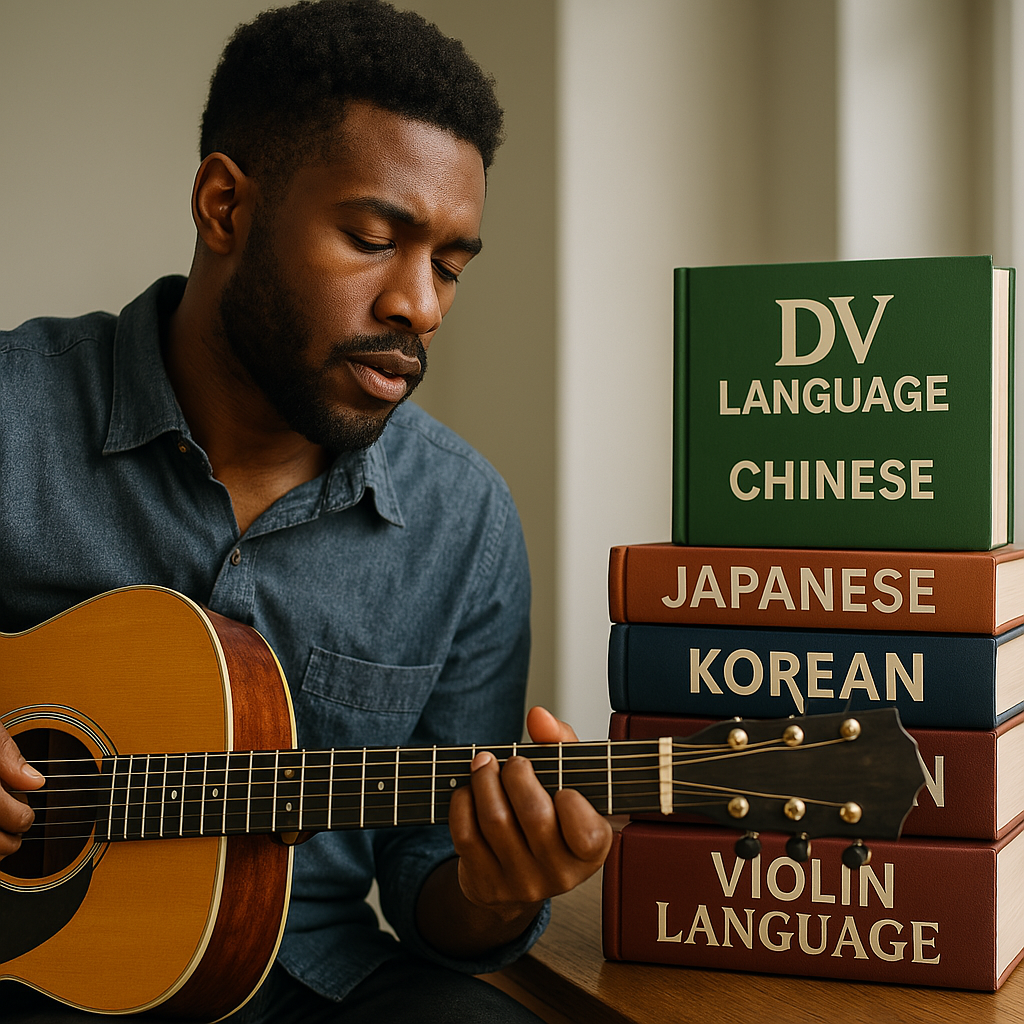


🎻 The DV Language for Violin: A New Way to Read and Write Music
By Ronen Kolton Yehuda (Messiah King RKY)
🎼 Introduction
The DV Language redefines how we write and read music — not only for piano, percussion, and orchestral instruments, but also for string instruments like the violin. DV Language uses intuitive text-based notation, understandable by both humans and AI, across languages and cultures.
To demonstrate its application to violin performance, we present a short, lyrical piece written in DV Language, complete with bow direction marks that work on any keyboard layout.
🎻 Bow Direction Symbols in DV Language (Keyboard-Compatible)
Symbol Meaning Keyboard Key Use Case > Down-bow Shift + . Strong start, gravity pull < Up-bow Shift + , Return stroke, softer phrase - Same-bow tie Dash (-) Legato / same stroke ^ Accent Shift + 6 Emphasis, attack
These symbols are placed before the note to indicate bow direction and technique.
🎵 The Piece: “Evening on the Lake” – Violin Solo in DV Language
🎼 DV Language Notation with Bowing
| >Sol1Q , <La1Q , >Si1Q |

🎻 Interpretation Guide
Bar 1–2: Ascending melodic phrases begin with down-bow (
>), alternating with up-bows (<) to keep balance.Bar 3–4: A lyrical descent returns the melody to home; dotted half-note for legato glide.
Bar 5: Repeated eighth-notes tied with dashes (
-) indicate a single sustained bow stroke.Bar 6–8: Builds toward closure, alternating bow strokes for control and expressiveness.
🎯 Why DV Language for Violin?
Easy to type on any keyboard (no music fonts required)
Works across languages and platforms
Compatible with AI interpreters, robotic players, and digital learning systems
Perfect for young learners, composers, and accessibility-focused applications
🧠 Next Steps
This DV notation can be:
Played by a violinist directly from the text
Rendered digitally using a DV-compatible interpreter
Taught to students learning phrasing and bow control
If you want, I can provide:
Sheet layout
Finger position guide
String assignment notation
Or a realistic AI-rendered performance
🎹 Keyboard-Friendly Bow Direction Symbols in DV Language
Symbol DV Meaning Keyboard Entry Notes > Down-bow Shift + . Start of phrase / stronger motion < Up-bow Shift + , Lighter phrasing / return stroke - Sustain (slur) Dash key Same bow / slide / legato ^ Accent / attack Shift + 6 Strong articulation or spike / Optional up-bow Slash key Light suggestion, not strict \ Optional down-bow Backslash key Also used for bow reentry marks
🎻 Example in DV Language with Keyboard Symbols
Here’s Minuet in G, keyboard-friendly version:
V| >Sol1Q , <La1Q , >Si1Q |
✅ Now this format:
Can be typed into any basic text editor (e.g., Notepad, Word, Google Docs)
Is compatible with DV software, AI tools, or musical chat input
Keeps bow control clear without needing custom fonts or graphics
 🎻 The DV Language for Violin: A New Way to Read, Bow, and Analyze Music
🎼 Introduction
The DV Language is a revolutionary music notation system — clean, readable, and designed for both humans and AI. Today, we apply it to the violin, demonstrating how musical phrases, bow direction, and theoretical degree analysis can be fully represented in text.
The DV Language helps you:
Understand pitch and rhythm
Control bowing
Interpret melodic function
Teach music across cultures and platforms
🎻 Bow Direction Marks (Keyboard-Based)
Symbol Meaning Keyboard Key > Down-bow Shift + . < Up-bow Shift + , - Same-bow tie Dash ^ Accent / Mark Shift + 6
🎼 The Piece: “Evening on the Lake” (Solo Violin in G Major)
Octave 1 = main register (middle)
Octave 2 = high register
🎵 DV Language Notation with Bowing
V| >Sol1Q , <La1Q , >Si1Q |
📊 Degree Analysis (Tonal Function in G Major)
DV Note Solfège Degree (G Maj) Function Sol Do I (Tonic) Home base La Re II (Supertonic) Movement Si Mi III (Mediant) Color/emotion Do Fa IV (Subdominant) Preparation Re Sol V (Dominant) Tension Mi La VI (Submediant) Color/minor feel Fa# Ti VII (Leading tone) Lift
🎼 Degree Flow per Bar
G (I) → A (II) → B (III)C (IV) → D (V) → E (VI)D (V) → E (VI) → F# (VII) → G (I)G (I): stability and lyrical sustainE (VI) → F# (VII) → G (I)🎯 Interpretation Insights
Melodic Shape: The phrase ascends from tonic to leading tone, then resolves gently.
Harmonic Role: Degrees IV–VII drive subtle tension before return to I.
Bow Use: Clear phrasing, alternating bows ensure breath-like motion.
📘 Why Use DV Language for Violin?
Clear, readable bowing and rhythm
Fast to write and teach
Universally accessible
Ideal for AI performance, notation, and music education
Add degree analysis for music theory learning or machine training
🎼 DV Language Degree Analysis: “Evening on the Lake” (Solo Violin, G Major)
Notation + Degree + Function(Note names are in English; Octave 1 = middle register; Degree is Roman numeral; Function is traditional harmony)🎻 DV Notation + Degree Mapping (per phrase)
Phrase 1
V| >Sol1Q , <La1Q , >Si1Q |Sol1 (G) → Degree I → Tonic
La1 (A) → Degree II → Supertonic
Si1 (B) → Degree III → Mediant
🧠 Function: Ascending stepwise melody, from tonic to mediant — stable, lyrical opening.
Phrase 2
V| <Do2Q , >Re2Q , <Mi2Q ||Do2 (C) → Degree IV → Subdominant
Re2 (D) → Degree V → Dominant
Mi2 (E) → Degree VI → Submediant
🧠 Function: Rising tension — subdominant to dominant to submediant, evoking warmth and movement.
Phrase 3
V| >Re2Q , <Mi2Q , >Fa#2Q |Re2 (D) → Degree V → Dominant
Mi2 (E) → Degree VI → Submediant
Fa#2 (F#) → Degree VII → Leading tone
🧠 Function: Climactic transition from dominant toward resolution — rising harmonic tension.
Phrase 4
V| <Sol2H , >Sol2Q ||Sol2 (G) → Degree I → Tonic
🧠 Function: Resolution. Return to G Major tonic — long held note affirms stability.
Phrase 5
V| >Sol2E , -Sol2E , -Sol2E |Sol2 (G) repeated → Degree I → Tonic
🧠 Function: Emphasized tonic repetition — lyrical sustain.
Phrase 6
V| <Mi2Q , >Fa#2Q , <Sol2Q ||Mi2 (E) → Degree VI → Submediant
Fa#2 (F#) → Degree VII → Leading tone
Sol2 (G) → Degree I → Tonic
🧠 Function: Mini-cadence — color (VI), rising (VII), resolve (I).
Phrase 7 (repeat)
V| >Re2Q , <Mi2Q , >Fa#2Q |Re2 (D) → Degree V → Dominant
Mi2 (E) → Degree VI → Submediant
Fa#2 (F#) → Degree VII → Leading tone
🧠 Function: Climactic ascent again toward tonic.
Phrase 8
V| <Sol2H , >Sol2Q ||Sol2 (G) → Degree I → Tonic
🧠 Function: Final restatement of the home key — lyrical closure.
✅ Summary of Degrees by DV Notation (Table)
DV Note Degree Function Sol1/2 I Tonic La1 II Supertonic Si1 III Mediant Do2 IV Subdominant Re2 V Dominant Mi2 VI Submediant Fa#2 VII Leading Tone
💡 Notes for Performers, Teachers, and AI Developers
You can tag each note in DV with a degree (e.g.,
Sol2Q°I,Fa#2Q°VII) for theory-aware notation.Use degree analysis in DV Language for:
Teaching harmonic function
Programming AI for musical phrasing
Analyzing melodic tension and resolution
Writing your own compositions using DV Logic
Excellent — you've now clarified that in DV Language degree analysis:
✅ 1st.2 = 8th degree
This sets the standard for extending degrees into the next octave or modal overflow.
🧠 DV Language Degree System (Extended)
DV Degree Notation Meaning Notes 1st.1 or +1 1st degree (Tonic) Base of the scale 2nd.1 or +2 2nd degree (Supertonic) 3rd.1 or +3 3rd degree (Mediant) 4th.1 or +4 4th degree (Subdominant) 5th.1 or +5 5th degree (Dominant) 6th.1 or +6 6th degree (Submediant) 7th.1 or +7 7th degree (Leading tone) 1st.2 or +8 8th degree (Octave/Tonic) One octave higher (tonic repeated) 2nd.2 or +9 9th degree (2nd octave) Extending modal sequence ... ... You may continue: 3rd.2 = 10, etc.
🎼 Examples in Use
DV Notation Interpretation Do1Q1st.1 C, 1st octave, quarter, 1st degree Re2Q2nd.1 D, 2nd octave, quarter, 2nd degree Mi2H3rd.1 E, half note, 3rd degree Do2Q1st.2 C in 2nd octave, 8th degree (octave) Re2Q2nd.2 D in 2nd octave, 9th degree
You may use either:
+8,+9,+10(compact)1st.2,2nd.2,3rd.2(structured, DV-style)
Here is the DV Language Degrees Analysis for the previously written violin piece (in C Major), using the new clarified degree format (e.g., 1st.1, 2nd.1, 1st.2 = 8th degree), aligned with each note of the piece:
🎻 Violin Piece in DV Language (Melody Only – Rewritten with Degree Analysis)
🪶 DV Language Melody: Degree/ Notation (Line at the same Line)
|Mi1/3rd.1Q ; Re1/2nd.1Q ; Do1/1st.1Q ; Re1/2nd.1Q
🔍 Degree Breakdown Summary:
| Note | Degree (C Major) | Label |
|---|---|---|
| Do | 1st | 1st.1 |
| Re | 2nd | 2nd.1 |
| Mi | 3rd | 3rd.1 |
| Fa | 4th | 4th.1 |
| Sol | 5th | 5th.1 |
| La | 6th | 6th.1 |
| Si | 7th | 7th.1 |
| Do (up) | 8th | 1st.2 |
🧠 Key Observations from Degree Use
The melody revolves mostly around 1st to 5th degrees: tonic, supertonic, mediant, dominant.
The 3rd degree (Mi) is emphasized, providing a melodic center.
Repetition of degrees (e.g.,
3rd.1,2nd.1) gives a lyrical, smooth contour.The final cadence resolves clearly to the 1st.1 (tonic Do) as a whole note — closing the musical thought with finality.
DV Language for Violin – Notes + Degree Analysis
🎼 DV Notation (Notes + Degrees)
Notes: Mi1Q ; Re1Q ; Do1Q ; Re1Q |
🔎 Why This Dual-Line Format Matters
Readable: Performers see the melody and degrees separately.
Theoretical clarity: Easy to analyze how each note fits into the scale.
Educational: Students can play from the top line while understanding harmony from the bottom line.
Universal: Both humans and AI can parse it line-by-line.
Perfect — let’s move into drums and percussion. DV Language is not only for melodic instruments like violin or piano — it also works beautifully for rhythm-only instruments such as drum kit, congas, bongos, djembe, cajón, etc.
Here’s a blog-style article introducing DV Language for drums, with a simple pop/rock drum groove as the example.
🎼 DV Language for Music: From Notes to Wave Frequencies
By Ronen Kolton Yehuda (Messiah King RKY)
🌍 Introduction
Music is vibration — air moving in waves. Traditional notation describes pitch and rhythm with abstract symbols, but it rarely connects directly to sound frequencies. The David Violin Language (DV Language) changes this.
DV Language writes music as text, and because each note has a defined frequency, it can also represent melodies as wave values. This bridges human-readable notation, machine logic, and the physical science of sound.
🎵 DV Language Basics (Music)
Each DV code combines:
Note name (Do, Re, Mi or C, D, E)
Octave number (1 = middle, 2 = above, –1 = below)
Duration (Q = quarter, H = half, W = whole, E = eighth, S = sixteenth)
📖 Example:La1Q= A in the middle octave, quarter note✅ Rest / silence:0QorMQ✅ Chords:Do1Q + Mi1Q + Sol1Q= C major triad🔬 DV Language in Frequencies
Every DV note can be expressed in Hertz (Hz):
DV Note Frequency (Hz) Duration Meaning Do1Q 261.63 Hz Quarter Middle C Re1Q 293.66 Hz Quarter D Mi1Q 329.63 Hz Quarter E Fa1Q 349.23 Hz Quarter F Sol1Q 392.00 Hz Quarter G La1Q 440.00 Hz Quarter A Si1Q 493.88 Hz Quarter B 📦 Example (C major scale in DV + frequency):DV:| Do1Q ; Re1Q ; Mi1Q ; Fa1Q ; Sol1Q ; La1Q ; Si1Q ; Do2Q ||Frequencies:| 261.63HzQ ; 293.66HzQ ; 329.63HzQ ; 349.23HzQ ; 392.00HzQ ; 440.00HzQ ; 493.88HzQ ; 523.25HzQ ||🎹 Case Study: Chopin Prelude (DV → Frequency)
Chopin – Prelude in E Minor, Op. 28 No. 4 (Right Hand, Opening Bars)
DV Notation:R| E1Q ; D#1Q ; E1Q ; D#1Q |R| E1Q ; D#1Q ; E1Q ; D#1Q ||Wave Frequency:R| 329.63HzQ ; 311.13HzQ ; 329.63HzQ ; 311.13HzQ |R| 329.63HzQ ; 311.13HzQ ; 329.63HzQ ; 311.13HzQ ||🎻 Violin Example (Bow Marks + Frequencies)
DV Notation:V| >Sol1Q , <La1Q , >Si1Q |Frequencies:V| >392HzQ , <440HzQ , >493.88HzQ |🥁 Drum Example (No Pitch, Only Rhythm)
DV:| HcE+KQ ; HcE ; HcE+SQ ; HcE ||Here, percussion has no fixed frequency — only time values (durations).🎯 Why Frequencies Matter in DV Language
Bridges physics + art → Notes are sound waves.
Universal measurement → Hertz values are global.
AI + robotics → Machines can parse DV text into exact sine waves.
Accessibility → Can help in sound therapy, acoustics, or music science.
📘 Conclusion
DV Language unifies music into text, notation, and frequency. From Chopin’s piano to violin melodies and drum grooves, every note can be written both as a symbol and as a sound wave value.
This duality — art + science, human + machine — makes DV Language not just a new notation system, but a universal bridge between music and the physics of sound.
| ✍️ By MKR: Messiah King RKY / Ronen Kolton Yehuda |

- 🎼 DV Language for Music: From Text to Wave Frequencies
By Ronen Kolton Yehuda (Messiah King RKY)
🌍 Introduction
Music is vibration. Every note is a sound wave, measured in Hertz (Hz) — cycles per second. Yet traditional music notation often hides this scientific foundation behind abstract symbols, clefs, and sharps.
The David Violin Language (DV Language) changes everything.DV writes music in simple text, and because each DV note corresponds to an exact frequency, it can also be expressed as waveforms. This makes DV Language a bridge between art and science, humans and machines, tradition and technology.🎵 DV Language Basics (Music)
In DV Language, every symbol combines:
Note Name (Do, Re, Mi … or C, D, E)
Octave Number (1 = middle, 2 = above, –1 = below)
Duration (Q = quarter, H = half, W = whole, E = eighth, S = sixteenth)
✅ Example:La1Q= La (A), middle octave, quarter noteOther rules:
0QorMQ= rest (silence)+= simultaneous notes (chords)| … |= box container for one bar
🔬 DV Notes as Frequencies
Every DV note equals a precise frequency.
DV Note Frequency (Hz) Duration Meaning Do1Q 261.63 Hz Quarter Middle C Re1Q 293.66 Hz Quarter D Mi1Q 329.63 Hz Quarter E Fa1Q 349.23 Hz Quarter F Sol1Q 392.00 Hz Quarter G La1Q 440.00 Hz Quarter A Si1Q 493.88 Hz Quarter B Do2Q 523.25 Hz Quarter C (one octave above Do1) 📦 Example:DV:| Do1Q ; Re1Q ; Mi1Q ; Fa1Q ; Sol1Q ; La1Q ; Si1Q ; Do2Q ||Frequencies:| 261.63HzQ ; 293.66HzQ ; 329.63HzQ ; 349.23HzQ ; 392.00HzQ ; 440.00HzQ ; 493.88HzQ ; 523.25HzQ ||📊 DV Language Waveform Example
Below is the C major scale (Do1 → Do2), written in DV Language and shown as actual sine waves.
Each section of the waveform corresponds to one DV note.
Labels show both the DV symbol and its frequency.
(Generated from DV notation:
| Do1Q ; Re1Q ; Mi1Q ; Fa1Q ; Sol1Q ; La1Q ; Si1Q ; Do2Q ||)
🎹 Case Study 1: Chopin in DV & Frequencies
Prelude in E Minor, Op. 28 No. 4 (RH opening bars):
DV:R| E1Q ; D#1Q ; E1Q ; D#1Q |R| E1Q ; D#1Q ; E1Q ; D#1Q ||Frequencies:R| 329.63HzQ ; 311.13HzQ ; 329.63HzQ ; 311.13HzQ |R| 329.63HzQ ; 311.13HzQ ; 329.63HzQ ; 311.13HzQ ||🎻 Case Study 2: Violin Phrase with Bow Marks
DV:V| >Sol1Q , <La1Q , >Si1Q |Frequencies:V| >392HzQ , <440HzQ , >493.88HzQ |Here, bow marks (> = down, < = up) are typed directly, while notes link to wave values.
🥁 Case Study 3: Drums (Rhythm-Only DV)
DV:| HcE+KQ ; HcE ; HcE+SQ ; HcE ||Since drums have no pitch, only time values (Q, E, etc.) are written.DV handles this by separating rhythm from frequency, making it universal across percussion and melodic instruments.🎯 Why Frequencies Matter in DV Language
Scientific Foundation → Music connects directly to sound physics.
Universal Measurement → Hertz values are global, beyond notation.
AI & Robotics → Machines can parse DV into exact waveforms or MIDI.
Education → Students learn music as both art and science.
📘 Conclusion
The DV Language is more than a new way to write notes — it is a universal framework.By combining text notation with wave frequencies, DV unites:Classical pieces like Chopin
Instrumental expression on violin and piano
Rhythmic clarity on drums
Scientific sound analysis
From humans to AI, from classrooms to concert halls, DV Language makes music clear, measurable, and future-ready.
| ✍️ By MKR: Messiah King RKY / Ronen Kolton Yehuda |
🎼 DV Language for Music: From Notes to Wave Frequencies
By Ronen Kolton Yehuda (Messiah King RKY)
🌍 Introduction
Music is vibration — air moving in waves. Traditional notation describes pitch and rhythm with abstract symbols, but it rarely connects directly to sound frequencies. The David Violin Language (DV Language) changes this.
DV Language writes music as text, and because each note has a defined frequency, it can also represent melodies as wave values. This bridges human-readable notation, machine logic, and the physical science of sound.
🎵 DV Language Basics (Music)
Each DV code combines:
Note name (Do, Re, Mi or C, D, E)
Octave number (1 = middle, 2 = above, –1 = below)
Duration (Q = quarter, H = half, W = whole, E = eighth, S = sixteenth)
📖 Example:La1Q= A in the middle octave, quarter note✅ Rest / silence:0QorMQ✅ Chords:Do1Q + Mi1Q + Sol1Q= C major triad🔬 DV Language in Frequencies
Every DV note can be expressed in Hertz (Hz):
DV Note Frequency (Hz) Duration Meaning Do1Q 261.63 Hz Quarter Middle C Re1Q 293.66 Hz Quarter D Mi1Q 329.63 Hz Quarter E Fa1Q 349.23 Hz Quarter F Sol1Q 392.00 Hz Quarter G La1Q 440.00 Hz Quarter A Si1Q 493.88 Hz Quarter B 📦 Example (C major scale in DV + frequency):DV:| Do1Q ; Re1Q ; Mi1Q ; Fa1Q ; Sol1Q ; La1Q ; Si1Q ; Do2Q ||Frequencies:| 261.63HzQ ; 293.66HzQ ; 329.63HzQ ; 349.23HzQ ; 392.00HzQ ; 440.00HzQ ; 493.88HzQ ; 523.25HzQ ||🎹 Case Study: Chopin Prelude (DV → Frequency)
Chopin – Prelude in E Minor, Op. 28 No. 4 (Right Hand, Opening Bars)
DV Notation:R| E1Q ; D#1Q ; E1Q ; D#1Q |R| E1Q ; D#1Q ; E1Q ; D#1Q ||Wave Frequency:R| 329.63HzQ ; 311.13HzQ ; 329.63HzQ ; 311.13HzQ |R| 329.63HzQ ; 311.13HzQ ; 329.63HzQ ; 311.13HzQ ||🎻 Violin Example (Bow Marks + Frequencies)
DV Notation:V| >Sol1Q , <La1Q , >Si1Q |Frequencies:V| >392HzQ , <440HzQ , >493.88HzQ |🥁 Drum Example (No Pitch, Only Rhythm)
DV:| HcE+KQ ; HcE ; HcE+SQ ; HcE ||Here, percussion has no fixed frequency — only time values (durations).🎯 Why Frequencies Matter in DV Language
Bridges physics + art → Notes are sound waves.
Universal measurement → Hertz values are global.
AI + robotics → Machines can parse DV text into exact sine waves.
Accessibility → Can help in sound therapy, acoustics, or music science.
📘 Conclusion
DV Language unifies music into text, notation, and frequency. From Chopin’s piano to violin melodies and drum grooves, every note can be written both as a symbol and as a sound wave value.
This duality — art + science, human + machine — makes DV Language not just a new notation system, but a universal bridge between music and the physics of sound.
| ✍️ By MKR: Messiah King RKY / Ronen Kolton Yehuda |


🥁 DV Language for Drums & Percussion: Reading and Writing Rhythm in Text
By Ronen Kolton Yehuda (Messiah King RKY)
🎼 Introduction
In traditional notation, drummers use a five-line staff with special symbols for each drum (kick, snare, hi-hat, toms, cymbals). While effective, this can be confusing for beginners, and difficult to parse digitally.
DV Language provides a clear, textual way to represent drum parts — using instrument tags + duration symbols. It’s readable by humans, teachable in classrooms, and processable by AI.
🥁 DV Language for Drums: The Core System
Each drum/cymbal is labeled with a short code.
Notes have durations just like melodic DV (Q = quarter, E = eighth, S = sixteenth, etc.).
Beats are grouped per bar with
| … |.You can stack instruments in one bar for simultaneous hits using
+.
Common Drum Kit Codes in DV Language:
| DV Code | Drum / Cymbal | Example Use |
|---|---|---|
| K | Kick (bass drum) | KQ = Kick quarter note |
| S | Snare | SE = Snare eighth note |
| Hc | Hi-hat closed | HcQ = Closed hi-hat quarter |
| Ho | Hi-hat open | HoQ = Open hi-hat quarter |
| Rc | Ride cymbal | RcQ = Ride cymbal quarter |
| Cc | Crash cymbal | CcQ = Crash quarter |
| T1, T2 | Toms (high/low) | T1E = High tom eighth |
| F | Floor tom | FQ = Floor tom quarter |

🎵 Example: A Classic Pop/Rock Groove
This is the most common drum beat in pop and rock (used in songs like Billie Jean by Michael Jackson, Boulevard of Broken Dreams by Green Day, etc.).
Traditional Groove Description:
4/4 Time
Hi-hat plays steady eighths
Kick on beats 1 and 3
Snare on beats 2 and 4
DV Language Translation
Bar 1: | HcE+KQ ; HcE ; HcE+SQ ; HcE ; HcE+KQ ; HcE ; HcE+SQ ; HcE ||
🥁 Step-by-Step Breakdown
HcE = Closed hi-hat, eighth note → continuous ticking
KQ = Kick, quarter → played on beats 1 and 3
SQ = Snare, quarter → played on beats 2 and 4
+ = Means “play together” (Hi-hat + Kick, or Hi-hat + Snare)
So this bar means:
Beat 1: Hi-hat + Kick (HcE+KQ)
Beat 2: Hi-hat + Snare (HcE+SQ)
Beat 3: Hi-hat + Kick (HcE+KQ)
Beat 4: Hi-hat + Snare (HcE+SQ)
Hi-hat keeps ticking between them
🎯 Why DV Works for Drummers
No staff → just text, clear and readable.
Universal → works for drum kit, djembe, cajón, bongos, tabla, etc.
Flexible → easy to add accents, ghost notes, dynamics (
^S= accented snare).Digital-friendly → text can be processed by AI to generate MIDI or sound.
🌍 Next Steps
Build a DV Percussion Library for drum grooves from jazz, funk, Latin, EDM.
Add educational material (e.g., DV Drum Book for beginners).
Integrate with AI drummers and digital DAWs.
✅ With DV Language, drummers can finally read and write rhythm as easily as words — opening the door to better teaching, global collaboration, and machine interpretation.

🥁 The DV Language for Drums: Billie Jean Groove Explained
By Ronen Kolton Yehuda (Messiah King RKY)
🎼 Introduction
Few drum beats are as legendary as Michael Jackson’s “Billie Jean” (1982). Played by drummer Ndugu Chancler, the groove is hypnotic, minimal, and instantly recognizable.
Traditionally, this groove is notated across a staff with multiple lines for kick, snare, and hi-hat. In DV Language, we reduce it to a clear, textual form — easy for humans, students, and even AI systems to read.
🥁 The Groove Basics
Time Signature: 4/4
Tempo: ≈118 BPM
Pattern:
Hi-hat closed (Hc): steady 8th notes
Kick (K): on beats 1 and 3
Snare (S): on beats 2 and 4
This simple combination creates the iconic, driving beat of Billie Jean.
🎶 DV Language Notation
🔡 One Full Bar
| HcE+KQ ; HcE ; HcE+SQ ; HcE ; HcE+KQ ; HcE ; HcE+SQ ; HcE ||
📝 Explanation
HcE = Hi-hat closed, 8th note
KQ = Kick, quarter note
SQ = Snare, quarter note
+ = play together (hi-hat + kick or snare)
; = separates notes inside the bar
|| = end of bar
This line, when looped, gives the famous Billie Jean pulse.
📦 Compact Box View
To make it even clearer, here’s the same groove broken into four beats (boxes):
[1] HcE+KQ ; HcE
🎯 Why DV Works for Drummers
Clarity: Every event has an instrument + duration
Compactness: One groove fits in one line of text
Universality: Works for drum kit, cajón, congas, or digital pads
Education: Students can “read rhythm like a sentence”
AI-ready: DV text can be converted directly into MIDI for playback
🌍 Conclusion
The beat of Billie Jean proves how DV Language makes rhythm simple and universal. Instead of deciphering staff lines, drummers can read, write, and share grooves in plain text.
With DV, rhythm is clear, global, and future-proof — just like the groove that made pop history.

🥁 DV Language for Drums: Billie Jean (4-Bar Intro)
By Ronen Kolton Yehuda (Messiah King RKY)
🎼 The Groove Foundation
Hi-hat closed (HcE) → steady 8th notes
Kick (KQ) → beats 1 & 3
Snare (SQ) → beats 2 & 4
Hi-hat open (HoE) → variation on beat 4 (bar 4)
🎶 DV Language Notation
🔡 4-Bar Groove
Bar 1: | HcE+KQ ; HcE ; HcE+SQ ; HcE ; HcE+KQ ; HcE ; HcE+SQ ; HcE ||Bar 2: | HcE+KQ ; HcE ; HcE+SQ ; HcE ; HcE+KQ ; HcE ; HcE+SQ ; HcE ||Bar 3: | HcE+KQ ; HcE ; HcE+SQ ; HcE ; HcE+KQ ; HcE ; HcE+SQ ; HcE ||Bar 4: | HcE+KQ ; HcE ; HcE+SQ ; HcE ; HcE+KQ ; HcE ; HcE+SQ ; HoE ||📦 Compact Box View
Bar 1–3 (steady groove):
[1] HcE+KQ ; HcE[2] HcE+SQ ; HcE[3] HcE+KQ ; HcE[4] HcE+SQ ; HcE ||Bar 4 (variation with open hi-hat):
[1] HcE+KQ ; HcE[2] HcE+SQ ; HcE[3] HcE+KQ ; HcE[4] HcE+SQ ; HoE ||📝 Explanation
Bars 1–3: Steady kick + snare + hi-hat pulse — the heartbeat of the song.
Bar 4: On the last beat, the hi-hat opens (
HoE), adding a subtle lift before the loop repeats.This tiny variation is what gives the groove its organic, living feel.
🎯 Why This Matters
In DV Language, we can:
Capture repetition (bars 1–3 identical)
Highlight variation (bar 4 hi-hat open)
Write entire grooves in just a few clean text lines
Teach students how to “hear” variation visually
🌍 Conclusion
The 4-bar intro of Billie Jean shows how DV Language not only captures the core groove but also the performance details that make it legendary.
In one text line per bar, drummers can learn, loop, and play with full clarity.DV turns rhythm into language — readable, teachable, and future-ready.


🎼 The DV Language: Redefining How We Write and Read Music, Dance, Theater and More
By Ronen Kolton Yehuda (Messiah King RKY)
🌍 Introduction
Music is a universal language — but the way we read and write it often acts as a barrier. Traditional staff notation, with its lines, clefs, and symbols, can feel abstract and intimidating.
The David Violin Language (DV Language) changes that. It’s a revolutionary text-based music notation system that uses simple, intuitive logic instead of staff lines. It’s not only easier to learn — it’s also designed for the future of music: for humans, for machines, and for global culture.
🎵 What Is DV Language?
DV Language is a textual, multilingual, and modular system that represents music with clarity and logic. Each note, rhythm, and structure can be written in a way that is:
✅ Readable for humans
✅ Typable on any keyboard
✅ Understandable by AI, robots, and software
✅ Translatable across languages and cultures
Instead of staff symbols, DV uses note names (Do, Re, Mi or C, D, E), octaves, and durations.
La1Q = La (A) in octave 1, quarter note🎼 DV Language Formats
Melodic Notes
| Do1Q ; Re1Q ; Mi1Q ; Fa1Q |
Scale Degrees
| +1.1Q ; +2.1Q ; +3.1Q ; +4.1Q |
Percussion & Drums
| KQ ; HcE ; HcE ; SQ ; HcE ; HcE ||
K = Kick
S = Snare
Hc = Hi-hat closed
Q = Quarter, E = Eighth
Chords
A Major = AQ or +1Q/+3Q/+5Q
Frequencies
| 440HzQ | → La1Q (A4, quarter note)
- Multilingual SupportDV works in Japanese, Chinese, Arabic, Hebrew, Hindi, Russian, Korean, French, Spanish, and more.
🎶 Case Study: Chopin in DV Language
Let’s see how DV Language can represent classical piano.
Example: Chopin – Prelude in E Minor, Op. 28 No. 4 (Opening Bars)
Right Hand (RH):
R| E1Q ; D#1Q ; E1Q ; D#1Q |
Left Hand (LH, chords):
L| E-1W + G-1W + C1W
✅ Both hands are aligned, readable, and easy to type.
🎻 DV Language for Violin (With Bow Marks)
DV can also handle string instruments. Bow directions can be typed directly:
>= Down-bow<= Up-bow-= Same bow (tie)^= Accent
Example (G Major melody):
V| >Sol1Q , <La1Q , >Si1Q |
With degree analysis:
Sol1 (I) → La1 (II) → Si1 (III)
🥁 DV Language for Drums: Billie Jean Groove
Perhaps the most famous drum beat in pop history is Michael Jackson’s Billie Jean (1982), played by Ndugu Chancler. In DV Language, it becomes strikingly simple.
One-Bar Groove (Basic Loop)
| HcE+KE ; HcE ; HcE+SE ; HcE ; HcE+KE ; HcE ; HcE+SE ; HcE ||
Breakdown:
HcE = Hi-hat closed, 8th note
KQ = Kick, quarter note
SQ = Snare, quarter note
= Played together
|| = End of bar
Four-Bar Intro (with hi-hat open on bar 4)
Bar 1: | HcE+KE ; HcE ; HcE+SE ; HcE ; HcE+KE ; HcE ; HcE+SE ; HcE ||
Compact box view:
[1] HcE+KE ; HcE
✅ With DV, the heartbeat of Billie Jean fits neatly into a text line.

🩰 Beyond Music: Dance, Theater, AI
DV Language extends beyond music to performance and robotics:
Dance:
| RH90FQ ; LH45RQ ; MJ ||(Right hand 90° forward, Left hand 45° right, then mute/still)Theater Cues:
| C"Love"Q ; R"you"Q ||AI/Robotics: DV can be parsed directly into MIDI or motion code.
🎯 Why DV Matters
Simplifies music learning for beginners and children
Bridges music and technology through structured code
Connects cultures with multilingual notation
Expands to percussion, dance, theater, and AI
📘 Conclusion
DV Language is not just notation — it’s a universal framework for music, motion, and machine performance.
Whether you are a pianist, violinist, drummer, dancer, or AI developer — DV Language speaks your language. From Chopin’s piano preludes to Michael Jackson’s pop grooves, DV makes music clear, textual, and ready for the future.

🎼 The DV Language: Redefining How We Write and Read Music, Dance, Theater and More
By Ronen Kolton Yehuda (Messiah King RKY)
🌍 Introduction
Music is universal — but traditional staff notation is a barrier. Clefs, sharps, flats, and symbols can confuse beginners, and they don’t translate well into digital, AI, or cross-cultural contexts.
The David Violin Language (DV Language) changes that. It’s a simple, text-based system that lets us write music like words: intuitive, multilingual, and machine-ready. From Chopin to Michael Jackson, from violin bow strokes to pop drum grooves, DV unifies music into one clear, global language.
🎵 What Is DV Language?
DV Language is a textual, modular system that expresses pitch, rhythm, articulation, and performance using logical symbols.
Notation Logic:
Note name: Do, Re, Mi… or C, D, E
Octave number: 1 = middle octave, 2 = above, –1 = below
Duration: Q = quarter, H = half, W = whole, E = eighth, S = sixteenth
Symbols:
| … |= bar box;= separate notes||= end of bar+= simultaneous notes/chords0Q/MQ= rest
La1Q = La (A), middle octave, quarter note🎹 Case Study 1: Chopin on Piano
Frédéric Chopin – Prelude in E Minor, Op. 28 No. 4 (Opening)
🎶 DV Language Translation
R| E1Q ; D#1Q ; E1Q ; D#1Q |
✅ Both hands are clear. The right hand is text melody; the left hand is chords. One bar per line = easy for reading, AI parsing, and teaching.
🎻 Case Study 2: Violin with Bowing & Degrees
DV can show bow direction on any keyboard:
>= Down-bow<= Up-bow-= Same bow (tie)^= Accent
🎵 Piece: “Evening on the Lake” (G Major, Lyrical)
V| >Sol1Q , <La1Q , >Si1Q |
📊 Degree Analysis (Dual Line):
Notes: Sol1 ; La1 ; Si1
✅ Dual-line DV format shows both melody and degree flow: tonic → supertonic → mediant. Perfect for both performance and theory.
🥁 Case Study 3: Drums – Billie Jean Groove
Michael Jackson’s Billie Jean (1982), played by Ndugu Chancler, is one of the most famous grooves ever. DV writes it cleanly.
🎶 One Bar (Basic Loop):
| HcE+KQ ; HcE ; HcE+SQ ; HcE ; HcE+KQ ; HcE ; HcE+SQ ; HcE ||
📦 Compact View (per beat):
[1] HcE+KQ ; HcE
🎶 4-Bar Intro (Variation in Bar 4):
Bar 1–3: same as above
✅ Bar 4 variation (open hi-hat HoE) shows how DV can capture tiny nuances that define a groove.
🩰 Beyond Music: Dance, Theater, AI
DV goes beyond sound.
Dance:
| RH90FQ ; LH45RQ ; MJ ||
(Right hand 90° forward, left hand 45° right, then still)
Theater:
| C"Love"Q ; R"you"Q ||
AI & Robotics: DV can be parsed into MIDI or motion code. Perfect for machine learning, smart instruments, and accessibility.
🎯 Why DV Matters
Simplifies learning for beginners & children
Bridges music and technology
Connects cultures with multilingual notation
Expands into drums, strings, dance, theater, and robotics
📘 Conclusion
From Chopin’s piano preludes to Billie Jean’s groove, from lyrical violin bowings to AI dance cues, DV Language shows that music can be written like text: universal, clear, and future-ready.
Whether you’re a pianist, violinist, drummer, dancer, or AI developer — DV speaks your language.
🩰 DV Language for Dance: A Universal System for Movement, Rhythm, and Expression
By Ronen Kolton Yehuda (Messiah King RKY)
🌍 Introduction
Dance is one of humanity’s oldest languages. From ritual to theater, from ballet to hip-hop, movement communicates stories beyond words. But unlike music, there has never been a simple, universal, text-based notation system for dance.
The David Violin Language (DV Language) changes this. Originally designed for music, DV Language extends naturally to dance, theater, and performance by using text symbols, numbers, and degrees of motion. Just as it allows music to be typed, read, and interpreted by both humans and AI, DV Language can now do the same for body movement.
🩰 Core Principles of DV Dance Language
DV Dance uses boxes (| … |) for time segments, just like in music. Inside each box, we place body part codes, degrees/angles, and durations.
✅ Body Part Codes
RH = Right Hand
LH = Left Hand
RF = Right Foot
LF = Left Foot
H = Head
T = Torso
J = Jump
✅ Direction & Degrees
F = Forward
B = Backward
L = Left
R = Right
U = Up
D = Down
Angles = measured in degrees (e.g., 90°, 45°)
✅ Durations
Q = Quarter (1 beat)
E = Eighth (1/2 beat)
H = Half (2 beats)
W = Whole (4 beats)
✅ Silence & Stillness
Mor0= Mute (still, no motion)
🎵 Example 1: A Simple Dance Phrase
“Pleia” (jump move) at the third quarter of the bar:
| MQ ; 0Q ; PleiaQ ; M1/4 ||
Explanation:
Beat 1 → Mute (standing still)
Beat 2 → Still (0)
Beat 3 → Pleia jump
Beat 4 → Return to stillness (mute)
💃 Example 2: Arm Angles in Motion
Right Hand forward, then rightward:
| RH90FQ ; RH90RQ ; MH ||
Breakdown:
RH90FQ = Right Hand, 90° Forward, Quarter duration
RH90RQ = Right Hand, 90° to the Right, Quarter duration
MH = Mute Hands (still)
🕺 Example 3: Steps + Style
DV Dance allows steps, tricks, and style variables.
| RFStepQ ; LFStepQ ; C ; SC ||
RFStepQ = Right Foot Step, Quarter duration
LFStepQ = Left Foot Step, Quarter duration
C = Clap
SC = Spanish Clap (variation)
Style can be tagged:
Style: Flamenco | RFStepQ ; LFStepQ ; SC ||
🤖 Horizontal & Vertical Notation
Like in DV Music, motions can be written:
Horizontally = sequential actions (steps in time)
Vertically = simultaneous actions (clap + step + turn at once)
Example (step + clap at the same time):
| RFStepQ + C ; LFStepQ + SC ||
🎭 Integration with Theater
DV Dance connects naturally with theater cues. You can sync movement, text, and rhythm in one box:
| C/Center "I love" Q ; RH90FQ + C ; RFStepQ ||
Meaning:
Actor center stage says “I love” (quarter beat)
At the same time → right hand forward + clap
Right foot steps forward
🎧 DJ / VJ / Multimedia Performance
DV Dance is time-based (BPM + beats), so it fits perfectly for:
DJs (movement synced with beat drops)
VJs (visual cues)
Avatars & robots (dance moves rendered in VR/AI)
Example for a dance + music box:
| HcE + KQ ; RFStepQ ; C ; RH90FQ ||
(Closed hi-hat with kick + dancer step + clap + right-hand forward gesture).
🎯 Why DV Dance Language Matters
Universal → Works across ballet, hip-hop, folk, theater, robotics.
Educational → Students can learn choreography like reading a sentence.
Technological → Avatars, VR performers, and robots can “read” dance.
Creative → Choreographers gain a compact, modular tool for notation.
🩰 Conclusion
Dance is music for the body. With DV Language, movement is written, read, and shared like music — in clean, logical text.
From simple steps to advanced tricks, from ballet to hip-hop, from theater stages to AI avatars — DV Dance bridges art and technology.
It allows performers, choreographers, and machines alike to speak the same universal dance code.

🚀 Developing DV Language: From Music to Dance, Theater, and AI
By Ronen Kolton Yehuda (Messiah King RKY)
🌍 Introduction
DV Language started as a breakthrough in music notation — a way to write melody, rhythm, and harmony in clean text. But it’s not only about music. The system has the potential to evolve into a universal creative language, mapping sound, movement, and performance for humans and machines alike.
This article suggests a development roadmap for expanding DV Language into different domains.
1. 📝 Music Expansion
Stage 1: Core Music
Publish the DV Music Books (Piano, Strings, Percussion, Wind).
Translate classics (Bach, Chopin, Beatles) into DV Language.
Build AI readers that can turn DV text into sound.
Stage 2: Advanced Theory
Add degrees (+1, +2, … 1st.2, 2nd.2).
Support chords, microtones, and polyrhythms.
Integrate with DAWs (Digital Audio Workstations).
2. 🩰 Dance Development
Body Mapping System: Define ~50 codes for body parts (RH, LF, T, H, etc.).
Directional Vectors: Degrees + directions (90F, 45R, 180B).
Steps & Tricks: Create DV shortcuts for dance moves (J = jump, SC = Spanish Clap, Spin = turn).
Cross-Layer Integration: Sync with DV Music (drum box + step box).
Applications: Dance education, avatars, robotic choreography.
3. 🎭 Theater & Script Integration
Text + Timing: Link words and phrases to beats (
C "I" Q ; C "love" Q).Stage Positions: Define codes for Center (C), Left (L), Right (R), Upstage (U), Downstage (D).
Cue System: Boxes trigger lines, movements, and lighting.
Applications: Actor rehearsal, VR theater, AI-assisted directing.
4. 🤖 Technology & AI
AI Readers: Convert DV text → MIDI → sound or movement.
Robotics: Robots play, sing, or dance directly from DV script.
Education Apps: Mobile apps where students read/play DV text.
Cross-Culture: Multilingual DV for global adoption.
5. 📚 Publishing & Licensing
DV Books Series: Music, Dance, Theater, AI.
DV Dictionary: Full lexicon of codes for all arts.
Exhibitions: Interactive museum shows (play DV → music + dance on screens).
Licensing: For schools, publishers, and tech companies.
- Books, Licensing & ExhibitionDV Language currently includes one online book on my blog (Music Theory with DV Language). More books are planned across strings/piano, rhythm, AI composition, performance arts, and multilingual music literacy. DV Language is also intended to be licensed, so others can create and publish books and courses with it. The DV Language Exhibition is in development as a future museum-ready immersive experience.
🌟 Long-Term Vision
DV Language becomes:
The universal musical alphabet (beyond staff notation).
The dance script for choreographers and avatars.
The cue system for theater and multimedia.
The AI code for machine creativity.
A single textual framework connecting art, education, and technology worldwide.
✅ This article could be titled:
“Developing DV Language: The Roadmap for Music, Dance, Theater & AI”
“From Notation to Creation: Expanding DV Language into a Universal Performance Code”
“The Future of DV Language: Building the Bridge Between Art and Machines”
 🩰 DV Language for Dance: A Universal System of Motion

By Ronen Kolton Yehuda (Messiah King RKY)
🎼 Introduction
| … |) and aligned with rhythm (Quarter = Q, Eighth = E, etc.).1. 🖐️ Body Parts & Directions
| Symbol | Meaning | Example in DV Box | Explanation |
|---|---|---|---|
| RH | Right Hand | | RH90FQ ; MQ | | RH forward 90° for 1 beat, then mute |
| LH | Left Hand | | LH45LQ ; MQ | | LH left 45° for quarter |
| RF | Right Foot | | RF180BQ ; MQ | | Step right foot back 180° |
| LF | Left Foot | | LF90FQ ; MQ | | Step left foot forward 90° |
| HD | Head | | HD45LQ ; MQ | | Head tilt left 45° |
| BD | Body/Torso | | BD90RQ ; MQ | | Body turn right 90° |
Direction Codes:
F = Forward
B = Backward
R = Right
L = Left
Angles (°): 0, 45, 90, 180
2. 🦶 Steps, Jumps, and Motion
| Symbol | Motion | Example in DV Box | Explanation |
|---|---|---|---|
| St | Step | | RFStQ ; LFStQ | | Step RF, then LF |
| J | Jump | | JQ ; MQ | | Jump, then land |
| SP | Spin / Turn | | SP360Q ; MQ | | Spin 360° in one beat |
| Sl | Slide | | RFSlQ ; MQ | | Slide RF |
| Pleia | Plié (bend knees) | | PleiaQ ; MQ | | Classical plié |
| K | Kick | | RKQ ; MQ | | Right leg kick |
3. 👏 Dance Tricks & Actions
| Symbol | Motion/Trick | Example in DV Box | Explanation |
|---|---|---|---|
| C | Clap | | C Q ; MQ | | Standard clap |
| SC | Spanish Clap | | SCQ ; MQ | | Flamenco-style clap |
| H | Hop | | RHopQ ; MQ | | Small jump on one foot |
| TW | Twist | | TW90RQ ; MQ | | Twist 90° right |
| MJ | Mute/Still | | MQ ; MQ | | Stand still |

4. 🧩 DV Box Examples
Example 1: Basic Walk
Example 2: Plié with Clap
Example 3: Spin and Jump
Example 4: Arm Motion Phrase
🎯 Why DV Language Works for Dance
🌍 Applications
Choreography: Fast notation for rehearsals
Dance Education: Teach beginners with text-based steps
Robotics/Avatars: AI learns DV moves as commands
Stage Performance: Sync music, dance, and theater with one DV score
🖋️ Conclusion
DV Language for Dance makes movement readable. With simple codes, symbols, and rhythmic boxes, dancers and creators can design choreographies, teach steps, and even instruct AI performers.
Like music notes, dance now has its own universal alphabet.

🩰 DV Language for Dance: A Real Example — Circle of Fire
By Ronen Kolton Yehuda (Messiah King RKY)
🎼 Introduction
Dance is movement in rhythm — but how do we write it?Traditional systems like Labanotation are beautiful, but too technical for most dancers, teachers, and students.The DV Language for Dance solves this with text-based notation, aligned with musical rhythm, and typed with any keyboard. It’s readable by humans, dancers, choreographers, and even AI robots.
To demonstrate, let’s create a short choreography, Circle of Fire, written fully in DV Language.
🔑 DV Language Basics for Dance
-
Every motion is inside a box:
| … | -
Durations follow music notation: Q = Quarter, E = Eighth, H = Half
-
Symbols:
-
RF/LF = Right/Left Foot
-
RH/LH = Right/Left Hand
-
C = Clap, SP = Spin, J = Jump, Pleia = Plié
-
F, B, L, R = Forward, Back, Left, Right
-
0 / M = Mute / Still
-
💃 The Piece: Circle of Fire
Style: Fusion (ballet + flamenco + modern)Time Signature: 4/4Tempo: 96 BPMLength: 4 bars🎶 DV Notation
Bar 1 – The Walk of Fire
| RF90FQ ; LF90FQ ; RF90FQ ; LF90FQ ||➡ Forward walking, four steps in rhythm.Bar 2 – Plié and Clap
| PleiaQ ; C Q ; MQ ; MQ ||➡ Knees bend (plié), clap, then pause (2 beats still).Bar 3 – Spin and Kick
| SP360Q ; RKQ ; MQ ; MQ ||➡ One full spin, right leg kick, then stand still.Bar 4 – Arms of Fire
| RH90FQ ; RH90RQ ; LH45LQ ; C Q ||➡ RH forward, RH to the right, LH to the left, finish with a clap.📊 Choreography Breakdown
Bar 1 – The dancer advances with steady, grounded steps — symbolizing entering the circle.Bar 2 – A plié with clap emphasizes ritual and rhythm.Bar 3 – The spin and kick represent breaking limits and unleashing energy.Bar 4 – The arms expand outward, ending with a unifying clap.🎭 Why This Works in DV
-
Readable: Any dancer can follow text instructions.
-
Rhythmic: Each move aligns to music’s beat grid.
-
Expressive: Includes gestures, tricks, and stillness.
-
Universal: Works across dance styles — ballet, flamenco, hip hop, contemporary.
-
AI-ready: Robots, avatars, or VR characters can follow DV Dance scripts.
🌍 Future of DV Dance
With DV Dance Language, choreographers could:
-
Publish entire dance pieces in books.
-
Teach students worldwide with text-based choreographies.
-
Create AI-driven dance avatars that respond in real-time.
-
Sync music, theater, and dance in one unified DV score.
🖋️ Conclusion
Circle of Fire shows that DV Dance can notate real choreographies, not just theoretical ideas. With simple symbols and rhythmic boxes, dance becomes legible, teachable, and programmable.
From classrooms to stages to AI robots — DV Language opens a new era where movement is a universal text.
🔥 DV Language for Dance: Circle of Fire
By Ronen Kolton Yehuda (Messiah King RKY)
🌍 Introduction
Dance, like music, is a universal language. Yet, traditional notation systems (such as Labanotation) can be overly complex for students, performers, and even AI systems.
The DV Language for Dance introduces a simple, text-based system — where body parts, directions, degrees, and motions are written as clearly as words. It is keyboard-typable, easy for humans to read, and instantly interpretable by machines.
The illustration “Circle of Fire” below demonstrates how DV notation can capture rhythm, steps, and tricks in a structured form.
📝 Core DV Dance Symbols
Symbol Meaning Example RH, LH Right Hand, Left Hand RH90FQ → Right Hand 90° Forward, Quarter RF, LF Right Foot, Left Foot RFQ → Right Foot step, Quarter MQ / 0Q Mute / Stillness MQ = body still, Quarter J Jump JQ → Jump, Quarter Pleia Spin / Pirouette PleiaQ → Pirouette, Quarter C, SC Clap / Spanish Clap C1/8 = Clap in eighth note + Simultaneous Motion RH90FQ+RFQ → Hand forward + Step Style Tag Dance Style Flamenco: SCQ ; Ballet: PleiaQ 💃 Real Example: Circle of Fire in DV Language
The choreography represents a 4-bar loop, combining steps, spins, and claps with rhythmic fire-like energy.
Notation:
Bar 1 | RFQ ; LFQ ; RH90FQ+SCQ ; MQ ||Bar 2 | PleiaQ ; RFQ ; LFQ ; C1/8+RH180RQ ||Bar 3 | JQ ; RH45UQ ; LH45UQ ; MQ ||Bar 4 | RFQ+LFQ ; RH90FQ ; SCQ ; PleiaQ ||Explanation:
-
Bar 1 → Step forward (RF, LF), hand forward + Spanish clap, then stillness.
-
Bar 2 → Pirouette, step sequence, right hand swings 180° to the right.
-
Bar 3 → Jump, raise both hands diagonally upward, hold still.
-
Bar 4 → Stomp both feet, hand forward, clap, spin.
🎨 Visual Illustration
Below is the Circle of Fire diagram, showing how DV Dance notation maps into symbolic form:
-
Arrows = direction of body parts
-
Circles = hand/foot positions
-
Labels = DV Language commands
-
Rhythm = measured in quarters and eighths
🌟 Why It Matters-
For dancers → simple, readable choreography notation
-
For teachers → easy to explain body movement and rhythm
-
For AI/avatars → DV text can be processed into motion vectors
-
For culture → works across dance styles: flamenco, ballet, hip-hop, robotics
🎭 Conclusion
The Circle of Fire shows how DV Language brings dance into text and image form — bridging human creativity with machine logic.
With DV, steps, spins, claps, and gestures can all be encoded and shared globally. This makes it not just a notation system, but a universal choreography language — ready for dancers, teachers, and even robotic performers.
-


Visualizing DV Language: From Musical Waves to Rhythmic Pulses
By Ronen Kolton Yehuda (Messiah King RKY)
🎼 Introduction
The DV Language is not just a method for writing music — it’s a way to bridge sound, rhythm, and digital interpretation. By using intuitive, typable notation such as Do1Q (quarter note Do in the first octave), DV allows both humans and machines to read and perform music easily.
But how does this notation look when transformed into real waveforms? And how does DV handle rhythms that don’t use melody at all — like a drum groove? This article visualizes both.
🌈 DV Note Frequencies as Sound Waves
Let’s start with a scale example. The following figure plots a waveform that travels through the C major scale, written in DV Language as:
Do1Q ; Re1Q ; Mi1Q ; Fa1Q ; Sol1Q ; La1Q ; Si1Q ; Do2Q
Each note is represented by a sine wave at its corresponding frequency:
| DV Note | Frequency (Hz) |
|---|---|
| Do1 | 261.63 |
| Re1 | 293.66 |
| Mi1 | 329.63 |
| Fa1 | 349.23 |
| Sol1 | 392.00 |
| La1 | 440.00 |
| Si1 | 493.88 |
| Do2 | 523.25 |
The visual waveform shows how these sounds evolve over time. Each vertical divider marks the start of a new note. This connection between notation and sound is what makes DV Language intuitive for both musicians and machines.
🎹 Chopin’s Alternating E–D# Motif: A Visual Rhythm
A great example of DV Language’s clarity is the famous alternating motif in Chopin’s Prelude in E minor. Using DV:
| E1Q ; D#1Q ; E1Q ; D#1Q ; E1Q ; D#1Q ; E1Q ; D#1Q ||
This simple, emotional phrase becomes a symmetrical waveform, alternating between the frequencies of E (329.63 Hz) and D# (311.13 Hz). Below is a chart that shows the resulting sound wave, illustrating both tonal contrast and rhythmic regularity.
🥁 Rhythm Without Pitch: DV for Drums
DV Language is not limited to melody. It also supports percussive rhythms and body pulses, such as those found in Billie Jean.
For example, the first bar might look like:
| HcE+KQ ; HcE ; HcE+SQ ; HcE ||
Where:
HcE= Hand clap, eighth noteKQ= Kick, quarter noteSQ= Snare, quarter note
The waveform here isn’t melodic—it’s a rhythm pulse timeline. The visual shows when each sound hits, without needing traditional percussion notation. This opens DV to DJs, drummers, and beat producers.
📊 Full Visual
Below is the combined figure used in this article:
.png)
🔚 Conclusion
These visualizations reveal the power of DV Language to unify musical theory, audio physics, and intuitive expression. Whether you’re composing classical melodies, analyzing rhythmic grooves, or teaching machines how to perform music — DV makes the invisible visible.
The future of music isn't just about hearing — it's about understanding, coding, and seeing sound.
🎭 DV Language for Theater
Introduction: One Line for All of Theater
Traditional theater scripts divide emotion, dialogue, movement, timing, and sound into separate instructions — scattered across pages. DV Language offers a unified, readable, typable, and machine-compatible format to express everything in one plain-text line.
This system is designed for:
Humans (actors, directors, stage managers)
Robots & AI avatars
Smart stage automation systems
Virtual & immersive theater productions
DV Theater Syntax: All Typable on a Standard Keyboard
[], <>, "", ;, : and letters.Let’s break it down:
🎙 Spoken Lines
"This is the line."
😠 Emotions (intensity 0–9):
[Angry5] "Don’t touch that!"
🎬 Stage Actions:
<stand> ; <walkL3> ; <sit>
<stand>= stand up<walkL3>= walk left 3 steps<bow>= bow down<jump2>= jump 2 units
🎭 Rhythm (timed delivery):
"Wait"Q ; "for"E ; "me"H
Q= Quarter beatE= Eighth beatH= Half beatCan also use:
W(whole),S(sixteenth),.(dot for dotted note)
🔊 Sound Effects:
[sound:thunder:S] ; [sound:glass_break:L]
Format:
[sound:TYPE:LENGTH]S= short,M= medium,L= long
💡 Lighting Effects:
[light:dim] ; [light:flash] ; [light:fadeout]
🌫 Scene and Cue Changes:
[scene:2] ; [cue:enter_right:John] ; [cue:music:start]
Example: A Full DV Theater Line
Traditional Script:
(She stands slowly. Angrily.)"You lied to me."(Thunder. Lights dim.)
DV Version:
<stand> ; [Angry6] "You lied to me."Q ; [sound:thunder:S] ; [light:dim]
Everything in one line — typable, readable, and executable.
Movement Commands:
Use angle brackets < > for body actions:
| Command | Meaning |
|---|---|
<stand> | Stand up |
<sit> | Sit down |
<walkL3> | Walk 3 steps left |
<walkR2> | Walk 2 steps right |
<jump> | Jump once |
<spinCW> | Spin clockwise |
<raise_hand> | Raise one hand |
<kneel> | Kneel down |
Choreography can now be included directly in line with acting.
Dialogue with Rhythm and Emotion
DV enables actors to speak in time — great for spoken word, rap theater, or robotic timing.
Example:
[Serious7] "I see now"Q ; "you were right"E ; "all along."H
This shows a steady first phrase, a quick second phrase, and a slow, dramatic final phrase.
Scene Control and Synchronization
Stage directions can include tech cues like light, music, and sound — all typable:
| Type | Format | Example |
|---|---|---|
| Sound | [sound:TYPE:LENGTH] | [sound:door_close:S] |
| Light | [light:TYPE] | [light:fadein] |
| Scene | [scene:NUMBER] | [scene:5] |
| Entry | [cue:enter_LEFT:Name] | [cue:enter_RIGHT:Emily] |
| Music | [cue:music:start] | [cue:music:stop] |
Multilingual, Multiplatform
DV Theater can be typed in any language, like this Hebrew example:
<stand> ; [כעס6] "שיקרת לי."Q ; [sound:thunder:S] ; [light:dim]
The format is identical — only the text changes — allowing global adaptation.
Robot & Virtual Theater Applications
Because it's fully text-based, DV Theater can control:
AI-generated avatars (VR, AR)
Real-time robot performances
Smart light, sound, and movement systems
One line of text can generate a full performance sequence.
Sample Scene Snippet in DV
[scene:3]
 Conclusion: Theater, Rewritten for Machines and Humans
DV Language for Theater transforms scripts into code-level clarity — where emotion, motion, timing, and tech are all expressed as plain text.
It opens the door for:
Faster rehearsals
Smart stage automation
AI-acted plays
Multilingual theater systems
Unified training for performance and robotics
The stage now speaks one universal typable line.
🎧 DV Language for DJs
 Introduction

DV Language isn’t just for music sheets or theater scripts — it’s also a complete live-performance syntax for DJs, producers, and live electronic acts.
Instead of using digital visual interfaces or DAW timelines, DV lets you write your entire DJ set, live loop routine, or electronic performance using plain text.
This text can be read by:
Human DJs as live-play scripts
AI or robotic DJs for automation
Software that interprets typed sets
DV DJ Syntax – Only Keyboard Symbols
No emojis. No graphics. All terminal-friendly.
🟢 Basic Structure
[track:Name:BPM:Key] ; [beat:Q] ; <loop:8> ; [FX:reverb:50%]
1. Load Track
[track:Feel_It:128:Amin]
Name= track or sample nameBPM= tempo in BPMKey= musical key
2. Beat Timing (Q/E/H/W = durations)
[beat:Q] = quarter note
Used for triggers, drops, transitions.
🔄 Loops and Sections
<loop:4> = Loop 4 beats
🎛 FX Controls
[FX:TYPE:VALUE]
Examples:
[FX:reverb:30%]
🔊 Cues & Triggers
[cue:1] ; [trigger:snare_roll:4] ; [slicer:on]
[cue:1]= cue point 1[trigger:SAMPLE:duration]= activate sample[slicer:on]= enable live beat slicing
🎚 Volume, EQ, Filter
[vol:track1:-2dB] ; [eq:high:+3] ; [filterHP:800Hz]
| Command | Meaning |
|---|---|
vol | Volume gain in dB |
eq:high/mid/low | EQ bands |
filterHP/LP | High-pass / low-pass filtering |
🧠 Example: Simple Live DJ Line
[track:Feel_It:128:Amin] ; [beat:Q] ; <loop:8> ; [FX:delay:1/8] ; [vol:-2dB]
This means:
Load track “Feel_It” in A minor at 128 BPM
Play quarter beat
Loop 8 beats
Apply 1/8 delay
Reduce volume by 2dB
🧪 Advanced Effects & Sync
<sync:track2> ; [FX:gate:sync] ; [fadein:4]
<sync:track2>= sync BPM/key with track 2[FX:gate:sync]= gated stutter synced to beat[fadein:4]= fade in over 4 beats
🧱 Building a Set
Use lines separated by newlines to script your full DJ set:
[track:IntroGroove:125:Cmin] ; <loop:4x2> ; [FX:reverb:40%]
Each line = timeline step. Can be read by a person, a robot, or an algorithm.
🪩 Scratch & Stutter
[scratch:FWD:2] ; [scratch:REV:1]
Scratch forward 2 beats
Scratch reverse 1 beat
Stutter (retrigger) every 1/16 note, 4 times
🧱 Structure Macros
[intro] ; [build] ; [drop] ; [breakdown] ; [outro]
Combine with tempo and FX to design full dynamic flow.
Example:
[intro] ; <loop:8> ; [FX:filterHP:800Hz]
🧠 Why Use DV for DJs?
Write your set as readable text
Automate live shows
Sync audio, lighting, visuals from one line
Program robots or AI DJs
Keep tempo/loop/sample FX data in scripts
Send typed routines to remote collaborators
📝 Full Routine Sample
[track:IntroGroove:125:Cmin] ; <loop:4x2> ; [FX:reverb:40%]
Conclusion
DV Language for DJs lets you control your full set — track, timing, FX, loops, transitions, cues, rhythm — in plain text.
It’s:
Cross-platform
Fully typable
AI-compatible
Performable by humans or machines
The dance floor now has a new language: typed, timed, triggered.

🎼 The DV Language: Redefining How We Write and Read Music, Dance, Theater, and More
By Ronen Kolton Yehuda (Messiah King RKY)
🌍 Introduction: A Universal Creative Alphabet
Music, dance, theater, and performance have always been human universals — yet the way we notate and transmit them has remained fragmented.
Musicians read staff lines and clefs.
Dancers depend on systems like Labanotation, which remain inaccessible to most.
Theater scripts separate text, stage directions, lighting cues, and emotions into disconnected blocks.
DJs and producers rely on graphical software timelines instead of human-readable scripts.
The David Violin Language (DV Language) unifies all of this into one textual, typable, multilingual, AI-ready system.
It is:
With DV Language, art is written like a sentence, shared like a text, and interpreted like code.

🎵 Part I – DV Language for Music
🔑 Core Symbols
| Symbol | Meaning | Example | Explanation |
|---|---|---|---|
| Q | Quarter note | Do1Q | C, middle octave, quarter |
| E | Eighth note | Mi1E | E, middle octave, 1/8 note |
| H | Half note | La1H | A, middle octave, half |
| W | Whole note | Do1W | C, middle octave, full bar |
| + | Chord | Do1Q+Mi1Q+Sol1Q | C major triad |
| 0 / M | Rest | 0Q or MQ | Silence |
📦 Example: C Major Scale
| Do1Q ; Re1Q ; Mi1Q ; Fa1Q ; Sol1Q ; La1Q ; Si1Q ; Do2Q ||| 261.63HzQ ; 293.66HzQ ; 329.63HzQ ; 349.23HzQ ; 392.00HzQ ; 440.00HzQ ; 493.88HzQ ; 523.25HzQ ||🎹 Case Study: Chopin Prelude in E Minor (Op. 28, No. 4)
Right Hand (opening bars)
DV:
R| E1Q ; D#1Q ; E1Q ; D#1Q |
Frequencies
R| 329.63HzQ ; 311.13HzQ ; 329.63HzQ ; 311.13HzQ |
Left Hand (chords)
L| E-1W + G-1W + C1W
✅ Clear, aligned, and typeable.
🎻 Part II – DV Language for Violin (Bowing + Degrees)
🎻 Bowing Symbols (Keyboard-Compatible)
>= Down-bow<= Up-bow-= Same bow (legato tie)^= Accent
🎵 Example: “Evening on the Lake” (G Major, lyrical violin phrase)
DV Notation:
V| >Sol1Q , <La1Q , >Si1Q |
Degree Analysis (Dual Line)
Notes: Sol1 ; La1 ; Si1
✅ Shows both performance (bowing, accents) and theory (degrees, tonal roles).

🥁 Part III – DV Language for Drums & Percussion
🥁 Drum Kit Codes
| DV Code | Instrument |
|---|---|
| K | Kick |
| S | Snare |
| Hc | Hi-hat closed |
| Ho | Hi-hat open |
| Rc | Ride cymbal |
| Cc | Crash cymbal |
| T1 / T2 | High/Low tom |
| F | Floor tom |
🥁 Example: Billie Jean Groove (Michael Jackson, 1982)
One-Bar Groove
| HcE+KQ ; HcE ; HcE+SQ ; HcE ; HcE+KQ ; HcE ; HcE+SQ ; HcE ||
Compact Box View
[1] HcE+KQ ; HcE
✅ Captures the legendary pulse in one clean line of text.

🩰 Part IV – DV Language for Dance
🖐️ Body Part Codes
RH = Right Hand
LH = Left Hand
RF = Right Foot
LF = Left Foot
HD = Head
BD = Body/Torso
Motions
St = Step
J = Jump
SP = Spin
Sl = Slide
Pleia = Plié
C = Clap
SC = Spanish Clap
💃 Example Choreography: Circle of Fire
| RF90FQ ; LF90FQ ; RF90FQ ; LF90FQ ||| PleiaQ ; C Q ; MQ ; MQ ||| SP360Q ; RKQ ; MQ ; MQ ||| RH90FQ ; RH90RQ ; LH45LQ ; C Q ||✅ Teachable, readable, programmable.
🎭 Part V – DV Language for Theater
DV Theater Syntax
Dialogue:
"This is the line."Emotion:
[Angry6] "Don’t touch that!"Action:
<stand> ; <walkL3> ; <sit>Sound:
[sound:thunder:S]Light:
[light:dim] ; [light:flash]Scene:
[scene:2] ; [cue:enterL:Anna]
Example Line
<stand> ; [Angry6] "You lied to me."Q ; [sound:thunder:S] ; [light:dim]
✅ One line = dialogue + emotion + action + tech cue.
🎧 Part VI – DV Language for DJs & Live Electronic
Syntax
Track Load:
[track:Name:BPM:Key]Loops:
<loop:8x2>Drops:
<drop:bar>FX:
[FX:reverb:40%] ; [FX:delay:1/8]Scratch:
[scratch:FWD:2]Structure:
[intro] ; [build] ; [drop] ; [outro]
Example Live Script
[track:IntroGroove:125:Cmin] ; <loop:4x2> ; [FX:reverb:40%]
✅ Human-readable DJ set, also executable by AI.
🎧 DV DJ Language – Structured Time Performance (In Development)
By Ronen Kolton Yehuda (Messiah King RKY)
The DV DJ Language follows the same structural principle as DV Music:
| ... |||Example of one empty bar structure:
| 1 2 3 4 |
In 4/4 time, this box contains four beats.
⏱ BPM and Precision
DJ performance is click-based and BPM-synchronized.
Every DV DJ script must define:
[BPM:128] [Time:4/4]
At 128 BPM:
🎚 Basic DJ Bar Example
[BPM:128] [Time:4/4]1 | KickQ ; KickQ ; KickQ ; KickQ |2 | KickQ ; KickQ ; KickQ ; KickQ |||
Each numbered box = one full bar.
Numbering is optional but recommended for long sets.
🎛 Beat-Level Action (Inside the Box)
Actions can target specific beats using duration logic.
| KickQ ; KickQ ; [FX:echo:S@4] ; KickQ |
Meaning:
This keeps timing mathematically precise.
🔇 Silence in DV DJ Language
Silence may be written in two ways.
1️⃣ Beat-Level Silence
| MQ ; MQ ; MQ ; MQ |
Four quarter-beat silences (one full bar).
2️⃣ Bar-Level Silence (Recommended for DJ Mode)
Because DJs count in bars, full-bar silence is preferred:
| MW |
W (Whole) = entire bar in 4/4.
For multiple silent bars:
| MW | x8
Meaning: eight full silent bars.
Time depends on BPM.
🎧 Structured Transition Example
[BPM:128] [Time:4/4]1 | KickQ ; KickQ ; KickQ ; KickQ |2 | KickQ ; KickQ ; KickQ ; KickQ |3 | MW |4 | MW |5 | [FX:delay:Q@4] ; [EQ:bass:cut@1] ; <drop:TrackB@1> |||
Explanation:
|| → end of structured sectionThis mirrors how DJs prepare and execute drops in real time.
🧱 Structural Principles of DV DJ Language
🛠 Development Status
The DV Music Language is currently the most developed and structured branch of the DV system.
The goal is consistency across all DV disciplines while respecting the unique logic of each art form.
🌐 Why DV Language Matters
Simplifies learning → children and beginners read music like sentences.
Bridges art and science → notes can be written as frequencies (Hz).
Machine-ready → robots, AI, and DAWs parse DV text into sound and motion.
Cross-cultural → DV works in Japanese, Chinese, Arabic, Hebrew, Hindi, Russian, English, Spanish, French, Korean, and beyond.
Multi-disciplinary → one system for music, dance, theater, DJ sets, and robotics.
📘 Conclusion
From Chopin’s preludes to Billie Jean’s groove, from violin bowings to dance choreographies, from theater scripts to DJ performances — DV makes all art forms readable as text, measurable as waves, and executable by machines.
Whether you are a student, teacher, composer, choreographer, or AI developer — DV Language speaks your language.

🌍 Introduction: Why a New Language for Art Is Needed
For centuries, art has been divided by systems of notation that are fragmented and inaccessible:
Music relies on staff notation, which requires years of training.
Dance has systems like Labanotation, understood by only a small circle of professionals.
Theater separates dialogue, emotion, movement, lighting, and sound into disconnected layers.
Percussion and DJ performance are often passed on orally or visually, without standardized writing.
Technology and AI can generate art, but lack a universal, human-readable code to bridge creativity and computation.
The DV Language offers a solution: a unified, text-based, typable, and machine-readable system for music, movement, theater, percussion, and performance.
It is designed to be:
Readable by humans
Typable on any keyboard
Teachable in classrooms worldwide
Interpretable by AI and robots

🎵 Features of DV Language
1. Text-Based Notation
Notes, rhythms, chords, and rests are written in plain letters and symbols.
Example:
Do1Q ; Re1Q ; Mi1Q= C–D–E quarter notes.Works equally with letters, solfège, or frequencies:
Do1Q=C4Q=261.63HzQ.
2. Cross-Disciplinary System
DV applies across art forms:
Music → melody, harmony, rhythm.
Violin/Strings → bowing (
>,<,-,^).Percussion → kick (K), snare (S), hi-hat (Hc), etc.
Dance → body-part codes (RH, LF, BD) + movements (St, J, SP).
Theater → dialogue, emotion, stage action, lighting, and sound in one line.
DJ/Producers → track load, loops, FX, drops, fades.
3. Educational Simplicity
DV can be typed on any computer, tablet, or phone.
Beginners read and write DV like sentences.
Works in multiple languages — English, Hebrew, Arabic, Chinese, Spanish, Russian, Korean, and more.
4. Dual Representation
Every note can be expressed in pitch, degree, or frequency.
This unites theory, practice, and science in one script.
5. Integration with AI and Robotics
DV is machine-readable: clear syntax means AI can interpret it directly.
Robots can execute DV for music and dance performance.
AI systems can generate DV scripts for humans to play.

🌟 Advantages of DV Language
🎓 For Education
Music students learn notation faster.
Dance students can write choreographies without specialist software.
Theater students integrate dialogue, movement, and cues into one unified line.
Children and beginners gain an immediate entry point into performance.
Teachers can type lessons directly, share by email or chat.
🌍 For Global Access
Works across cultures and alphabets.
Breaks the monopoly of staff notation and specialist codes.
Enables cross-cultural collaboration: a Spanish guitarist, a Japanese dancer, and an AI composer can all read the same DV script.
🎶 For Musicians & Performers
Faster to learn and teach.
Compact notation for melody, harmony, rhythm, and movement.
Can be integrated into digital platforms, DAWs, and apps.
🤖 For AI and Technology
Provides AI with a symbolic grammar of performance.
Bridges human-readable notation with machine-executable code.
Opens possibilities for music education apps, robot performances, and AI-human co-creation.
📚 For Research and Culture
Offers a new field of study in musicology, dance studies, and performance theory.
Connects art, linguistics, mathematics, and computer science.
Creates a universal framework for the documentation and preservation of cultural performance.
📢 Collaboration Invitation
I am calling for collaboration across domains:
Artists & Performers → to apply DV Language in practice and contribute examples.
Educators & Institutions → to integrate DV into classrooms and curricula.
Researchers & Scholars → to study DV’s implications in art, culture, and technology.
Technologists & AI Developers → to implement DV in apps, AI models, and robotic systems.
All collaboration will respect intellectual property:
DV Language remains my original creation (copyright Ronen Kolton Yehuda).
Collaborators will be credited and acknowledged for their contributions.
The shared goal is not ownership transfer, but to establish DV as a global cultural and educational standard.
✨ Conclusion
Between music, dance, theater, and technology.
Between human creativity and artificial intelligence.
Between education, performance, and cultural preservation.
It is a system that allows a child, a professional artist, and an AI to read the same script and bring it to life in their own way.
I invite you — musicians, dancers, actors, DJs, educators, researchers, and AI developers — to join me in this mission.
Together, we can establish DV Language as the universal creative and educational code for the 21st century.

📢 Call for Collaboration: Building the Future with DV Language
By Ronen Kolton Yehuda (Messiah King RKY)
🌍 Introduction
The arts have always united humanity — through music, dance, theater, rhythm, and performance. Yet, the way we write and share them has been fragmented and limited:
Music requires years of training in staff notation.
Dance notation remains inaccessible to most.
Theater divides dialogue, stage movement, and technical cues into separate forms.
Percussion and DJ performance are often undocumented or locked into software timelines.
AI and robots generate art, but lack a universal, human-readable code to interpret and share it.
The DV Language changes this.
It is a universal, text-based, typable, and AI-readable system that unifies all forms of performance into one coherent language.
Now, I am calling for collaboration to develop and spread it further.
🎶 What DV Language Is
A simple notation for music:
Do1Q ; Re1Q ; Mi1Q(C–D–E quarter notes).A bowing system for violin and strings (
>,<,-,^).A clear structure for percussion (K = Kick, S = Snare, Hc = Hi-hat closed).
A body-based code for dance (RH = Right Hand, LF = Left Foot, BD = Body, SP = Spin, J = Jump).
A theater script system that merges dialogue, action, lighting, and sound into one line.
A DJ and producer tool with loops, drops, FX, and transitions written in text.
A frequency-based system that connects notes with scientific precision (C4 = 261.63Hz).
DV is:
Human-readable → simple to type, learn, and teach.
Machine-readable → interpretable by AI, robots, and software.
Cross-cultural → works in English, Hebrew, Arabic, Chinese, Spanish, Russian, and more.
🌟 Why Collaboration Matters
DV Language is at the foundation stage. To make it a global educational and cultural standard, collaboration is essential.
I invite:
Musicians and performers → to test and apply DV in compositions, lessons, and live practice.
Dancers and choreographers → to write choreography in DV and help refine movement codes.
Theater directors and actors → to script performances with DV’s integrated system.
Percussionists and DJs → to document and share grooves and sets in text.
Educators and schools → to integrate DV into teaching for children, beginners, and advanced students.
AI researchers and developers → to train models to read, generate, and perform DV notation.
Cultural institutions → to use DV for archiving and preserving art in a global, accessible format.
⚖️ Legal and Ethical Framework
DV Language remains my original creation (copyright Ronen Kolton Yehuda).
Collaborators will be fully credited in publications, research, and projects.
Rights and recognition are shared fairly — the aim is not ownership transfer, but cultural and educational development.
This ensures clarity, fairness, and protection for all who join.
🚀 The Advantages of DV Collaboration
For education → a simpler way to teach music, dance, and theater.
For culture → a universal code to preserve and share traditions.
For AI and robotics → a symbolic grammar for machine performance.
For the arts → a unifying language across disciplines and cultures.
📢 The Invitation
I extend this invitation to artists, educators, researchers, technologists, and institutions worldwide:
Join me in developing, testing, teaching, and spreading the DV Language.
Together, we can:
Publish new articles and resources.
Develop open educational materials.
Build AI and software tools that read and perform DV.
Establish DV as a global creative and educational standard for the 21st century.
✨ Closing Words
Art belongs to all. Education must be universal. AI is now part of our world.
The DV Language is the bridge between them.
I invite you to collaborate in shaping this future — for humanity, for education, and for the union of art and technology.
- 🎶 Note to ReadersThe musical passages included here were generated by AI. I have not yet reviewed or corrected them, so please forgive any inaccuracies. What matters most in this article is not the perfection of the music itself, but the clarity of the DV Language concept — a system designed to express music in a way that both humans and machines can understand.
DV Language Dictionary (General) — Music, Dance, Theater, DJ (Draft v0.1, not final)
By Ronen Kolton Yehuda (MKR: Messiah King RKY)
Important note (clear)
This is a general draft dictionary, not the final DV standard.
Some parts below are definitions, and some are suggestions for future development. Wherever something is only a suggestion, it is marked as (Suggestion).
Later, each field (Music / Dance / Theater / DJ) will get its own full lexicon and stricter rules.
DV Language is also designed to be multilingual. Because it is text-based and rule-based, it can be written using different alphabets and writing systems (English/Latin letters, Hebrew, Cyrillic, etc.), while keeping the same DV logic, timing structure, and event syntax. The language is intended to stay readable for humans and structured for software/AI, even when the visible symbols are adapted to different languages.
DV Language is a time-based arts language: it treats creative performance as timed “events” placed inside a structured timeline (DV boxes). Music is the most developed layer today, but the same timing logic can also describe other time-based fields (dance, theater, DJ, and more). Importantly, DV is not tied to one spoken language: the same DV system can be expressed in multiple languages and alphabets as long as the mapping is consistent. For clarity, most examples in these documents are shown in English, but the same DV rules can be applied in other languages without changing the core method.
1) DV Core (Shared Across All Fields)
1.1 DV Boxes (time containers)
-
| ... |= one DV time box (commonly one bar, but can be any fixed unit you define) -
||= end-of-section marker
1.2 Separating events inside a box
Events inside one box are sequential in time. You may separate them using:
-
;(semicolon) or -
,(comma)
Rule: choose one separator style per piece (recommended: ;).
Example:
| Event1 ; Event2 ; Event3 |
or
| Event1, Event2, Event3 |
1.3 Actors (who performs)
DV can optionally label who performs each line or box.
General pattern:
Actor| ... |
Examples:
-
Music:
R|(right hand),L|(left hand),V|(violin),S|(singer) -
Dance:
Dancer1|,Dancer2|,GroupA| -
Theater:
Actor1|,Actor2|,CharacterName| -
DJ:
DeckA|,DeckB|,Mic|,FX1|
1.4 Duration codes (shared timing dictionary)
These duration tokens are shared across fields (where relevant):
Wor1/1= whole-
Hor1/2= half -
Qor1/4= quarter -
Eor1/8= eighth -
Sor1/16= sixteenth -
Tor1/32= thirty-second
Examples:
-
Do4W= Do octave 4, whole -
Do4(1/4)= Do octave 4, quarter -
KickT= kick, thirty-second -
0(1/8)= rest, eighth
1.5 Silence / no action
-
0Q,0E, etc. = rest / no event in that time slot -
MQ,ME, etc. = explicit mute / forced silence / stop (Suggestion: exact meaning may differ per field and later standardization)
1.6 Optional headers (recommended when needed)
Headers are metadata written above the boxes, when useful:
-
[BPM:120]tempo -
[Time:4/4]meter -
[Key:C] [Scale:Major](mainly for degree-based music writing)
(Suggestion: Dance/Theater/DJ can also use BPM and Time as a pure timing grid even if there is no music.)
2) DV Music Language (General Dictionary)
2.1 Basic music token logic
The basic DV note token is:
Pitch + Octave + Duration
Examples:
-
Do4Q -
Mi5E -
La3H
Octave uses standard musical numbering (middle region around octave 4).
2.2 Pitch representations
DV music can represent pitch using one of these systems (use one consistently per piece):
-
Solfege:
Do Re Mi Fa Sol La Si -
Letters:
C D E F G A B -
Degrees:
+1 +2 +3 +4 +5 +6 +7(requires key/scale context) -
Frequency:
440Hzetc. (Suggestion: for synthesis/AI)
2.3 Chords (simultaneous tones)
Chords are simultaneous tones and are written using +.
Recommended general rule (DV-clean):
-
Put duration once at the end of the stack.
Examples:
-
Do4+Mi4+Sol4Q -
La3+Do4+Mi4Q -
Degrees:
+1+3+5Q(with key/scale defined)
2.4 Music example (simple and correct)
[BPM:120] [Time:4/4]
| Do4Q ; Re4Q ; Mi4Q ; Fa4Q | ||
| Do4+Mi4+Sol4Q ; 0Q ; La3+Do4+Mi4Q ; 0Q | ||
DV Music Language — Full Lexicon (Draft v0.1)
By Ronen Kolton Yehuda (MKR: Messiah King RKY)
This is a working draft of the DV Music lexicon. It documents the current mapping clearly for readers and for future standardization. Some details may change later.
1) Structure and Syntax
DV Box (time container)
-
| ... |= one DV music box (commonly one bar) -
||= end of section marker
Event separators (inside a box)
-
Events inside a box are sequential in time.
-
Separate events with
;or,(choose one style per piece).
Examples:
| Do4Q ; Re4Q ; Mi4Q ; Fa4Q ||
| Do4Q, Re4Q, Mi4Q, Fa4Q ||
In DV Language, simultaneous notes do not have to be marked with a plus sign (+). The plus sign (+) is optional and may be used only as an additional visual marker.
When two or more notes appear within the same time unit, before the next separator such as a comma (,) or semicolon (;), they are understood as sharing the same temporal position. As such, they may be performed simultaneously even without an explicit plus sign (+).
DV Language supports both horizontal and vertical representation of such notes. However, the choice between these two forms depends strongly on the writing environment. In digital systems — especially in text-based composition tools, software interfaces, and computer-readable formats — horizontal writing is generally the more practical format, because vertical stacking is often difficult or impossible to implement. By contrast, in handwritten or printed formats, vertical arrangement may be convenient and visually intuitive, especially since traditional music notation commonly represents simultaneous sounds vertically.
Accordingly, both forms are correct in DV Language. Horizontal arrangement is generally preferred for computers and digital playback or composition, while vertical arrangement may be particularly useful on paper. In both forms, notes located within the same unit before the separator may be interpreted and played together.
Layer / actor prefix (recommended)
Write a prefix before a box to indicate the performer line (hand/instrument/voice):
-
R| ... |right hand -
L| ... |left hand -
P| ... |piano (general) -
V| ... |violin -
G| ... |guitar -
B| ... |bass -
D| ... |drums / percussion -
S| ... |singer/voice
(You can define additional instruments similarly.)
2) Headers (recommended when relevant)
-
[BPM:120]tempo -
[Time:4/4]time signature -
[Key:C]key -
[Scale:Major]scale (especially important when using degrees)
Example:
[BPM:120] [Time:4/4] [Key:C] [Scale:Major]
3) Duration Lexicon
Wor1/1= whole-
Hor1/2= half -
Qor1/4= quarter -
Eor1/8= eighth -
Sor1/16= sixteenth -
Tor1/32= thirty-second
Examples:
Do4W Do4H Do4Q Do4E Do4S
Here is a decent addition you can add:
Multiplier (X + Number)
DV Language can use X followed by a number as a multiplier. This can apply either to a duration or to a full box. When used with a duration, it means that the duration is extended proportionally. For example, QX4 = W, WX4 = 4W, and EX2 = Q. When used with a box, it means that the entire box should be duplicated or repeated that number of times. For example, | ... |X3 means that the same box is repeated three times. This makes DV Language more compact and practical, especially when writing repeated rhythmic or melodic patterns.
4) Pitch Lexicon (4 representations)
Use one representation consistently per piece.
Solfège
Do Re Mi Fa Sol La Si
Letter notes
C D E F G A B
Degrees (scale degrees)
+1 +2 +3 +4 +5 +6 +7
Recommended format: +Degree.OctaveDuration
Example: +1.4Q
When using degrees, include key/scale headers.
Frequency (optional)
440Hz, 261.63Hz, etc.
Solfège (multilingual writing — same DV logic)
DV solfège note names can be written in different alphabets/languages while keeping the same DV structure (boxes, separators, octaves, durations). The mapping stays equivalent; only the written symbols change.
English / basic Latin (reference)
| Do4Q ; Re4(1/4) ; Mi4Q ; Fa4(1/4) | Sol4Q ; La4Q ; Si4Q ; Do5Q ||
French / Spanish / Portuguese (accented)
| Dó4Q ; Ré4(1/4) ; Mí4Q ; Fá4(1/4) | Sol4Q ; Lá4Q ; Sí4Q ; Dó5Q ||
Filipino / Tagalog
| Do4Q ; Re4(1/4) ; Mi4Q ; Fa4(1/4) | Sol4Q ; La4Q ; Ti4Q ; Do5Q ||
Chinese
| 哆4Q ; 来4(1/4) ; 咪4Q ; 发4(1/4) | 唆4Q ; 拉4Q ; 西4Q ; 哆5Q ||
Korean (Hangul)
| 도4Q ; 레4(1/4) ; 미4Q ; 파4(1/4) | 솔4Q ; 라4Q ; 시4Q ; 도5Q ||
Japanese (Katakana)
| ド4Q ; レ4(1/4) ; ミ4Q ; ファ4(1/4) | ソ4Q ; ラ4Q ; シ4Q ; ド5Q ||
Russian (Cyrillic)
| До4Q ; Ре4(1/4) ; Ми4Q ; Фа4(1/4) | Соль4Q ; Ля4Q ; Си4Q ; До5Q ||
Hindi (Devanagari)
| सा4Q ; रे4(1/4) ; ग4Q ; म4(1/4) | प4Q ; ध4Q ; नि4Q ; सा5Q ||
Thai
| โด4Q ; เร4(1/4) ; มี4Q ; ฟา4(1/4) | ซอล4Q ; ลา4Q ; ซี4Q ; โด5Q ||
Vietnamese
| Đô4Q ; Rê4(1/4) ; Mi4Q ; Fa4(1/4) | Sol4Q ; La4Q ; Si4Q ; Đô5Q ||
5) Octaves
Use standard musical octave numbering (middle register around octave 4).
Examples:
Do4 (middle register)
Do5 (higher)
Do3 (lower)
So a normal note token looks like:
Do4Q
6) Note Tokens (core writing rule)
Single note event
Format: Pitch + Octave + Duration
Examples:
Do4Q
Mi5E
La3H
Degree note event
Format: +Degree.OctaveDuration
Examples:
+1.4Q
+5.3H
7) Silence / Rests
Rest
0W 0H 0Q 0E 0S
Example:
| Do4Q ; 0Q ; Mi4Q ; 0Q ||
Mute / explicit silence (optional concept)
MW MH MQ ME MS
Example:
| Do4Q ; MQ ; Do4Q ; MQ ||
8) Chords (Harmony)
DV supports two chord writing modes.
8.1 Chord as a chord-name token
Format: ChordName + Duration
Examples:
CQ (C chord)
CmQ (C minor)
CmajH (C major, half)
CminQ (C minor, quarter)
G7Q (G7, quarter)
AmQ (A minor, quarter)
Example in a box:
| CmajQ ; 0Q ; AmQ ; 0Q ||
8.2 Chord as explicit tones (stacked notes)
Use + to stack simultaneous tones, then add one duration at the end.
Examples:
Do4+Mi4+Sol4Q
La3+Do4+Mi4Q
C4+E4+G4Q
Example in a box:
| Do4+Mi4+Sol4Q ; 0Q ; La3+Do4+Mi4Q ; 0Q ||
8.3 Chord as degrees
Examples:
+1+3+5Q
+6+1+3Q
(Requires key/scale context.)
9) Voice / Lyrics
Lyrics aligned to notes
Format: PitchOctave "text" Duration
Example:
[BPM:80] [Time:4/4]
S| Do4 "Hel-" E ; Re4 "lo" E ; Mi4 "my" Q ; Fa4 "friend" Q | ||
Timed spoken text (no pitch)
Format: "text"Duration
Example:
S| "Stop!"Q ; 0Q ; "Now."Q ; 0Q | ||
10) Percussion (starter mapping)
Example tokens (expand as needed):
Kick Snare Hat Clap Tom Ride Crash
Example:
[BPM:128] [Time:4/4]
D| KickQ ; SnareQ ; KickQ ; SnareQ || or by shortcut D| K(1/4) ; SQ ; KQ ; SQ ||
11) Full Examples
Example A — simple melody
[BPM:120] [Time:4/4]
| Do4Q ; Re4Q ; Mi4Q ; Fa4Q ||
| Sol4Q ; La4Q ; Si4Q ; Do5Q ||
Example B — chords (tones)
[BPM:100] [Time:4/4]
| Do4+Mi4+Sol4Q ; 0Q ; La3+Do4+Mi4Q ; 0Q ||
Example C — chords (names)
[BPM:100] [Time:4/4]
| CmajQ ; 0Q ; AmQ ; 0Q ||
Example D — two hands
[BPM:90] [Time:4/4]
R| Mi5Q ; Re5Q ; Do5Q ; Re5Q ||
L| Do3H ; Sol2H ||
Example E — degrees
[Key:C] [Scale:Major] [BPM:120] [Time:4/4]
| +1.4Q ; +2.4Q ; +3.4Q ; +4.4Q ||
| +5.4Q ; +6.4Q ; +7.4Q ; +1.5Q ||
🎼 DV Music Language — Full Dictionary & Working Specification
3) DV Dance Language (General Dictionary)
3.1 What dance must express
DV Dance aims to express, per event:
-
Where on stage
-
What movement happens
-
How long it lasts
-
Optional: direction / facing / quality
3.2 Stage position system (Suggestion)
(Suggestion: still under development, but recommended for precision.)
Use normalized stage coordinates so it works on any stage:
-
(X...,Y...)where-
X is left-to-right from
-1.0to+1.0 -
Y is back-to-front from
0.0to1.0
-
Examples:
-
center stage:
(X0,Y0.5) -
front center:
(X0,Y0.9)
3.3 Targets (body focus)
Use body targets only when it makes sense:
-
FB= full body (walk/step/turn/jump) -
Hands= both hands together (clap) -
RH/LH= right/left hand (point/wave/reach)
3.4 Dance event format (Suggestion)
(Suggestion: draft structure.)
(Position) Target:Action Duration [optional tags]
Optional tags (Suggestion):
-
direction:
[Dir:45R],[Dir:90F] -
quality:
[Soft3],[Sharp7]
3.5 Dance example (common sense)
[BPM:120] [Time:4/4]
Dancer1| (X0,Y0.5) FB:WalkQ ; (X0.2,Y0.6) Hands:ClapQ ; (X0.2,Y0.6) FB:TurnQ ; (X0,Y0.5) FB:StepQ ||
DV Dance Language — Full Lexicon (Draft v0.1)
By Ronen Kolton Yehuda (MKR: Messiah King RKY)
This is a working draft of the DV Dance lexicon. It defines a clear, common-sense structure for writing choreography as timed events inside DV boxes. Some details may change later during standardization.
1) Structure and Syntax
DV Box (time container)
-
| ... |= one DV dance box (commonly one bar, or any fixed unit you define) -
||= end of section marker
Event separators (inside a box)
-
Events inside a box are sequential in time.
-
Separate events with
;or,(choose one style per piece).
Example:
| Event1 ; Event2 ; Event3 | ||
Actor / dancer prefix (recommended)
-
Dancer1| ... | -
Dancer2| ... | -
GroupA| ... |
(You can use character names too.)
2) Timing (recommended headers)
Dance can be synchronized to music, or exist alone with a timing grid.
-
[BPM:120]tempo grid -
[Time:4/4]meter grid
Example:
[BPM:120] [Time:4/4]
Durations use the same DV duration lexicon: W H Q E S.
3) The DV Dance Event Logic (clear structure)
A DV Dance event should answer:
-
Where is the dancer (optional but recommended)
-
What action/movement happens
-
How long it lasts
-
Optional: direction/facing/quality/intensity
Recommended event format (v0.1):
(Position) Target:ActionDuration [optional tags]
Notes:
-
Position is optional if the movement is “in place,” but recommended for choreography and blocking.
-
Target is used only when it makes sense (full body vs hands vs one hand).
-
Duration is part of the action token (Q/E/etc).
4) Stage Position Lexicon (recommended mapping)
4.1 Coordinate system (works on any stage)
Use normalized stage coordinates:
-
X: left to right,
-1.0to+1.0 -
Y: back to front,
0.0to1.0
Write as: (X...,Y...)
Examples:
-
center stage:
(X0,Y0.5) -
front center:
(X0,Y0.9) -
back left:
(X-0.8,Y0.1) -
back right:
(X0.8,Y0.1)
4.2 Optional shortcuts (if you want them later)
(Suggestion) You may also define: CS, DS, US, SL, SR, but coordinates are the precise method.
5) Targets (Body Focus) — Common Sense Only
Use targets that match real movement logic:
Full-body targets
-
FB= full body (walk/step/run/turn/jump/poses)
Two-hand / two-arm targets
-
Hands= both hands together (clap, hold, open/close together) -
Arms= both arms (raise, open, cross)
Single-side targets (only for one-hand actions)
-
RHright hand (point/wave/reach/touch) -
LHleft hand (point/wave/reach/touch)
Foot/leg targets (optional for detailed steps)
-
RFright foot -
LFleft foot -
RLright leg -
LLleft leg
Rule:
-
Don’t write actions that require two hands under
RHorLH. UseHandsinstead.
6) Action Lexicon (starter set, expandable)
This is a v0.1 “starter dictionary” of movement verbs. Add more later as you standardize.
6.1 Locomotion (FB)
-
Walk -
Step -
Run -
Slide
6.2 Rotation (FB)
-
Turn -
Spin -
Pivot
6.3 Jumps (FB)
-
Jump -
Hop
6.4 Poses / levels (FB)
-
Stand -
Kneel -
Sit -
Lean
6.5 Gestures (Hands / RH / LH / Arms)
-
Clap(Hands only) -
Wave(RH/LH/Arms) -
Point(RH/LH) -
Reach(RH/LH/Arms) -
Open/Close(Hands/Arms)
7) Direction, Facing, and Level (optional tags)
Use tags only when needed. Keep them short.
7.1 Direction tag (gesture direction)
-
[Dir:90F]forward -
[Dir:45R]diagonal right -
[Dir:45L]diagonal left -
[Dir:180B]backward
(You can define your own angle system later; this is a workable draft.)
7.2 Facing tag (where the body faces)
-
[Face:F] [Face:B] [Face:L] [Face:R]
7.3 Level tag
-
[Level:Low] -
[Level:Mid] -
[Level:High]
7.4 Quality / intensity tag (optional)
Examples (draft):
-
[Soft3] -
[Sharp7] -
[Heavy8] -
[Float5]
8) Silence / Stillness (dance “rest”)
If you want to represent “no movement” / hold position:
-
FB:HoldQ(recommended, clear)
or (if you prefer DV mute style): -
MQ(optional concept)
Recommended for dance: use Hold explicitly.
Example:
(X0,Y0.5) FB:HoldQ
9) Examples (complete and common sense)
Example A — basic movement with one clap
[BPM:120] [Time:4/4]
Dancer1| (X0,Y0.5) FB:WalkQ ; (X0.2,Y0.6) Hands:ClapQ ; (X0.2,Y0.6) FB:TurnQ ; (X0,Y0.5) FB:StepQ ||
Example B — right-hand gesture (direction included)
[BPM:120] [Time:4/4]
Dancer1| (X0,Y0.5) FB:StandQ ; (X0,Y0.5) RH:PointQ [Dir:45R] ; (X0,Y0.5) RH:WaveQ [Dir:90F] ; (X0,Y0.5) FB:StepQ ||
Example C — two quick claps (timed correctly)
[BPM:120] [Time:4/4]
Dancer1| (X0.2,Y0.6) Hands:ClapE ; (X0.2,Y0.6) Hands:ClapE ; (X0.2,Y0.6) FB:TurnQ ; (X0,Y0.5) FB:WalkH ||
Example D — two dancers (simple synchronization)
[BPM:120] [Time:4/4]
Dancer1| (X-0.3,Y0.5) FB:WalkQ ; (X0,Y0.5) FB:TurnQ ; (X0.3,Y0.5) FB:WalkQ ; (X0.3,Y0.5) FB:HoldQ ||
Dancer2| (X0.3,Y0.5) FB:HoldQ ; (X0.3,Y0.5) FB:WalkQ ; (X0,Y0.5) FB:TurnQ ; (X-0.3,Y0.5) FB:WalkQ ||
10) DV Dance Vocabulary Expansion (Optional Libraries) — Draft v0.1
This section lists optional “movement libraries” you can use inside DV Dance events.
They are vocabulary suggestions, not yet a fixed standard. You can expand, rename, or localize them later.
General DV usage pattern (reminder)
(Position) Target:MoveDuration [optional tags]
Examples:
(X0,Y0.5) FB:TurnQ [Face:R]
(X0,Y0.5) Hands:ClapE
(X0,Y0.5) RH:PointQ [Dir:45R]
10.1 Ballet / Classical (Suggested tokens)
Use FB: for full-body steps/positions, and Arms: / Hands: when relevant.
Positions / basic actions
-
Plié(orPlieif you prefer no accents) -
Releve -
Tendu -
Degage -
RondDeJambe -
Arabesque -
Attitude -
Passe -
PortDeBras(arms sequence)
Turns / jumps
-
Pirouette -
ChaineTurns -
Jete -
Assemble -
SautDeChat
Example (ballet-style)
[BPM:120] [Time:4/4]
Dancer1| (X0,Y0.5) FB:PlieQ ; (X0,Y0.5) FB:ReleveQ ; (X0,Y0.5) FB:PirouetteH [Face:F] ||
10.2 Hip-Hop / Street (Suggested tokens)
Grooves / fundamentals
-
Bounce -
Rock -
StepTouch -
BodyRoll -
ChestPop -
Isolation(use with a target:T:IsolationQ)
Footwork / steps
-
TwoStep -
Grapevine -
KickStep -
Shuffle
Style elements
-
Freeze(recommended asFB:HoldQorFB:FreezeQ) -
Wave(useArms:WaveQorRH:WaveQ)
Example (hip-hop-style)
[BPM:100] [Time:4/4]
Dancer1| (X0,Y0.5) FB:BounceQ ; (X0,Y0.5) T:ChestPopQ ; (X0,Y0.5) FB:TwoStepQ ; (X0,Y0.5) FB:FreezeQ ||
10.3 Modern / Contemporary (Suggested tokens)
Qualities / actions
-
Contract -
Release -
Suspend -
Fall -
Recover -
Spiral -
Slide -
Reach
Floorwork (if you want it)
-
FloorSlide -
Roll -
Crawl -
Rise
Example (contemporary)
[BPM:90] [Time:4/4]
Dancer1| (X0,Y0.5) FB:SuspendQ [Float5] ; (X0,Y0.5) FB:SpiralQ ; (X0.2,Y0.4) FB:FloorSlideH ; (X0.2,Y0.4) FB:RiseQ ||
10.4 Salsa (Suggested tokens)
Basic timing idea (Suggestion)
Salsa is often taught in counts (e.g., 1-2-3, 5-6-7). In DV you can still write it as beat events inside boxes.
Starter tokens
-
BasicStep -
SideBasic -
CrossBodyLead(partner dance concept; can be used asFB:CrossBodyLeadH) -
RightTurn -
LeftTurn -
OpenBreak
Example (salsa feel, single dancer)
[BPM:180] [Time:4/4]
Dancer1| (X0,Y0.5) FB:BasicStepH ; (X0,Y0.5) FB:RightTurnH ||
10.5 Tango (Suggested tokens)
Starter tokens
-
Walk(tango walk; you may keepFB:WalkQbut label style as tango) -
Corte -
OchoForward -
OchoBack -
Giro -
Gancho(advanced) -
Pause(or useFB:HoldQ)
Example (tango phrasing)
[BPM:120] [Time:4/4]
Dancer1| (X0,Y0.5) FB:WalkQ ; (X0.1,Y0.5) FB:OchoForwardQ ; (X0.1,Y0.5) FB:OchoBackQ ; (X0.1,Y0.5) FB:HoldQ ||
10.6 Ballroom / Social (Waltz, Foxtrot, Swing) (Suggested tokens)
Waltz / general ballroom
-
BoxStep -
ProgressiveStep -
NaturalTurn -
ReverseTurn
Swing / jive / social
-
TripleStep -
RockStep -
KickBallChange -
UnderarmTurn(partner concept)
Example (ballroom-style)
[BPM:90] [Time:3/4]
Dancer1| (X0,Y0.5) FB:BoxStepW ||
10.7 Folk / Line / Group Dances (Suggested tokens)
Useful for groups and formations.
-
LineStep -
CircleStep -
Grapevine -
Stamp -
Clap(useHands:Clap) -
TurnInPlace
Example (group / folk feel)
[BPM:120] [Time:4/4]
GroupA| (X0,Y0.5) FB:CircleStepH ; (X0,Y0.5) Hands:ClapQ ; (X0,Y0.5) FB:TurnQ ||
10.8 Naming standard (so it stays clean)
To keep vocabulary consistent across many dance styles:
-
Use CamelCase for multi-word moves:
CrossBodyLead,KickBallChange,RondDeJambe -
Keep targets logical:
FBfor whole-body,Handsfor claps,RH/LHfor single-hand gestures -
If a move is partner-specific, you can keep it as a name but treat it as choreography direction (Suggestion)
DV Dance — Formations and Spacing for Groups (Suggestion, still in development)
This is an optional direction for DV Dance when working with multiple dancers. The goal is to describe group arrangement on the stage (formation) and how the group moves/rearranges over time, using the same DV timing logic. The idea is: write a Group line for stage organization (formation + spacing + facing, and optional assignment of dancers to positions), and then write either a Group movement line (if everyone does the same) or individual D1| D2| ... lines (if dancers do different moves). This notation is a suggestion only and still needs development and later standardization.
In practice, this lets you write things like: “the group forms a wide line facing front, walks forward together, then rearranges into a circle and claps on beats.” Formation names, spacing tags, and assignment formats are not final yet—they are working tokens meant to keep choreography readable until the DV Dance standard is finalized.
Example (suggestion only)
[BPM:120] [Time:4/4]
GroupA| ToForm:LineH [Space:Wide] ; Form:LineH [Space:Wide] [Face:Front] ||
GroupA| FB:WalkQ ; FB:WalkQ ; FB:TurnQ ; FB:HoldQ ||
GroupA| ToForm:CircleH [Space:Wide] ; Form:CircleH [Space:Wide] [Face:Center] ||
GroupA| FB:StepQ ; Hands:ClapQ ; FB:StepQ ; Hands:ClapQ ||
DV Dance Language — Classical Notation Mapping, Draft v0.2
Core event
(Position) Target:ActionDuration [Movement information]
Example:
(X0,Y0.5,Z0) RLeg:TenduQ [Dir:F] [Level:L] [Support:L] [Face:DS]
Traditional-to-DV mapping
| Dance-notation information | DV Dance representation |
|---|---|
| Dancer/body part | D1, FB, Head, T, Pelvis, RArm, LArm, RH, LH, RLeg, LLeg, RF, LF |
| Direction | [Dir:F], [Dir:FR], [Dir:R], [Dir:BR], [Dir:B], [Dir:BL], [Dir:L], [Dir:FL], [Dir:Place] |
| Level | [Level:L], [Level:M], [Level:H] |
| Duration | W H Q E S T, fractions and multipliers |
| Supporting limb | [Support:L], [Support:R], [Support:Both], [Support:None] |
| Weight transfer | [Weight:L>R] |
| Facing | [Face:DS], [Face:US], [Face:SL], [Face:SR], or degrees |
| Stage position | (X…,Y…,Z…) |
| Destination | [To:X…,Y…,Z…] |
| Travelling path | [Path:Line], [Path:Arc], [Path:Circle], [Path:Zigzag] |
| Rotation | [Turn:R90], [Turn:L180], [Turn:R360] |
| Pose | [Pose:Arabesque], [Pose:Attitude], [Pose:Retire] |
| Movement quality | [Quality:Legato], [Quality:Sharp], [Quality:Suspended] |
| Partner relationship | [Partner:D2], [Contact:RH-LH], [Lead:D1] |
| Formation | [Form:Line], [Form:Circle], [Space:Wide] |
Coordinate standard
[Stage:Proscenium][Axes:X=StageRight,Y=Upstage,Z=Up]
Therefore:
-
X-= stage left -
X+= stage right -
Y-= downstage -
Y+= upstage -
Z= height above the floor
This prevents ambiguity between the dancer’s perspective and the audience’s perspective.
Sequential and simultaneous movement
; separates sequential events.
D1| FB:PlieQ ; FB:ReleveQ ; FB:PirouetteH ||
Movements before the separator occur simultaneously. The + remains an optional visual marker:
D1| FB:PlieQ [Depth:Demi] + Arms:PortDeBrasQ [Level:L>M] ||
Each body action may have its own duration because, unlike notes in a chord, simultaneous movements may end at different times.
Holds and choreographic breaks
0Q
No new choreographic action for one quarter duration.
FB:HoldQ
Maintain the present pose and support exactly.
FB:FreezeQ
Deliberate, expressive stillness.
These must appear visually in both the DV score and the traditional movement timeline.
Classical ballet library
Named ballet movements should be macros built over the core movement information:
PlieReleveEleveTenduDegageFonduFrappeDeveloppeGrandBattementRondDeJambePortDeBrasPirouetteChaineTurnsChasseGlissadePasDeBourreeAssembleJeteGrandJeteSissonnePasDeChatChangementEchappeEntrechatArabesqueAttitudeRetire
Important distinction:
-
Retire= the held ballet position. -
Passe= the action of passing the foot through that position.
Ballet-school terminology can vary, especially arm positions, so pieces should optionally declare:
[BalletSchool:RAD][BalletSchool:Vaganova][BalletSchool:Cecchetti][BalletSchool:French]
Complete ballet example
[DV:Dance/0.2][BPM:120] [Time:4/4][Stage:Proscenium][Axes:X=StageRight,Y=Upstage,Z=Up][BalletSchool:RAD]D1|(X0,Y0.5,Z0) FB:PlieQ [Depth:Demi] [Support:Both]+ Arms:PortDeBrasQ [Level:L>M] ;(X0,Y0.5,Z0) RLeg:TenduQ [Dir:F] [Level:L] [Support:L] ;(X0,Y0.5,Z0) FB:PirouetteH [Turn:R360] [Support:L] [Pose:Retire] ;FB:HoldQ||
4) DV Theater Language (General Dictionary)
4.1 What theater must express
DV Theater aims to express, per event:
-
Blocking (where on stage)
-
Action (stand/sit/approach/exit)
-
Speech (dialogue)
-
Optional: emotion / intention
-
Optional: cues (sound/light/prop/video)
4.2 Theater event format (Suggestion)
(Suggestion: draft structure.)
(Position) <Action> "Text" Duration [optional tags]
-
Actions written in angle brackets:
<stand>,<sit>,<approach:Actor2> -
Dialogue in quotes, timed:
"text"Q -
Emotion tag (Suggestion):
[Angry6],[Calm2] -
Cues (Suggestion):
[sound:thunder:E],[light:dim:Q]
4.3 Theater example (common sense)
[BPM:96] [Time:4/4]
Actor1| (X0,Y0.5) <stand> ; [Angry6] "You lied to me."H ; [sound:thunder:E] ; [light:dim:Q] ||
DV Theater Language — Full Lexicon (Draft v0.1, not final)
By Ronen Kolton Yehuda (MKR: Messiah King RKY)
This is a working draft of the DV Theater lexicon. It is still in development, and details may change later during standardization. The goal here is clarity and common sense: every box is fully timed, actors have locations, and silence/holds are written explicitly.
1) Structure and Syntax
DV Box (time container)
-
| ... |= one DV theater box (commonly one bar, or any fixed unit you define) -
||= end of section marker
Event separators (inside a box)
-
Events inside a box are sequential in time.
-
Separate events with
;or,(choose one style per piece).
Example:
| Event1 ; Event2 ; Event3 ; Event4 ||
Actor / channel prefix (recommended)
Write one line per actor or per technical channel:
-
Actor1| ... | -
Actor2| ... | -
Narrator| ... | -
Cues| ... |(sound/light/video/props if you want a dedicated cue line)
2) Timing and Box Completion (important rule)
Recommended headers
-
[BPM:96](optional but recommended) -
[Time:4/4](recommended)
Duration tokens (same as DV core)
Wor1/1= wholeHor1/2= halfQor1/4= quarterEor1/8= eighthSor1/16= sixteenthTor1/32= thirty-second
Box completion rule (common sense)
If [Time:4/4], then each box should account for 4 quarters (Q+Q+Q+Q), or any equivalent sum (H+H, H+Q+Q, etc.).
If a beat has “nothing,” write it as 0Q (rest) or a hold action like <hold>Q.
3) Theater Event Logic (clear structure)
A theater event can include:
-
Location (blocking)
-
Action / body motion
-
Dialogue / speech
-
Emotion/intention (optional)
-
Cues (sound/light/prop/video)
Recommended per-event pattern (v0.1):
(Position) ActionOrSpeechDuration [optional tags]
Important practical rule:
-
In theater, the actor should have a position at least once per box, and whenever the position changes.
-
Silence or holding still should still include location:
(X0,Y0.5) <hold>Qor(X0,Y0.5) 0Q
4) Stage Position Lexicon (blocking)
4.1 Coordinate system (recommended)
Use normalized stage coordinates (same logic as DV Dance):
-
X: left to right,
-1.0to+1.0 -
Y: back to front,
0.0to1.0
Write as: (X...,Y...)
Examples:
-
center stage:
(X0,Y0.5) -
front center:
(X0,Y0.9) -
back left:
(X-0.8,Y0.1) -
back right:
(X0.8,Y0.1)
4.2 Optional simple labels (Suggestion)
If later you want human shortcuts: Center / Left / Right / Front / Back (but coordinates are the precise method).
5) Silence, Hold, and Rest
Use explicit time writing:
-
0Q,0E, etc. = rest / no event in that time slice -
<hold>Q= actor holds position / stillness for that slice (recommended for theater) -
MQ(optional concept) = forced mute/stop (use only if you already use it elsewhere; otherwise prefer<hold>and0)
Examples:
(X0,Y0.5) <hold>Q
(X0,Y0.5) 0Q
6) Action Lexicon (body motions / stage actions)
Actions are written in angle brackets: <...>
6.1 Basic posture / stillness
-
<stand> -
<sit> -
<kneel> -
<rise> -
<bow> -
<hold>(hold position/stillness)
6.2 Movement / blocking
-
<walk> -
<run> -
<step> -
<turn> -
<move:(X...,Y...)>(move to a specific coordinate) -
<approach:Actor2>(approach another actor)
6.3 Looking / attention direction
-
<look:Actor2> -
<look:Audience> -
<look:Sky> -
<look:(X...,Y...)>(look toward a point)
6.4 Prop interactions (examples)
-
<pickup:PropName> -
<putdown:PropName> -
<open:Door> -
<close:Door> -
<give:PropName:Actor2>
6.5 Enter/exit (Suggestion)
-
<enter> -
<exit>
(Suggestion: later you can standardize sides like SL/SR, but coordinates are enough.)
7) Gesture Targets (common sense body mapping)
Use targets only when it makes sense:
-
Hands= both hands together (clap, open both hands, hold an object with both hands) -
Arms= both arms (open wide, raise arms) -
RH/LH= single-hand gestures (point, wave, touch) -
FB= full body motion (step, turn, lean)
Gesture format (v0.1):
Target:GestureDuration [optional tags]
Gesture vocabulary (starter):
-
Hands:Clap -
Hands:Open/Hands:Close -
Arms:Open/Arms:Raise/Arms:Lower -
RH:Point/LH:Point -
RH:Wave/LH:Wave -
RH:Reach/LH:Reach
Optional tags:
-
[Dir:45R] [Dir:90F]etc. for gesture direction -
[Face:F] [Face:L] [Face:R]for body facing (optional)
8) Dialogue Lexicon (speech)
8.1 Spoken text timed to the grid
Dialogue is written in quotes with a duration:
-
"text"Q -
"text"E -
"text"H
Example:
(X0,Y0.5) "Where are you?"Q
8.2 Dialogue with emotion tag (optional)
Add emotion/intention as a tag before the speech or after it:
-
[Angry7] "You lied."Q -
[Calm2] "I’m fine."Q
(Exact emotion vocabulary can expand later.)
9) Cues Lexicon (sound / light / video / props)
Cues are timed events too. Recommended format:
[sound:NAME:Duration]
[light:NAME:Duration]
[video:NAME:Duration]
[prop:NAME:Duration] (optional)
Examples:
-
[sound:thunder:Q] -
[sound:door_slam:E] -
[light:dim:Q] -
[light:blackout:Q] -
[video:scene1_fadein:H]
Box completion rule applies to cue lines too:
In 4/4, the cue line should also add up to 4 beats, using 0Q where nothing happens.
10) Complete Examples (4/4 boxes fully filled, location always present)
Example A — one actor: stand, gesture, speak, hold + cues (one full bar)
[BPM:96] [Time:4/4]
Actor1| (X0,Y0.5) <stand>Q ; (X0,Y0.5) RH:PointQ [Dir:90F] ; (X0,Y0.5) [Angry7] "You lied to me."Q ; (X0,Y0.5) <hold>Q ||
Cues| [sound:thunder:Q] ; [light:dim:Q] ; 0Q ; 0Q ||
Example B — two actors: approach + reply, with clear timing (two bars)
[BPM:96] [Time:4/4]
Actor1| (X-0.4,Y0.5) <walk>Q ; (X-0.2,Y0.5) <approach:Actor2>Q ; (X-0.1,Y0.5) "Where are you going?"Q ; (X-0.1,Y0.5) <hold>Q ||
Actor2| (X0.4,Y0.5) <hold>Q ; (X0.4,Y0.5) <turn>Q ; (X0.4,Y0.5) [Calm2] "Home."Q ; (X0.4,Y0.5) <hold>Q ||
Actor1| (X-0.1,Y0.5) Hands:OpenQ ; (X-0.1,Y0.5) "Wait."Q ; (X-0.1,Y0.5) <hold>Q ; (X-0.1,Y0.5) <hold>Q ||
Actor2| (X0.4,Y0.5) <move:(X0.8,Y0.5)>Q ; (X0.8,Y0.5) <exit>Q ; (X0.8,Y0.5) 0Q ; (X0.8,Y0.5) 0Q ||
Cues| 0Q ; [sound:footsteps:Q] ; 0Q ; [light:fade:Q] ||
Example C — silent acting: look to sky + gesture + pause (one bar)
[BPM:96] [Time:4/4]
Actor1| (X0,Y0.9) <stand>Q ; (X0,Y0.9) <look:Sky>Q ; (X0,Y0.9) Arms:RaiseQ ; (X0,Y0.9) <hold>Q ||
Cues| 0Q ; 0Q ; [light:spot:Q] ; 0Q ||
5) DV DJ Language (General Dictionary)
5.1 What DJ must express
DV DJ aims to express:
-
beat-accurate structure (drops, loops, transitions)
-
deck actions (play/stop/cue)
-
effects (echo/delay/reverb)
-
EQ/filter moves
-
planned silence or breaks
5.2 DJ event format (Suggestion)
(Suggestion: draft structure.)
-
Actors:
DeckA|,DeckB|,Mic| -
Actions written as tokens such as:
-
<play:DeckA> -
<stop:DeckA> -
<drop@1>(drop on beat 1) -
<loop:8>(loop length)
-
-
FX/Cuts (Suggestion tokens):
-
[FX:echo:E@4](echo on beat 4) -
[EQ:bass:cut@1]
-
5.3 DJ example (simple, readable)
[BPM:128] [Time:4/4]
DeckA| <play:DeckA> |
| KickQ ; KickQ ; KickQ ; KickQ |
| 0W |
| [EQ:bass:cut@1] ; [FX:echo:E@4] ; <drop@1> ||
(Suggestion: exact DJ token naming will be standardized later.)
DV DJ Language — Full Lexicon (Draft v0.1, not final)
By Ronen Kolton Yehuda (MKR: Messiah King RKY)
This is a working draft of the DV DJ lexicon. It is still in development, and details may change later during standardization. The goal is clarity and common sense: DV DJ writes a set as timed events inside DV boxes, with explicit silence when needed, and boxes that fully match the time signature.
1) Structure and Syntax
DV Box (time container)
-
| ... |= one DV DJ box (commonly one bar) -
||= end of section marker
Event separators (inside a box)
-
Events inside a box are sequential in time.
-
Separate events with
;or,(choose one style per set).
Example:
| Event1 ; Event2 ; Event3 ; Event4 ||
Actor / channel prefix (recommended)
Use a prefix to show which channel/deck the events belong to:
-
DeckA| ... | -
DeckB| ... | -
Mic| ... | -
FX1| ... |(optional) -
Master| ... |(optional) -
Beat| ... |(optional: if you want a pure beat/drum guide line)
2) Timing and Box Completion (important rule)
Recommended headers
-
[BPM:128] -
[Time:4/4]
Duration tokens
Wor1/1= wholeHor1/2= halfQor1/4= quarterEor1/8= eighthSor1/16= sixteenthTor1/32= thirty-second
Box completion rule (common sense)
If [Time:4/4], each box should account for 4 quarters (Q+Q+Q+Q), or equivalent sums.
If a beat has “no action,” write it explicitly as:
-
0Q(rest / nothing happens), or -
MQ(mute / forced silence) if you want a stronger “cut” meaning.
3) Core DJ Concepts (what DV DJ represents)
DV DJ events usually fall into these categories:
-
Track / deck state (load, play, stop, cue)
-
Mix structure (drop, loop, transition, break)
-
Crossfader / volume (fade, cross, level)
-
EQ / filter (bass cut, high cut, sweep)
-
FX (echo, delay, reverb, gate, etc.)
-
Silence / breaks (explicit empty time)
4) Track and Deck Control Lexicon
These are suggested control tokens (draft v0.1). Keep them short and readable.
4.1 Track declaration (optional)
-
[track:NAME] -
[track:NAME:BPM](optional) -
[track:NAME:KEY](optional)
Example:
DeckA| [track:SongA] ; 0Q ; 0Q ; 0Q ||
4.2 Deck state actions
Actions are written in angle brackets:
-
<play> -
<stop> -
<pause>(optional) -
<cue>(jump to cue) (optional) -
<sync>(optional)
Example (start playing on beat 1):
DeckA| <play>Q ; 0Q ; 0Q ; 0Q ||
5) Structure and Transition Lexicon
5.1 Drop / start moment
-
<drop>= the drop happens now (at this beat)
Example:
DeckB| <drop>Q ; 0Q ; 0Q ; 0Q ||
5.2 Looping (suggested)
-
<loop:Length>where Length is in beats or bars
Examples:<loop:4>(4 beats),<loop:8>(8 beats)
Example (engage loop on beat 1):
DeckA| <loop:4>Q ; 0Q ; 0Q ; 0Q ||
5.3 Break / no-beat section
You can represent breaks with 0 or M and/or a label token:
-
0W= silent bar (rest) -
MW= hard cut bar (mute) -
[break](optional label)
Example:
| 0W ||
or
| MW ||
6) Crossfader / Volume Lexicon (suggested)
Keep it simple in v0.1.
6.1 Crossfader (optional)
-
<xf:0>= fully DeckA -
<xf:0.5>= center -
<xf:1>= fully DeckB
Example:
Master| <xf:0.5>Q ; 0Q ; 0Q ; 0Q ||
6.2 Volume (optional)
-
<vol:0..10>or<vol:0..100>(pick one later)
Example:
DeckA| <vol:7>Q ; 0Q ; 0Q ; 0Q ||
7) EQ and Filter Lexicon
Write EQ/filter as bracket events, timed like everything else.
7.1 EQ (suggested format)
-
[EQ:bass:cut:Q] -
[EQ:bass:boost:Q] -
[EQ:mid:cut:Q] -
[EQ:high:cut:Q]
Example:
DeckA| [EQ:bass:cut:Q] ; 0Q ; 0Q ; 0Q ||
7.2 Filter (suggested format)
-
[Filter:HP:Q](high-pass) -
[Filter:LP:Q](low-pass)
(Optional intensity can be standardized later.)
Example:
DeckB| [Filter:HP:Q] ; 0Q ; 0Q ; 0Q ||
8) FX Lexicon
FX are timed events, written in brackets:
Suggested tokens:
-
[FX:echo:Q] -
[FX:delay:E] -
[FX:reverb:Q] -
[FX:gate:E]
Example:
DeckA| 0Q ; 0Q ; [FX:echo:Q] ; 0Q ||
9) Silence / Cuts
-
0Q= no action this beat -
MQ= hard mute/cut this beat (if you want stronger meaning)
Example (one-beat drop to silence):
| 0Q ; 0Q ; MQ ; 0Q ||
10) Full Examples (4/4 boxes fully filled)
Example A — simple beat guide + DeckA starts
[BPM:128] [Time:4/4]
Beat| KickQ ; KickQ ; KickQ ; KickQ ||
DeckA| <play>Q ; 0Q ; 0Q ; 0Q ||
Example B — transition idea: bass cut + echo before drop
[BPM:128] [Time:4/4]
DeckA| [EQ:bass:cut:Q] ; 0Q ; [FX:echo:Q] ; 0Q ||
DeckB| 0Q ; 0Q ; 0Q ; <drop>Q ||
Master| <xf:0>Q ; <xf:0.5>Q ; <xf:0.5>Q ; <xf:1>Q ||
Example C — break (silent bar) then drop
[BPM:128] [Time:4/4]
| 0W ||
DeckB| <drop>Q ; 0Q ; 0Q ; 0Q ||
Example D — loop engage for 4 beats
[BPM:128] [Time:4/4]
DeckA| <loop:4>Q ; 0Q ; 0Q ; 0Q ||
DeckA| 0Q ; 0Q ; [Filter:HP:Q] ; 0Q ||
DV DJ — Track Assignment and Switching (Draft v0.1, still in development)
1) Assign / load a track to a deck
Use a timed “load” event:
-
<load:TrackName>(or<load:ID>if you prefer IDs)
Example (load at beat 1):
DeckA| <load:SongA>Q ; 0Q ; 0Q ; 0Q ||
You can also declare track metadata (optional):
-
[track:SongA] -
[track:SongA:BPM128:Am](optional)
2) Start / stop a track
-
<play>starts the current loaded track on that deck -
<stop>stops it
Example (start at beat 1):
DeckA| <play>Q ; 0Q ; 0Q ; 0Q ||
3) Mark the transition moment
Use one simple token for the “now we switch focus” moment:
-
<next>= transition to the next track begins (draft marker) -
<drop>= the new track’s drop hits now (strong moment)
Example:
DeckB| 0Q ; <next>Q ; 0Q ; <drop>Q ||
4) Crossfade / fade (the actual switch)
Write crossfader movement on the Master| line:
-
<xf:0>fully A -
<xf:0.5>center -
<xf:1>fully B
Example (move A -> B across 4 beats):
Master| <xf:0>Q ; <xf:0.3>Q ; <xf:0.7>Q ; <xf:1>Q ||
5) A full “switch to next track” example (clear and complete)
[BPM:128] [Time:4/4]
Bar 1 (prepare next track on DeckB while DeckA plays):
DeckA| 0Q ; 0Q ; 0Q ; 0Q ||
DeckB| <load:SongB>Q ; <cue>Q ; 0Q ; 0Q ||
Bar 2 (start DeckB quietly, then crossfade):
DeckB| <play>Q ; 0Q ; 0Q ; <drop>Q ||
Master| <xf:0>Q ; <xf:0.3>Q ; <xf:0.7>Q ; <xf:1>Q ||
End of General DV Dictionary (Draft v0.1)
Beyond music, dance, theater, and DJ, DV Language can naturally expand into additional time-based arts and timed creative workflows. Since DV is built on timeline boxes + timed events, it can also be adapted to areas like:
-
Video / film editing (cuts, transitions, subtitles, overlays, timing)
-
Animation / motion graphics (key moments, layer changes, movement cues)
-
Lighting & stage technology (light scenes, spot cues, effects timed to beats)
-
Live broadcast / camera direction (camera switches, shot types, on-screen graphics timing)
-
Sound design / Foley (SFX triggers, intensity, spatial placement over time)
-
Spoken-word / podcast editing (speaker turns, pauses, emphasis, mute/bleep zones)
-
Interactive media & games (cutscene timing, triggers, dialogue + SFX cues)
-
Exhibitions / museum experiences (narration, screens, lights, and visitor flow cues)
-
Robotics performance scripting (timed movement cues synchronized with music or events)
These are future expansion directions (not yet standardized), but they follow the same DV principle: write time → place events inside boxes → synchronize multiple layers reliably.
Legal & Collaboration Notice
The DV Language (David Violin Language) — including its complete notation system, digital structure, textual syntax, harmonic and rhythmic encoding, multi-domain application across music, dance, theater, frequency mapping, and its integration with artificial intelligence (AI) and computing systems — is an original invention and publication by Ronen Kolton Yehuda (MKR: Messiah King RKY).
This innovation — encompassing its notation design, digital processing logic, symbolic representation of time and harmony, algorithmic translatability, and AI-interactive framework — was first authored and publicly released to establish intellectual ownership and authorship rights.
The DV Language establishes a universal, text-based system for reading, writing, and computing music and performance. It enables direct communication between human creativity and artificial intelligence, bridging notation, digital sound synthesis, and algorithmic interpretation across all instruments, frequencies, and expressive domains.
I welcome ethical collaboration, licensing discussions, academic partnerships, AI and computing integration projects, and educational or cultural cooperation for the responsible development, recognition, and deployment of the DV Language as an international standard for digital and artistic communication.
— Ronen Kolton Yehuda (MKR: Messiah King RKY)
Links: Articles and Demo Tools
DV Music Language Solo Masterpieces – Public Domain Series, Volume 1
DV Music Language Composer Pro — Demo V1
DVMLL: DV Music Language Looper - Demo V1
DVMLS: DV Music Language School — Demo V
DV MUSIC LANGUAGE PLAYER DEMO v1
DV Music Language Player & Tutor
DV Classical Dance Language Player Demo V1
DV Theater Language Player Demo V1
From Music to Movement: Introducing the DV Classical Dance Language Player Demo V1
DV Theater Language Player Demo V1: A Play as a Living Score


📖 For more article, check out my blogs - MKR: Messiah King RKY (Ronen Kolton Yehuda) 🔗 Medium • Substack • Blogger


DV Language: David Violin Language
ReplyDeleteDV Language – Duration Multiplication Rule (Node-Based)
ReplyDeleteDo1Q × 4 = Do1W
This does not mean:
four separate Do1Q events merged
It means:
one Do1 node whose duration equals 4×Q
So structurally:
Node count: 1
Pitch: Do1
Duration: Q × 4 → W
General Rule
Do1W × n = Do1nW
This represents:
a single musical node
with extended temporal length
not repeated playback events
DV Language Rule: Plus Sign and Separation
ReplyDeleteIn DV Language, the plus sign (+) is optional.
Separation between time units is defined by a comma (,) or a semicolon (;).
When notes appear in the same position before a comma or semicolon, they are understood to be played simultaneously, even if the plus sign is not written.
Notes can be written:
horizontally (on the same line), or
vertically (stacked)
In both cases, the meaning is the same: the notes are played at the same time.
The plus sign (+) may be added for clarity, but it is not required.
We should define a clear way in DV Music Language to mark the beginning and end of a musical sentence or phrase. The exact symbols are still open for development. We can explore dedicated opening/closing signs, paired symbols, visual markers, or another original DV-specific solution that is intuitive, easy to type, visually clear, and cannot be confused with existing musical notation or other DV syntax.
ReplyDeleteCurrently, in the DV Music Language composers, fractions can also express durations longer than a whole note.
ReplyDeleteThe fraction notation works inversely for duration. For example:
1/4 → quarter duration
1/2 → half duration
1/1 → one whole
2/1 → two wholes
4/1 → four wholes
So, just as a quarter is represented by 1/4, reversing/extending the ratio allows durations beyond a whole: 4/1 represents a duration of four whole notes.