Artificial Intelligence for Base and Facility Security: Intelligent Systems for Protection, Prediction, and Response
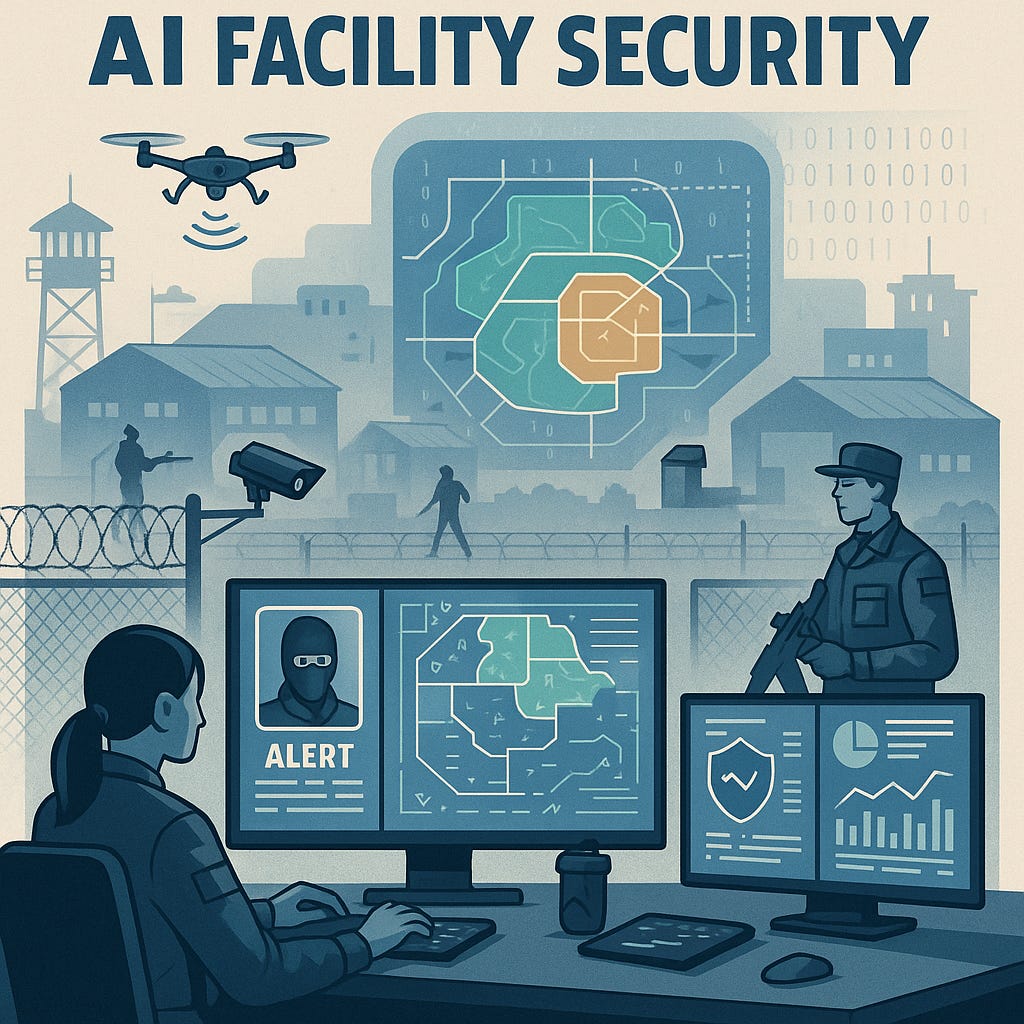
Artificial Intelligence for Base and Facility Security: Intelligent Systems for Protection, Prediction, and Response
By Ronen Kolton Yehuda (Messiah King RKY), June 2025
Abstract
As security threats evolve—ranging from terrorism and sabotage to drone attacks, insider threats, and cyber-infiltration—securing physical spaces like military bases, energy facilities, airports, and command centers requires more than walls and cameras. Artificial Intelligence (AI) enables a shift from static defense to dynamic, real-time security ecosystems. This article introduces a framework for using AI to protect locations and installations through multi-sensor fusion, resource allocation, autonomous alerting, incident scripting, and spatial analysis. The article includes technical components, ethical requirements, deployment strategies, and use-case scenarios.

1. Introduction: The Need for AI-Enhanced Security
Critical infrastructure and high-risk zones (military bases, airfields, government centers, factories) require more than human guards and passive systems. AI enhances these by providing:
-
Predictive threat modeling
-
Real-time sensor integration
-
Automated threat classification
-
Incident response scripts and playbooks
-
Intelligent deployment of patrols, drones, and reinforcements
AI doesn’t replace human security—it amplifies it with constant vigilance and logic-driven action, even under stress or chaos.

2. System Architecture Overview
| Module | Function |
|---|---|
| Sensor Fusion Engine | Merges data from CCTV, radar, thermal, acoustic, and environmental sensors |
| Threat Detection AI | Identifies suspicious movements, masked individuals, drones, weapons |
| Location Risk Evaluator | Analyzes terrain, surrounding zones, and recent patterns |
| Resource Recommendation AI | Suggests placement of guards, towers, drones, and emergency assets |
| Incident Script Engine | Generates if-then-response protocols for different threat levels |
| Ethics and Compliance Core | Ensures AI behavior stays within law and command restrictions |
3. Intelligent Site Security: From Surveillance to Prediction
3.1 Real-Time Surveillance and Tracking
AI connects to a grid of security cameras, motion sensors, and biometric scanners to monitor base perimeters, entrances, internal zones, and access points. Computer vision and thermal imaging flag anomalies such as:
-
Masked individuals in off-limits zones
-
Loitering near sensitive installations
-
Unusual vehicle behavior at gates
-
Sudden drops in visibility due to smoke or fog
3.2 Pattern Recognition and Behavioral Anomalies
AI learns regular patterns—daily vehicle flows, shift changes, environmental baselines—and flags deviations. Example triggers:
-
Movement in an off-limits hangar at 3 AM
-
A person pacing near a fuel depot
-
Drone hovering beyond normal height thresholds
4. AI-Based Resource Placement and Recommendations
4.1 Guard and Patrol Optimization
AI evaluates blind spots, threat levels, access logs, and incidents to recommend optimal:
-
Patrol routes (adjustable in real-time)
-
Guard post placement
-
Drone hover zones
Example Output:
"Increase drone surveillance at Northwest perimeter between 02:00–04:00 due to repeat sensor anomalies in adjacent civilian area."
4.2 Emergency Resource Allocation
In the event of expected or unfolding threats, AI preemptively stages:
-
Firefighting units near fuel storages during heatwaves
-
Medical units near open-air events
-
Communication relays in blackout-prone sectors
5. Location Analysis and Strategic Placement Recommendations
AI evaluates security risk factors when choosing or reinforcing a site:
| Factor | AI Evaluation Parameters |
|---|---|
| Terrain | Line-of-sight for guards, elevation for towers or radars |
| Proximity to Threat Zones | Civil unrest, enemy lines, known smuggling corridors |
| Infrastructure Access | Roads, power, communication lines (and redundancy plans) |
| Historical Threat Data | Past sabotage, intrusion, or drone activity patterns |
| Civilian Proximity | Balance between protection and avoiding population collateral |
Output Example:
“Suggested relocation of ammo storage 300m north: reduces crossfire risk to adjacent village by 90% and improves drone detectability.”
6. Incident Script Engine: Real-Time Action Protocols
AI generates dynamic incident scripts based on type, intensity, and location of the threat.
Example Script – Intruder at Perimeter Fence
{
Example Script – Suspicious Vehicle at Entrance
-
Scan license plate + compare to whitelist
-
Alert gate guard + display risk rating
-
Activate barrier and wait for human confirmation
7. Use Cases and Deployment Scenarios
| Scenario | Description |
|---|---|
| Military Base | Full perimeter defense, drone patrols, internal access control, alerts |
| Nuclear Facility | Radiation monitoring + AI-based breach detection + insider behavior modeling |
| Forward Operating Base | AI-predictive IED risk zones, counter-sniper drones, low-bandwidth operations |
| Civil Infrastructure | Airport perimeter detection, anomaly alerts, crowd flow AI |
| Embassy Security | VIP access monitoring, protest detection, de-escalation AI |
8. Ethical and Legal Safeguards
-
No Lethal Action Without Human ConfirmationAll autonomous responses are non-lethal unless explicitly authorized by command.
-
Privacy-by-DesignCivilian faces blurred/stored only with authorized triggers. Logs encrypted.
-
Bias DetectionAI must not discriminate based on race, attire, or non-threatening behavior. Continuous retraining is mandatory.
-
Override ProtocolsHuman commanders have live dashboard access and override capability for every AI script.
9. Integration with Defense and Civil Systems
AI security platforms can integrate with:
-
National defense radar grids
-
Emergency response dispatch
-
Smart city traffic and energy systems
-
Civilian drone traffic control
-
Secure mobile command apps
10. Conclusion
Artificial Intelligence is no longer just a camera-enhancer—it is the silent logic layer behind a secure base or facility. By predicting threats, placing resources wisely, and guiding every action script with human oversight, AI becomes a guardian—not just a watcher.
Its future includes:
-
Distributed AI defense nodes
-
Inter-base predictive coordination
-
Simulated drills using AI-generated threats
-
Real-time ethical compliance audits
The smarter our infrastructure becomes, the more it must be secured—not with walls, but with intelligent and moral systems.
Keywords
AI base security, autonomous defense, intelligent surveillance, incident scripting, ethical AI systems, patrol optimization, AI-powered threat detection, military infrastructure security, base protection AI, drone defense coordination
Would you like this adapted for presentation slides, turned into a PDF, or paired with a visual infographic or realistic illustration of AI-protected bases?
Here is the technical version of the article on AI for Security of Bases and Strategic Locations, including modules, logic flows, threat response scripting, and deployment architecture:
Technical Framework: Artificial Intelligence for Base and Facility Security
By Ronen Kolton Yehuda (Messiah King RKY) – June 2025
Abstract
This technical paper presents a modular AI architecture for autonomous and semi-autonomous security of physical locations, including military bases, airports, critical infrastructure, and command centers. It details sensor fusion, threat detection, resource recommendation, incident response scripting, and human-in-the-loop control layers. The system is designed to preempt, monitor, and mitigate security risks through dynamic behavior analysis, real-time environment scanning, and programmable compliance enforcement. Deployment options include fixed, mobile, and distributed node configurations.
1. System Objective
To secure high-value or high-risk physical locations using a multi-layered AI framework capable of:
-
Multi-modal threat detection (visual, thermal, audio, radar, etc.)
-
Resource deployment optimization
-
Real-time incident scripting
-
Adaptive patrol path generation
-
AI-assisted human decision support
-
Auditable ethical compliance and override
2. System Architecture Overview
| Layer | Components | Purpose |
|---|---|---|
| Sensor Fusion Layer | Visual (CCTV), IR, LIDAR, radar, acoustic, motion | Data aggregation and anomaly detection |
| Threat Analysis Engine | Object tracking, gait analysis, loitering models | Behavior-based risk classification |
| Resource Optimization AI | Spatial grid + asset positioning engine | Patrol, guard, drone, camera placement recommendation |
| Incident Script Generator | Rule-based + AI-generated protocols | Predefined and dynamic response sequences |
| Location Risk Evaluator | GIS + urban/terrain logic | Base siting, blind spot mapping, environmental scoring |
| Ethics Filter | Rule of Law models, override logs, geofencing | Ensure legal compliance and enforce red-line constraints |
| Operator Interface | Secure dashboard, manual override, alerts UI | Human command integration |
3. Sensor Fusion & Threat Detection
3.1 Multi-Modal Sensor Grid
Inputs are processed through time-synced modules using cross-validation.
-
Visual AI: Object detection, intrusion detection, facial recognition
-
Thermal Mapping: Human/animal detection through heat gradients
-
Motion Tracking: Speed, direction, proximity alerts
-
Acoustic Signatures: Gunfire, engine noise, abnormal speech patterns
-
Drone Radar: Detects low-flying rotary-wing or fixed-wing drones
3.2 Threat Classification Models
-
Deep CNN + LSTM pipelines to track motion patterns
-
Mask Detection, posture anomaly filters (e.g., crouching + static = high threat)
-
Re-ID (Re-identification) models to track individuals across camera zones
-
Confidence scoring system for multi-sensor corroboration
-
E.g., Thermal + Motion + Loitering Pattern = High Probability Intrusion (0.91)
-
4. Resource Allocation and Placement Optimization
4.1 Spatial Grid Modeling
-
The facility is divided into zones (Z1…Zn) based on:
-
Entry points, terrain elevation, lighting, historical incidents
-
-
Real-time risk level matrix:R(Zi) = f(threat_density, visibility_score, critical_asset_proximity, historical_risk)
4.2 Optimization Function
Let G = set of guards, D = set of drones, C = camera assets.
Goal: Maximize coverage and response time, minimize risk exposure
Objective:
maximize ∑ (Coverage(Zi) × Priority(Zi)) - ∑ (Deployment_Cost)
5. Incident Script Engine
5.1 Script Format (Example JSON)
{
5.2 AI-Generated vs. Predefined Protocols
-
Predefined = curated responses to common scenarios
-
AI-Generated = built from NLP + real-time asset capacity + outcome optimization
-
Uses sequence-to-sequence transformer models to generate complex multi-stage responses
-
6. Location Risk Scoring Framework
Factors and Input Sources:
| Risk Dimension | Parameters |
|---|---|
| Terrain Vulnerability | Elevation, natural cover, visibility, escape paths |
| Surrounding Environment | Civilian proximity, slum adjacency, protest hotspots |
| Historical Incident Map | Past attacks, thefts, breaches, drone violations |
| External Influence Zones | Terrorist presence, smuggling routes, hostile surveillance |
Risk Score per Location =
R = w1*T + w2*S + w3*H + w4*E
7. Human-AI Interaction and Ethical Guardrails
7.1 Human-in-the-Loop (HITL)
-
All lethal or detainment actions require human review unless under autonomous protocol pre-approval
-
Every action is logged with:
-
initiator,response_type,timestamp,ethics_passed,commander_override
-
7.2 Red-Line Filters
-
Geo-fenced civilian zones (schools, mosques, clinics) tagged as No-Engage
-
Face/attire recognition excludes medical staff, surrendered individuals
-
Response suggestions filtered by:
-
Collateral risk matrix
-
IHL (International Humanitarian Law) compliance ruleset
-
8. Deployment Models
| Type | Power Source | Use Case | Examples |
|---|---|---|---|
| Fixed Command Hub | Grid / Microgrid | HQ, airport, nuclear plant | Full-stack AI + human teams |
| Edge Unit Node | Battery + Solar | Border bases, outposts | Local sensor + alert logic |
| Drone Swarm Net | Fuel-cell / Li-ion | Rapid perimeter + supply patrols | Autonomous aerial response |
| Mobile Security Kit | Hybrid Battery | Events, VIP security, convoy | Rugged portable deployable |
9. Integration and Protocols
-
Data Sync: All nodes sync to Central Threat Cloud (encrypted, decentralized)
-
Communication: Mesh network using adaptive frequency hopping (jam-resistant)
-
APIs:
-
GET /incidents/today -
POST /deployments/new -
PATCH /risk-map/{zone_id}
-
-
Sim Mode: Run simulations using historical + synthetic data for training
10. Future Enhancements
-
AI-generated training missions with synthetic enemy actors
-
Psychological risk evaluation: facial fatigue, stress detection
-
Crowd anomaly mapping during mass gatherings
-
Inter-base coordination via swarm-AI threat intelligence relay
-
Ethical Escalation Protocols (EEP) embedded into every decision branch
Conclusion
AI-powered facility and base security must combine precision, speed, and restraint. This system presents a scalable, ethically bound architecture for real-world deployment in critical environments. By fusing advanced sensing, scenario modeling, and legal logic enforcement, this AI platform offers not just smarter security—but security that honors safety, law, and humanity.
Keywords
AI facility defense, AI security grid, autonomous patrol, military base protection, ethical AI systems, drone surveillance AI, anomaly detection, tactical scripting, red-line enforcement AI, intelligent infrastructure defense
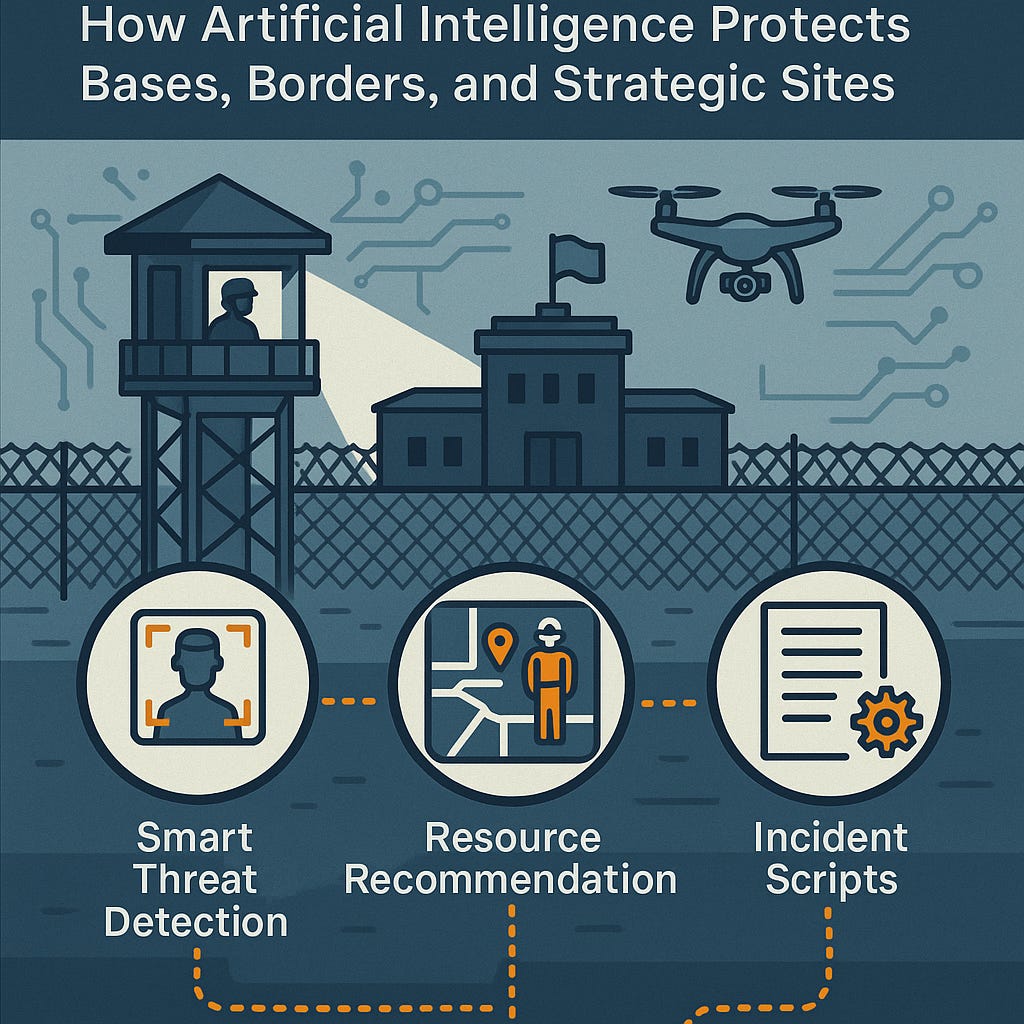
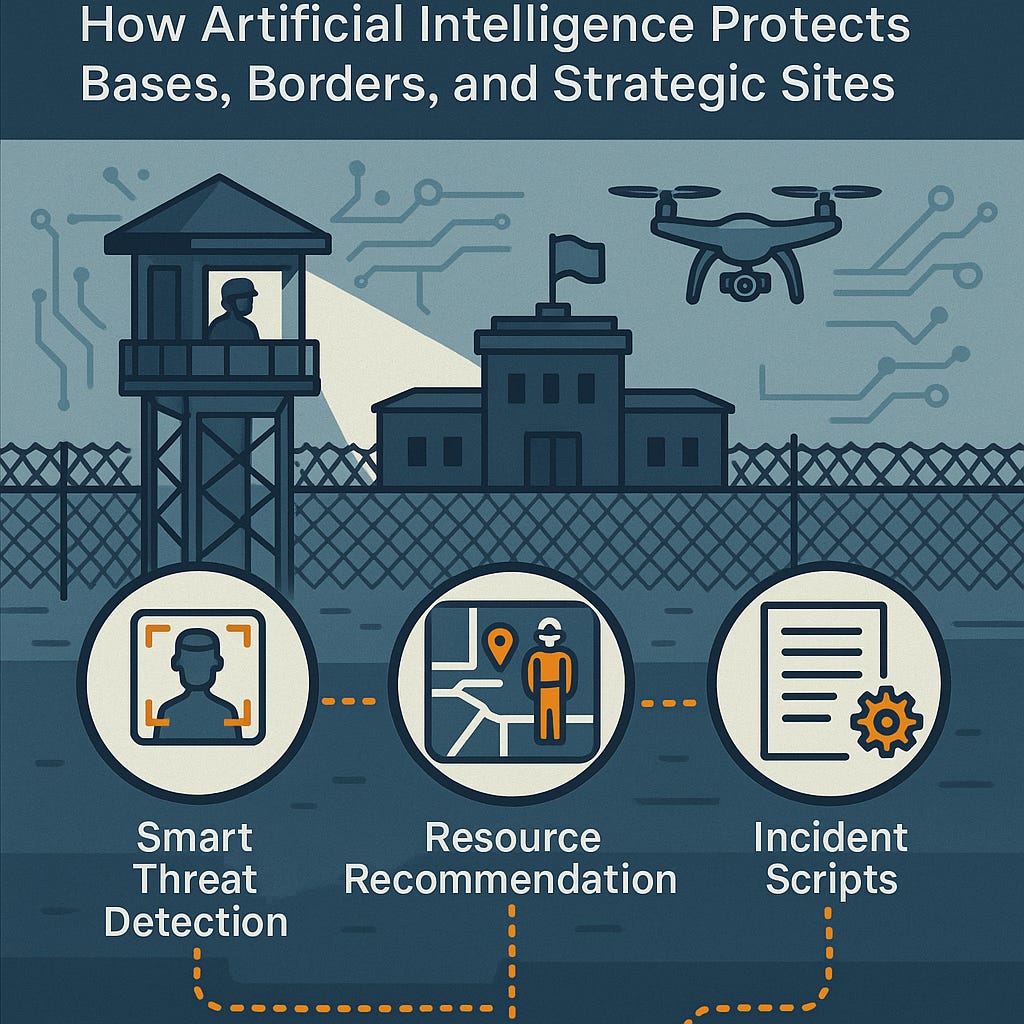
🛡️ AI for Facility Security: How Artificial Intelligence Protects Bases, Borders, and Strategic Sites
In an era of advanced threats—from drones and intrusions to cyberattacks and sabotage—protecting physical locations such as military bases, power stations, airports, and borders has never been more complex. Cameras and fences are no longer enough. What’s needed now is intelligence—Artificial Intelligence.
AI is revolutionizing security operations by turning ordinary surveillance into predictive, responsive, and ethical protection systems. This article explores how AI can be used to protect strategic locations, how it decides where to send resources, and how it reacts to incidents in real time—without losing human oversight.
🔍 What Is AI Security for a Place?
AI security refers to systems that can watch, detect, analyze, and respond to threats automatically or semi-automatically. These systems combine video feeds, sensors, maps, and behavior detection software into one intelligent brain that watches over a facility—day and night.
Instead of just recording what happened, AI systems predict what might happen next.
🧠 Key Capabilities of AI Facility Protection
1. Smart Threat Detection
AI scans video, motion, and thermal sensors to detect intrusions or suspicious behavior—like someone lingering too long near a fence, or a drone flying where it shouldn’t.
It can recognize faces, identify weapons, detect loitering, and even spot crawling or crouching movements that human guards might miss.
2. Resource Recommendation
AI doesn’t just watch—it helps command. It recommends where to place cameras, when to deploy patrols, or how many guards are needed at each location based on historical data and real-time risks.
3. Incident Scripts
When something happens—like a break-in, drone attack, or perimeter breach—AI generates a script of actions, such as:
-
Alert security
-
Activate sirens or lights
-
Send drones to the area
-
Notify nearby forces
-
Broadcast warnings in multiple languages
Each step is chosen based on the type of threat, available personnel, time of day, and legal limitations.
🗺️ How Does AI Choose the Best Location for Resources?
Using a digital map of the base or facility, AI assigns scores to each zone based on:
-
How visible and accessible it is
-
Proximity to sensitive assets (like weapon storage or servers)
-
History of past incidents
-
Political or social risks in the area
Based on these scores, AI suggests the most effective layout for guards, cameras, floodlights, and even walls or drone patrol routes.
📜 Example of an AI Security Script
Scenario: Intruder detected on thermal camera near perimeter fence (Zone E4)
AI Response Script:
-
Raise alert to central command
-
Flash perimeter lights in Zone E4
-
Send two aerial drones for overhead visual
-
Broadcast warning via loudspeaker in 3 languages
-
Record event and trigger review mode
-
If intruder moves toward critical area, notify rapid response team
All actions are logged and include a human override option if needed.
🧩 Ethics and Oversight
AI does not replace human responsibility. Every action—especially if it involves force or confrontation—goes through:
-
Human-in-the-loop review for approval
-
No-kill zones for schools, clinics, and civilian zones
-
Facial recognition safeguards to avoid misidentifying civilians or workers
-
Red line filters to automatically reject illegal or immoral responses
Every step taken by the system is auditable and transparent.
🚀 Where Can AI Facility Security Be Used?
AI security systems are already being designed or deployed in:
-
Military bases (border outposts, airfields, naval yards)
-
Critical infrastructure (power plants, data centers)
-
Airports and seaports
-
High-risk government buildings
-
Temporary field bases and disaster zones
-
VIP convoys and large event protection
Systems can be installed permanently or used as mobile kits powered by batteries and solar panels.
🌍 The Future of Secure Facilities
AI is not just watching—it’s learning. Future upgrades will include:
-
Crowd behavior prediction during protests or emergencies
-
Emotional detection (like fear or aggression) from facial cues
-
AI security coordination between multiple bases in a region
-
Simulated training with fake threats to test system response
-
AI-led de-escalation tactics for peacekeeping missions
The vision: smart, ethical, fast-acting protection that adapts without relying only on muscle or firepower.
🧭 Final Thoughts
Securing a place today is about more than walls and weapons. It’s about awareness, speed, and control. With AI, we can protect people and property with intelligence—predicting threats, responding wisely, and always staying within the law.
When designed with humanity in mind, AI doesn’t just guard—it guides. It becomes a partner in keeping our most important locations safe, efficient, and ethical.
Abstract
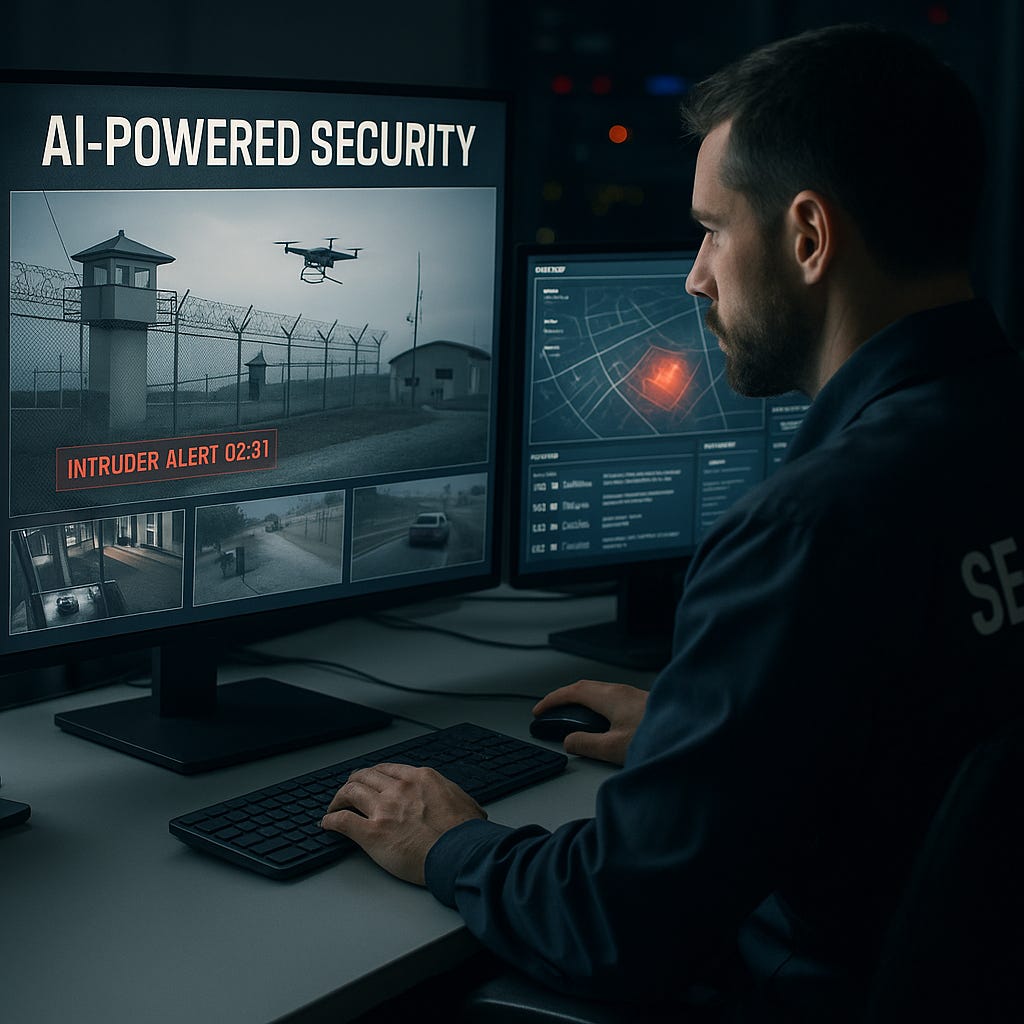
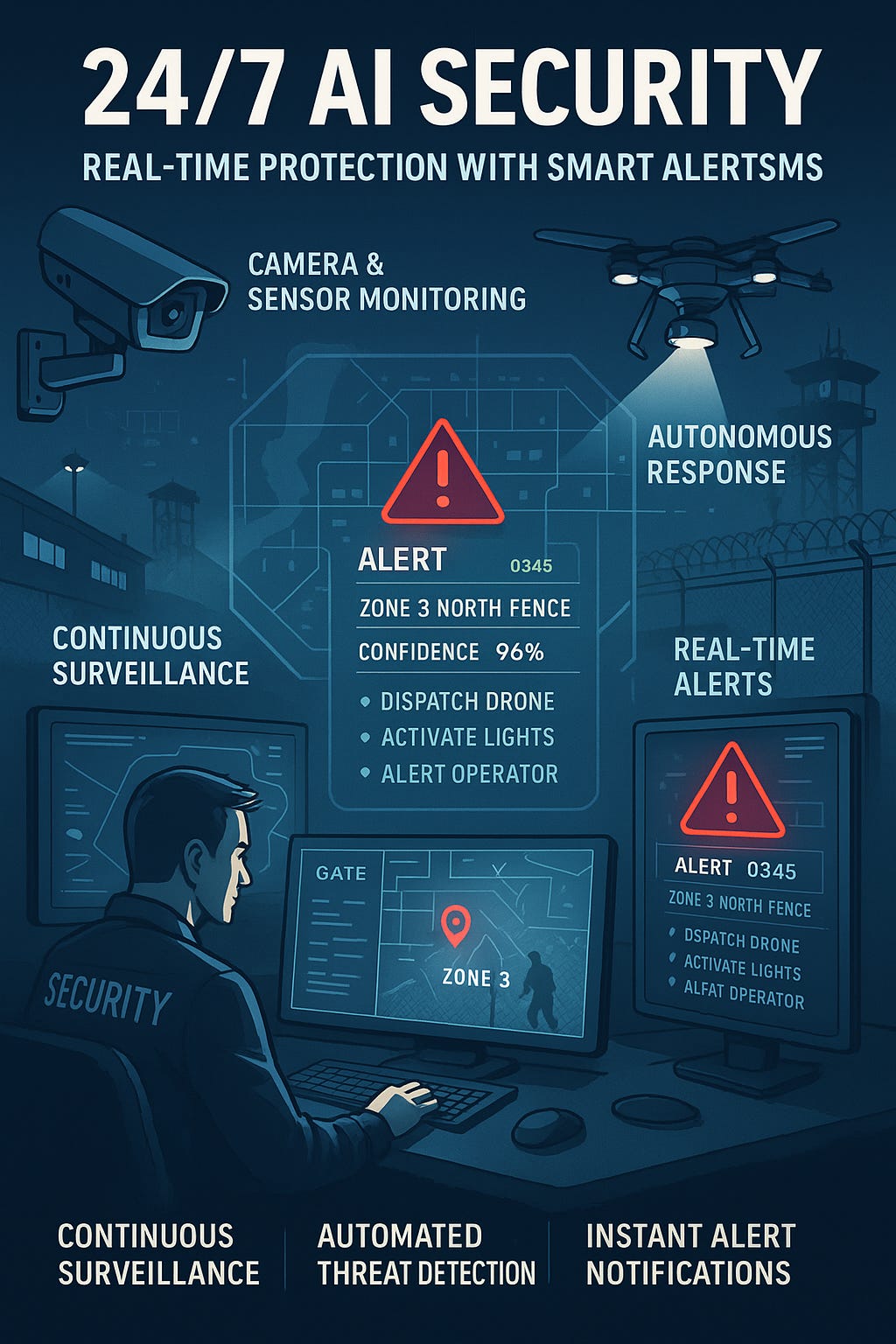
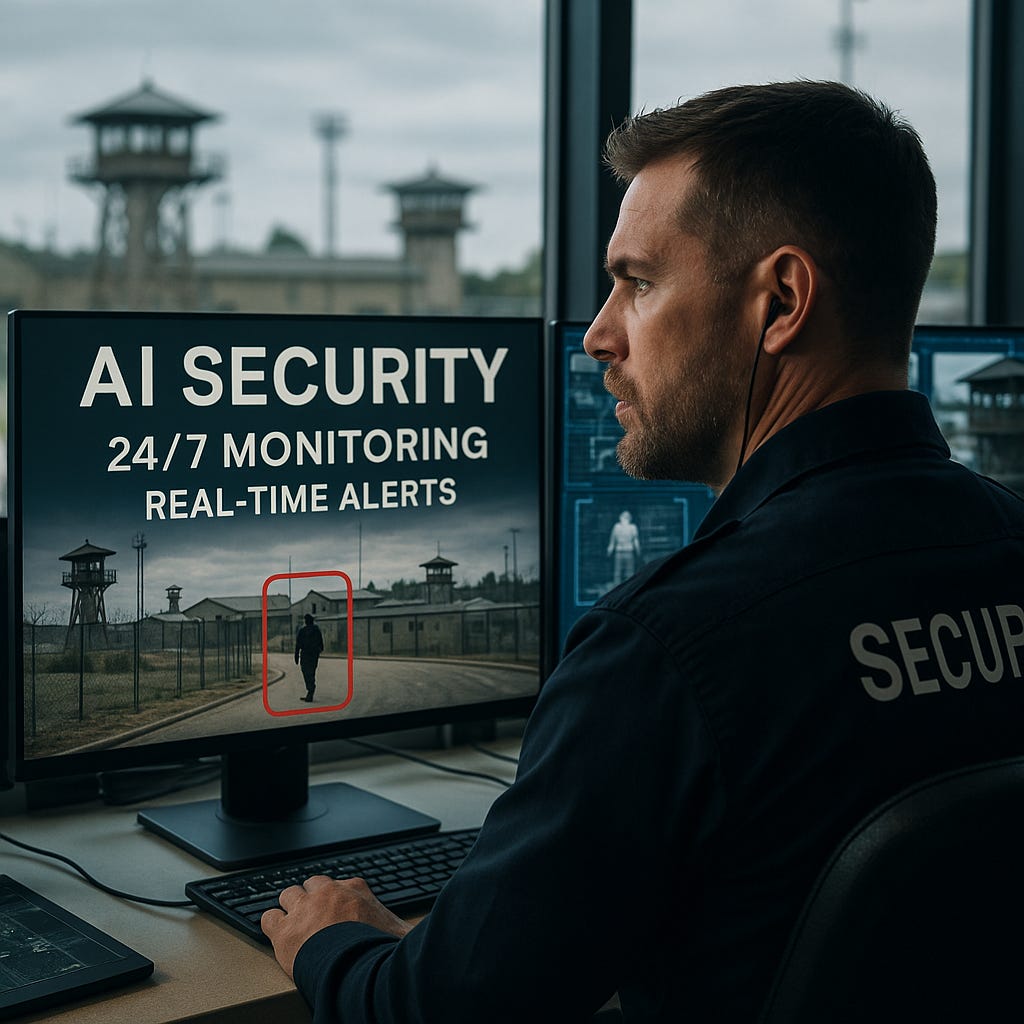
In an era of continuous threat exposure, from drone incursions to insider sabotage, security must be both constant and intelligent. Artificial Intelligence (AI) offers around-the-clock protection that goes beyond passive surveillance, enabling real-time alerts, autonomous analysis, and fast decision support. This article introduces the concept of 24/7 AI Security for strategic facilities—focusing on how AI-driven systems ensure full-time vigilance, threat classification, and instant response coordination.
1. Introduction: Why 24/7 AI Security Is Essential
Human guards need sleep. Cameras need monitoring. But threats can emerge at any moment—especially during the off-hours. Traditional security systems often detect incidents after they occur. AI security systems operate continuously, analyzing multiple input streams without fatigue, bias, or delay.
24/7 AI security enables:
-
Instant recognition of intrusion or tampering attempts
-
Automated alerts to on-site or remote operators
-
Preemptive deployment of drones or smart barriers
-
Legal and ethical response enforcement
2. Core Components of a 24/7 AI Security System
| Module | Role |
|---|---|
| Sensor Fusion Engine | Unifies data from cameras, thermal sensors, acoustic monitors, drones |
| Threat Intelligence Core | Evaluates activity patterns, compares against normal baselines |
| Real-Time Alert Engine | Pushes alerts to mobile, desktop, or control systems instantly |
| Incident Playbook AI | Generates pre-scripted response protocols for various threats |
| Human Oversight Interface | Allows command center staff to review, override, or escalate |
3. Real-Time Alert Logic
AI systems process data as it streams in—detecting, verifying, and responding within milliseconds. Alert workflows typically follow this path:
-
Detection – anomaly flagged (e.g., heat signature on perimeter fence)
-
Validation – AI cross-checks with known events or authorized personnel
-
Alert – if suspicious, a real-time alert is pushed to:
-
Mobile command apps
-
Security consoles
-
Drones and patrols
-
-
Escalation Protocol – if threat confirmed, multi-step responses begin
Example Real-Time Alert:
{
4. 24/7 Surveillance Without Blind Spots
AI constantly monitors:
-
Perimeters with object detection and loitering analysis
-
Entrances with facial recognition, badge validation, and gait analysis
-
Airspace using drone-tracking radar and geo-fence violation alerts
-
Sensitive zones with temperature, noise, and vibration tracking
Shift changes and nighttime operations are not weaknesses in an AI-based system. It learns when fewer humans are present and compensates with tighter watch zones.
5. Autonomous Response and Human Review
AI doesn’t act alone—it works in coordination with human oversight. When a high-confidence threat is detected:
-
Automated actions begin (lights, sirens, voice warnings, drone dispatch)
-
Operator receives alert and may:
-
Confirm and escalate
-
Override for known personnel
-
Log as false alarm (training data is updated)
-
AI can handle 99% of low-tier events autonomously, allowing humans to focus on complex decisions.
6. Applications of 24/7 AI Security
| Location Type | AI Use Cases |
|---|---|
| Military Bases | Patrol automation, intrusion detection, drone tracking |
| Energy Facilities | Sabotage prevention, fire risk alerts, vibration sensors |
| Airports | Gate security, perimeter breaches, crowd flow monitoring |
| Government Sites | Unauthorized access detection, VIP movement tracking |
| Border Checkpoints | Vehicle scanning, document verification, loitering analysis |
7. Benefits Over Traditional Security Systems
| Traditional | 24/7 AI-Based |
|---|---|
| Passive cameras | Active behavior analysis |
| Slow manual alerts | Instant mobile alerts |
| Human fatigue | Non-stop attention |
| Routine patrols | Dynamic, optimized patrols |
| Delayed response | Pre-scripted rapid reactions |
8. Ethical and Operational Safeguards
Even under full automation, ethics and legality remain central:
-
No lethal action without human approval
-
Privacy-by-design: facial data stored only when needed
-
Override access: command staff can pause, override, or disable any script
-
Audit logs: every alert, action, and decision is logged with timestamps
9. Conclusion: Intelligence That Never Sleeps
AI security systems now serve as the digital eyes and ears of our most sensitive locations. With real-time detection, predictive insight, and scripted response—all monitored by human controllers—security becomes both smarter and safer.
By combining autonomous vigilance with human judgment, 24/7 AI security doesn’t just defend perimeters—it reshapes the future of infrastructure protection.
Keywords:
AI security, 24/7 monitoring, real-time threat detection, autonomous alerts, base protection, AI patrol, incident scripting, military AI, infrastructure defense, ethical AI security
⚖️ Legal Statement — Intellectual Property & Collaboration
Artificial Intelligence for Base and Facility Security: Intelligent Systems for Protection, Prediction, and Response
By Ronen Kolton Yehuda (MKR: Messiah King RKY)
June 2025
© 2025 Ronen Kolton Yehuda. All rights reserved.
This publication — including all derivative works, technical frameworks, articles, and system models titled under “Artificial Intelligence for Base and Facility Security,” “24/7 AI Security,” or related sections — constitutes the original intellectual property of Ronen Kolton Yehuda (MKR: Messiah King RKY).
It is protected under international copyright, patent, and moral rights law.
All described concepts, architectures, algorithms, terminology, and security frameworks — including sensor fusion systems, AI incident scripting, threat modeling logic, and ethical control structures — are considered proprietary inventions under the creative and research authorship of the Author.
Usage and Reproduction Rights
-
Permitted Use: Academic citation, brief quotation (up to 300 words), and non-commercial educational referencing — only with full attribution to Ronen Kolton Yehuda (MKR: Messiah King RKY).
-
Restricted Use: Any republication, reproduction, commercial adaptation, translation, AI-model training, or technical implementation based on the content requires prior written authorization from the Author.
-
Unauthorized use, including AI data extraction or derivative commercial deployment, is a direct infringement of intellectual property rights and may result in legal enforcement.
Collaboration & Licensing
Collaborators, partners, or organizations seeking to build upon or deploy any concepts presented herein must enter a formal written IP agreement with the Author.
Such agreement shall define authorship acknowledgment, ownership distribution, confidentiality, and ethical compliance obligations.
All co-developed works shall maintain attribution to the Author and cite the original framework title.
Ethical and Legal Responsibility
Given the dual-use and defense-related nature of this publication, all implementations, adaptations, or demonstrations of its principles must strictly comply with:
-
International Humanitarian Law (IHL)
-
Export control and sanctions regulations
-
Civilian protection and privacy statutes
-
Prohibition on lethal automation without human oversight
This publication is intended for academic, defense research, and ethical development purposes only. Any misuse or weaponization that violates humanitarian law is strictly forbidden and legally actionable.
Contact for Permissions and Collaboration
For licensing, institutional collaboration, research partnerships, or commercial proposals, please contact the Author directly through official or verified communication channels.
Ronen Kolton Yehuda (MKR: Messiah King RKY)
Founder, Author, and Intellectual Rights Holder
© 2025 – All Rights Reserved.
Check out my blogs:
Substack: ronenkoltonyehuda.substack.com
Blogger: ronenkoltonyehuda.blogspot.com
Medium: medium.com/@ronenkoltonyehuda
Check out my blogs:
Substack: ronenkoltonyehuda.substack.com
Blogger: ronenkoltonyehuda.blogspot.com
Medium: medium.com/@ronenkoltonyehuda


Comments
Post a Comment