🤖 Autonomous Weed Removal Robot: Precision Weed Control for Farms and Gardens
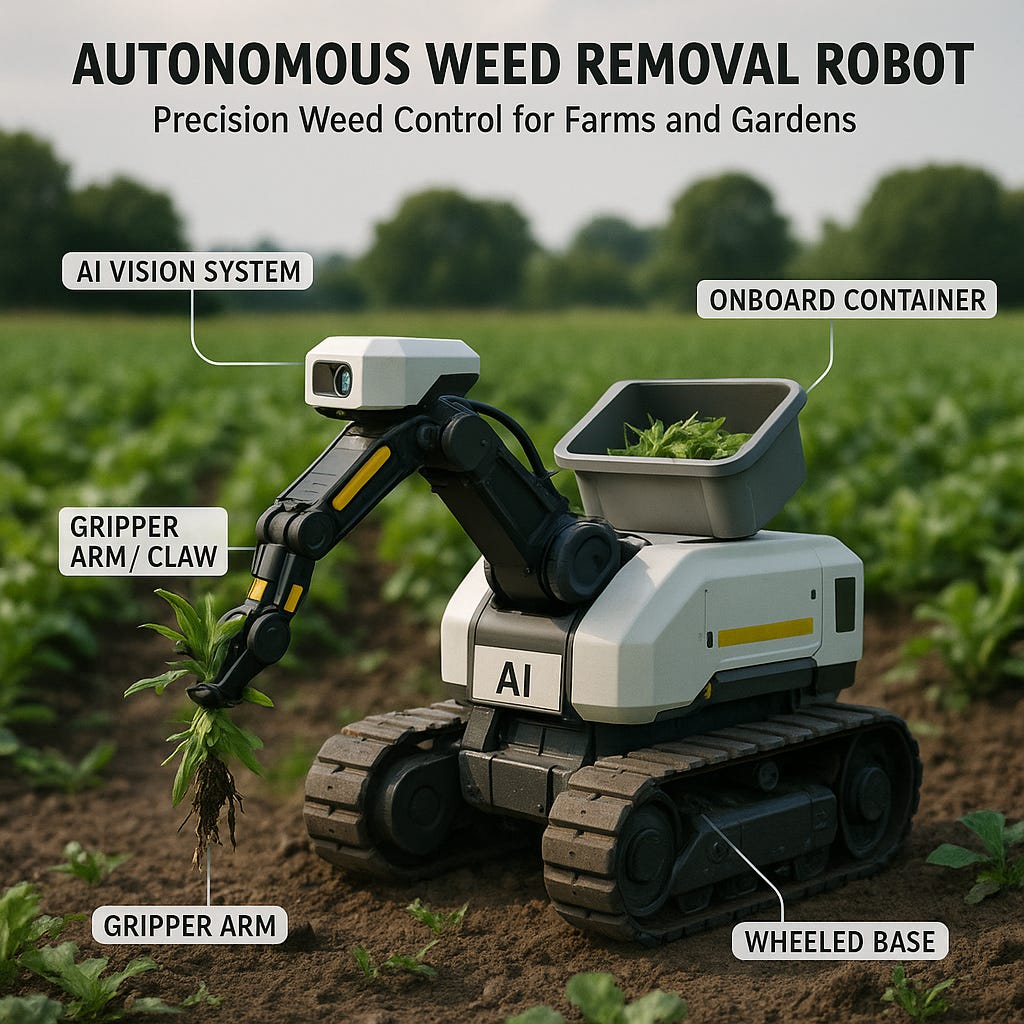
🤖 Autonomous Weed Removal Robot: Precision Weed Control for Farms and Gardens
By Ronen Kolton Yehuda (Messiah King RKY)
🌿 Introduction
As agriculture moves toward automation and sustainability, one of the most persistent challenges remains weed management. Traditional weed control methods—manual weeding, herbicide application, or plastic mulching—are labor-intensive, environmentally harmful, or inefficient. Enter the Autonomous Weed Removal Robot: an AI-powered machine that identifies, extracts, and collects weeds with precision.
This robotic system is designed for use in both large-scale farms and residential or urban gardens, offering a clean, chemical-free approach to weed control.
🎯 Core Functions
The robot performs three primary actions:
-
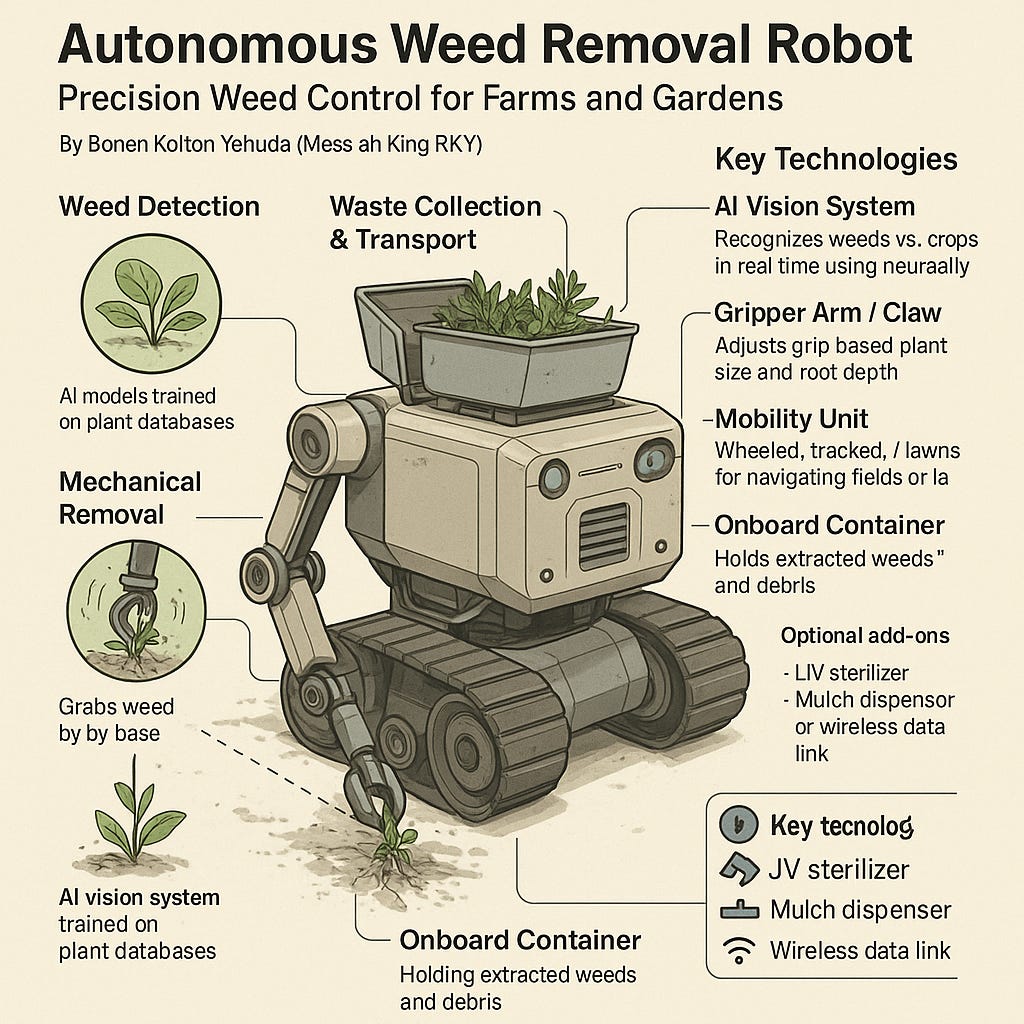
Weed DetectionUsing computer vision and AI models trained on plant databases, the robot can differentiate weeds from crops based on leaf shape, color, position, and growth pattern.
-
Mechanical RemovalThe robot features a robotic arm or claw that grabs the weed by the base, pulls it from the soil (including roots), and ensures complete extraction.
-
Waste Collection & TransportExtracted weeds are stored in an onboard collection bin, which is periodically emptied into a designated composting or waste area—or transferred to a centralized green waste pile.
🧠 Key Technologies
| Module | Description |
|---|---|
| AI Vision System | Recognizes weeds vs. crops in real time using neural networks. |
| Gripper Arm / Claw | Adjusts grip based on plant size and root depth. |
| Mobility Unit | Wheeled, tracked, or legged base for navigating fields or lawns. |
| Onboard Container | Holds extracted weeds and debris. |
| GPS & Mapping | For route planning and area tracking. |
| Optional Add-ons | UV sterilizer, mulch dispenser, or wireless data link. |
🚜 Use Cases
-
Agriculture:
-
Vegetable fields, orchards, and vineyards
-
Organic farms requiring non-chemical weed removal
-
-
Urban & Home Gardening:
-
Yards, flower beds, community gardens
-
Public parks and educational garden plots
-
🌍 Environmental & Operational Benefits
| Benefit | Impact |
|---|---|
| Herbicide-Free | No chemicals used, protecting soil health and biodiversity. |
| Labor Reduction | Replaces hours of manual labor with automated sweeps. |
| Soil Integrity | Extracts weeds gently to preserve surrounding root systems. |
| Reusable Biomass | Weed matter can be composted or reused as mulch. |
| Precision Application | Avoids damaging nearby crops or decorative plants. |
🔋 Power and Runtime
-
Battery-powered (Li-ion) with solar panel recharge option
-
Runtime: 6–10 hours per charge
-
Smart docking station for auto-recharging and software updates
📊 Performance Metrics (Prototype Trials)
| Parameter | Value |
|---|---|
| Weed Detection Accuracy | 95–98% under normal daylight conditions |
| Average Extraction Time | 2–4 seconds per weed |
| Container Capacity | 3–6 kg of biomass |
| Daily Coverage | Up to 1 hectare in field conditions |
🛠️ Customization Options
-
Interchangeable claws for different soil types
-
Night-vision or low-light mode
-
Remote control app for manual override
-
Integration with smart irrigation and monitoring systems
🔄 Integration with Smart Farms
The weed removal robot can serve as part of a larger autonomous farm ecosystem, working in sync with:
-
Drones for plant health imaging
-
Soil sensors for moisture and nutrient tracking
-
Automated irrigation systems for water efficiency
🔚 Conclusion
The Autonomous Weed Removal Robot is a clean, smart, and scalable solution for managing weeds in both rural and urban settings. By using AI and precision mechanics, it replaces manual weeding and chemical herbicides with efficient, sustainable action—protecting crops, the environment, and human labor alike.
As agriculture embraces automation, this robot will become a vital player in maintaining clean, productive, and environmentally safe fields.

Autonomous Weed Removal Robot: AI-Based Mechanical Weed Control for Smart Agriculture
By Ronen Kolton Yehuda (Messiah King RKY)
1. Abstract
This article presents the design and operational framework for an Autonomous Weed Removal Robot—a mobile, intelligent platform for detecting, extracting, and storing weeds in agricultural fields and gardens. Unlike chemical or manual weeding methods, this robot leverages artificial intelligence (AI), computer vision, and electromechanical tools to provide sustainable, non-toxic, and cost-effective weed control. It integrates seamlessly with smart irrigation systems, soil sensors, and existing farm automation infrastructure.
2. Introduction
Weed proliferation in farming is a major cause of nutrient competition, crop loss, and water inefficiency. Traditional methods such as herbicides contribute to soil and water pollution, while manual labor is costly and inconsistent.
The proposed robot eliminates these drawbacks by using:
-
Real-time AI-powered weed detection
-
Precision mechanical extraction (non-herbicidal)
-
Autonomous mobility for field navigation
-
Smart farm ecosystem integration
3. System Overview
| Component | Description |
|---|---|
| AI Vision System | Real-time image recognition to identify weeds based on shape, color, texture, and location relative to crop layout. |
| Navigation Unit | GPS, LiDAR, and ultrasonic sensors for self-driving functionality in structured and unstructured fields. |
| Mechanical Extractor Arm | Robotic actuator with adjustable torque and depth settings to uproot weed structures completely. |
| Collection Bin | Internal storage for extracted weeds with auto-compaction mechanism. |
| Communication Module | Wireless interface (LoRa, Wi-Fi, 5G) for farm network sync and control commands. |
| Power Unit | Rechargeable battery pack or solar + battery hybrid for continuous operation. |
4. Technical Specifications
| Parameter | Value / Description |
|---|---|
| Detection Accuracy | ≥ 95% in varied lighting and terrain conditions |
| Extraction Depth Range | 0–10 cm (adjustable) |
| Daily Coverage (per charge) | 1–2 hectares |
| Max Speed | 0.5–1 m/s |
| Battery Runtime | 6–12 hours (field-dependent) |
| Charging Time | 3–5 hours |
| Mobility Type | Wheeled or tracked, adaptable for crop spacing |
5. AI Model and Dataset
The weed recognition engine is built on a deep convolutional neural network (CNN) trained with diverse datasets of common and invasive weeds. Training includes:
-
Leaf pattern classification
-
Stem geometry segmentation
-
Crop vs. weed differentiation logic
-
Edge-case training with occlusions and debris
The system uses real-time inference to decide whether to extract or bypass a plant. False positive rates are reduced with a multi-angle verification camera system.
6. Control and Autonomy
| Feature | Capability |
|---|---|
| Autonomous Mode | Full field coverage using predefined paths or AI-generated navigation maps |
| Manual Override | Via remote tablet or mobile app |
| Multi-Robot Coordination | Mesh network communication with other units |
| Obstacle Avoidance | AI-based prediction + emergency stop |
7. Integration with Smart Agriculture
| Integration | Function |
|---|---|
| Drip Irrigation Systems | Avoids disrupting pipes; can alert for damage |
| Soil Sensors | Uses real-time soil data to adjust depth and location of extractions |
| Crop Management Software | Syncs operation logs with crop health monitoring |
| Drone Overwatch | Can receive weed map overlays for priority-based routing |
8. Environmental and Economic Benefits
| Metric | Benefit |
|---|---|
| Herbicide Elimination | Zero chemical runoff; protects pollinators and soil life |
| Water Savings | Eliminates unnecessary irrigation to weed areas |
| Yield Improvement | Up to 15–20% in weed-heavy environments |
| Labor Reduction | Saves up to 300–500 labor hours per hectare per season |
9. Maintenance and Durability
| Component | Maintenance Interval | Notes |
|---|---|---|
| Extractor Arm | Every 3–6 months | Replace worn blades |
| AI Camera Lens | Monthly clean | Dustproof casing recommended |
| Battery Pack | Replace every 2–4 years | Based on discharge cycles |
| Tires / Tracks | Annual or as needed | Field and terrain-dependent |
10. Future Development Directions
-
Modular Attachments: for fertilizing, mulching, or pesticide spraying (non-weeding seasons)
-
Swarm AI: coordinated operation with dozens of small robots
-
Home Garden Version: reduced size model for urban vegetable growers
-
Voice + Vision Command: Natural-language-based control for accessibility
11. Conclusion
The Autonomous Weed Removal Robot presents a transformative tool for precision agriculture and sustainable food production. By integrating AI, robotics, and ecological principles, it provides a clean alternative to chemical weeding while enhancing field efficiency and yield performance.
Its adaptability across field sizes—from industrial farms to home gardens—makes it a cornerstone for next-generation farming.

🤖 Autonomous Weed Removal Robot: A Clean Revolution in Agriculture
By Ronen Kolton Yehuda (Messiah King RKY)
🌱 A New Era in Weed Management
As global agriculture faces increasing demands for efficiency, sustainability, and reduced labor costs, one problem remains stubbornly universal: weeds.
Traditional methods—whether it's hours of backbreaking labor, spraying harmful herbicides, or laying down plastic mulches—either damage the environment, harm soil biodiversity, or cost too much in time and resources.
Now, a smart, mechanical alternative is taking root: the Autonomous Weed Removal Robot. It combines artificial intelligence, robotics, and ecological design to deliver precise, chemical-free weed control—safely and automatically.
🔧 How It Works
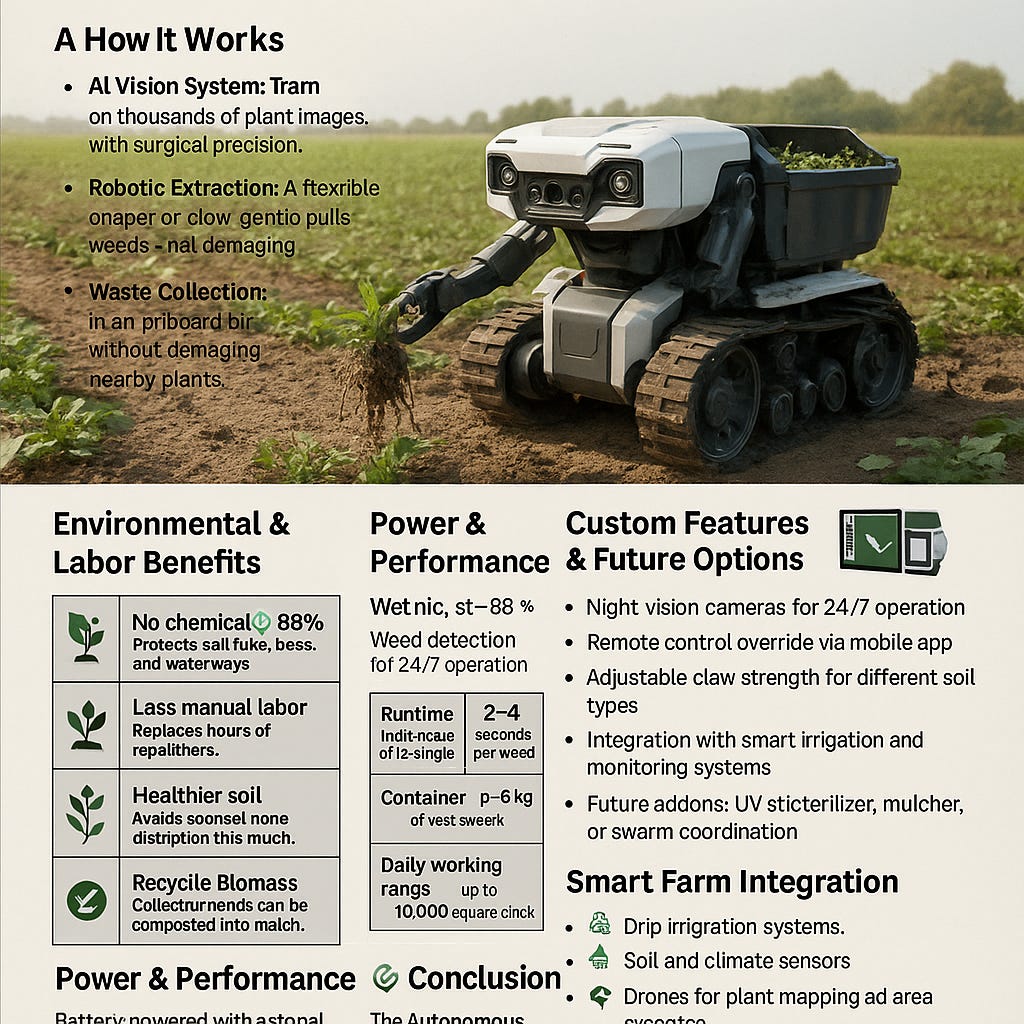
This robot is built to identify, remove, and collect weeds with surgical precision. Its operation includes:
-
AI Vision System: Trained on thousands of plant images, the robot uses computer vision to distinguish weeds from crops in real time.
-
Robotic Extraction: A flexible gripper or claw gently pulls weeds out—roots and all—without damaging nearby plants.
-
Waste Collection: Weeds are stored in an onboard bin for later composting or disposal, keeping fields clean and organized.
🚜 Built for All Fields — Big and Small
The robot is designed for use in:
-
Commercial agriculture: Vegetable plots, orchards, and vineyards, especially organic farms that avoid herbicides.
-
Urban and home gardening: Flower beds, backyard farms, school gardens, and municipal green areas.
Its size, mobility, and smart controls allow for both large-scale farming and compact garden care.
🌍 Environmental & Labor Benefits
| Feature | Impact |
|---|---|
| 💧 No Chemicals | Protects soil life, bees, and waterways. |
| 🧑🌾 Less Manual Labor | Replaces hours of repetitive fieldwork. |
| 🪴 Healthier Soil | Avoids root zone disruption of crops. |
| ♻️ Recycles Biomass | Collected weeds can be composted into mulch. |
| 🎯 Precise Targeting | Prevents crop damage and unnecessary action. |

🔋 Power & Performance
-
Battery-powered with optional solar charging panel
-
Runtime: 6–10 hours on a single charge
-
Coverage: Up to 1 hectare/day
-
Smart docking station for auto-charging and system updates
📊 Real-World Performance
Prototype trials show:
| Metric | Value |
|---|---|
| Weed detection accuracy | 95–98% |
| Average removal time | 2–4 seconds per weed |
| Container capacity | 3–6 kg of weeds |
| Daily working range | Up to 10,000 square meters |
🛠️ Custom Features & Future Options
-
Night-vision cameras for 24/7 operation
-
Remote control override via mobile app
-
Adjustable claw strength for different soil types
-
Integration with smart irrigation and monitoring systems
-
Future add-ons: UV sterilizer, mulcher, or swarm coordination
🔄 Smart Farm Integration
The robot fits into broader precision agriculture ecosystems, syncing with:
-
🌿 Drip irrigation systems
-
📡 Soil and climate sensors
-
🚁 Drones for plant mapping and area scouting
-
📱 Farm management apps
✅ Conclusion
The Autonomous Weed Removal Robot represents a leap forward in green, efficient, and intelligent farming. It removes the need for herbicides, reduces labor, protects crops, and supports a future of clean agriculture.
Whether it’s clearing weeds from a massive field or a small community garden, this robot empowers growers with precision, sustainability, and peace of mind.
As the agriculture of the future grows smarter, this robot will be at the frontline—rooting out weeds and cultivating change.




Comments
Post a Comment