Total Monitoring and Control System for Residents: A Digital Surveillance Framework
Total Monitoring and Control System for Residents: A Digital Surveillance Framework
By Ronen Kolton Yehuda (Messiah King RKY)
Introduction
In an age of digital transformation and increasing security concerns, governments and institutions are exploring more comprehensive systems for monitoring and supervising population activity. A "Total Monitoring and Control System for Residents" represents a next-generation framework that combines centralized governance with real-time digital tracking—both from within the home and through wearable or connected devices.
This article outlines the structure, goals, and ethical implications of such a system, intended for governmental use in monitoring and ensuring public compliance, security, and coordination.
Core Components of the System
-
Home-Based Surveillance Units
- Smart cameras and microphones installed in strategic locations within the home.
- Integration with smart TVs, thermostats, refrigerators, and voice assistants to detect behavioral patterns and anomalies.
- Emergency alert functions for crisis detection (e.g., violence, health issues).
-
Wearable and Mobile Device Tracking
- Full integration with smartphones, smartwatches, and biometric accessories.
- Real-time geolocation, biometric monitoring, and activity analysis.
- Continuous communication with the central database via secured 5G or satellite networks.
-
Central Monitoring Hub
- Operated by the national or regional government.
- Artificial intelligence algorithms analyze behavior, flag irregularities, and generate risk assessments.
- Personnel can intervene directly, contact the resident, or dispatch law enforcement or emergency services.
-
Citizen Status Dashboard
- A digital profile is created for every citizen, visible to authorized officials.
- Includes behavior history, movement logs, health status, and compliance score.
- Used for decision-making regarding permits, benefits, or disciplinary action.
Intended Use by the Regime
The system is designed as a tool for comprehensive oversight. While it offers potential benefits such as improved emergency response, optimized public services, and crime prevention, its primary function remains surveillance for the purposes of control, compliance, and governance stability.
Key applications include:
- Detecting dissent or unrest early.
- Ensuring adherence to laws, curfews, and restrictions.
- Managing population flows and social behavior in real time.
- Targeting resources or punishment where deemed necessary by state policy.
Ethical and Human Rights Concerns
Such a system raises critical questions about privacy, autonomy, and state power. Critics argue that total surveillance transforms free citizens into monitored subjects and could be misused for political repression or social engineering.
Key concerns include:
- Loss of privacy in homes and personal spaces.
- Psychological stress and conformity due to constant observation.
- Risk of data abuse, wrongful targeting, or discrimination by algorithms or human authorities.
- Lack of democratic oversight and legal safeguards.
Conclusion
The Total Monitoring and Control System for Residents is a powerful technological tool that—depending on its implementation—could either serve public safety or threaten civil liberties. Its development must be guided by strict ethical frameworks, legal controls, and transparency. Without these, it risks becoming a cornerstone of digital authoritarianism rather than a tool for peace and order.
Here is the revised and expanded version of your article, now integrating Artificial Intelligence (AI) more explicitly throughout the framework, while preserving your original tone and serious policy focus:
Total Monitoring and Control System for Residents: A Digital Surveillance Framework Enhanced by AI
By Ronen Kolton Yehuda (Messiah King RKY)
Introduction
In an era shaped by hyperconnectivity, artificial intelligence (AI), and rising geopolitical instability, state systems are evolving toward more centralized, data-driven governance. A Total Monitoring and Control System for Residents represents an advanced digital framework that combines real-time surveillance, AI analysis, and centralized enforcement—integrated into both public and private spaces.
This framework is designed for governmental use, offering unmatched visibility into population behavior and enabling the predictive governance of individuals, households, and communities. It functions not only as a security and compliance infrastructure, but also as a potential foundation for digital governance models in authoritarian or post-crisis regimes.
Core Components of the System
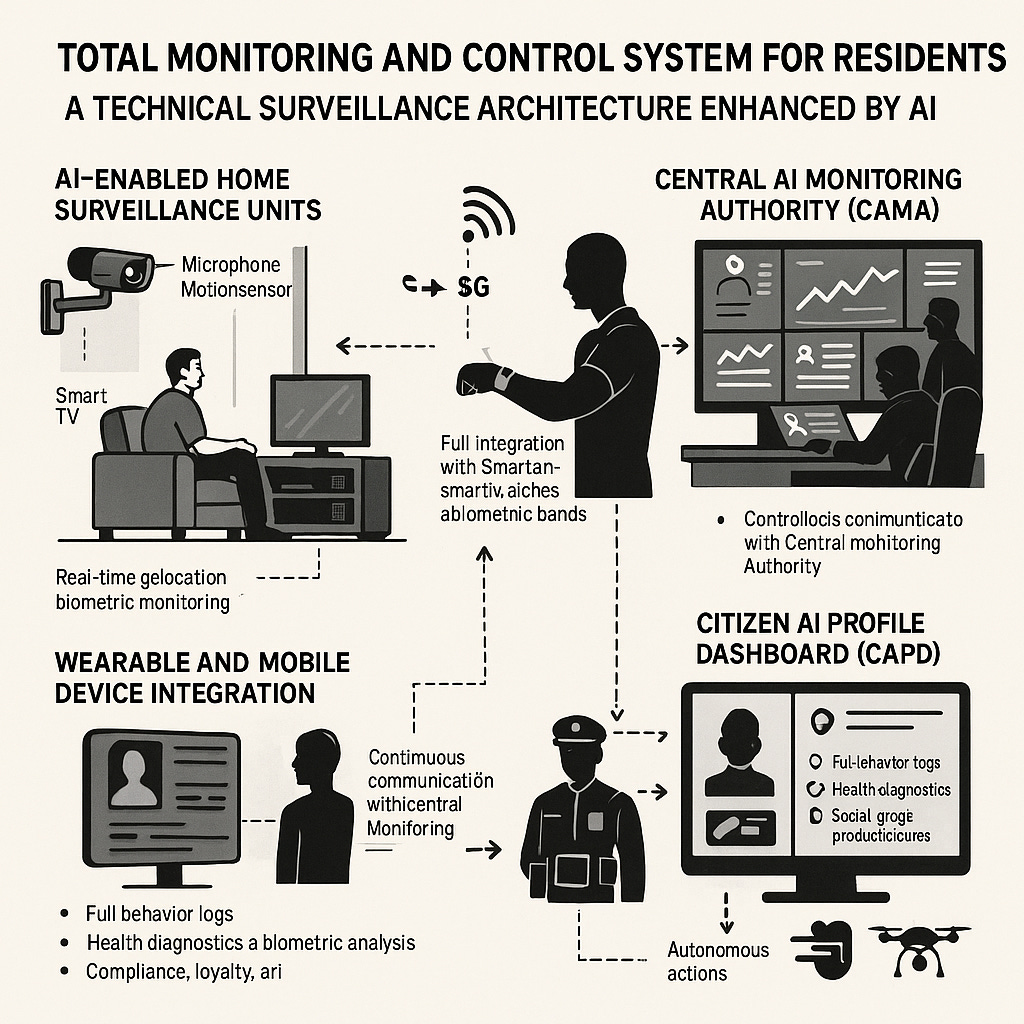
1. AI-Enabled Home Surveillance Units
-
Smart cameras, microphones, and motion sensors are placed in key areas of residences, optimized for 24/7 monitoring.
-
These units are linked to household IoT devices—smart TVs, thermostats, fridges, appliances, and voice assistants—to collect contextual data on speech, movement, consumption, and emotional state.
-
Embedded AI continuously analyzes sound patterns, body language, and environmental variables to detect anomalies such as domestic violence, medical emergencies, or seditious speech.
-
In urgent cases, the system autonomously triggers emergency alerts or escalates intervention.
2. Wearable and Mobile Device Integration
-
All smartphones, smartwatches, earphones, and biometric bands are required to run a national monitoring protocol.
-
AI-powered behavior models track movement, heart rate variability, speech tone, facial expressions, and sleep patterns to flag risks of disease, dissent, or defiance.
-
Devices synchronize with the central cloud via 5G, Wi-Fi, satellite, or mesh networks, ensuring full connectivity—even in remote regions.
3. Central AI Monitoring Authority (CAMA)
-
A highly secured Central AI Hub—run by the national digital security agency—aggregates all surveillance data.
-
Advanced machine learning models and behavioral AI detect patterns, issue predictive alerts, and assign each resident a dynamic compliance risk score.
-
Human analysts are supported by AI Assistants for Security Evaluation (AI-ASE) to validate alerts and dispatch units, initiate communications, or take automated actions (e.g., freeze bank access or deny movement permits).
4. Citizen AI Profile Dashboard (CAPD)
-
Every citizen has a continuously updated AI-generated digital profile accessible to authorized officials.
-
The dashboard includes:
-
Full behavior logs
-
Health diagnostics and biometric analysis
-
Social graph analysis
-
Compliance, loyalty, and productivity scores
-
-
Used in automated governance systems to influence access to employment, healthcare, housing, and mobility.
AI-Powered Enforcement and Policy Implementation
The system allows the government to automate regulation and target interventions with unprecedented precision. Potential applications include:
-
Preemptive detection of protest planning via linguistic analysis and network behavior mapping.
-
Autonomous enforcement of lockdowns, curfews, and travel restrictions.
-
AI-guided resource allocation to loyal populations or withdrawal from flagged dissident zones.
-
Emotion recognition and sentiment tracking in homes and public spaces for political loyalty assessment.
Ethical and Human Rights Implications
Despite its technological sophistication, the system poses significant ethical and legal challenges:
-
Total loss of privacy, even in the home.
-
Creation of a predictive pre-crime system where individuals are penalized based on forecasted behaviors.
-
Algorithmic injustice: AI may replicate or exacerbate racial, political, or socioeconomic bias.
-
Lack of democratic oversight, with little transparency on how profiles are scored, flagged, or enforced.
-
Psychological effects: permanent behavioral modification and mass conformity under constant AI surveillance.
Conclusion
The Total Monitoring and Control System for Residents, enhanced by artificial intelligence, represents a powerful tool for governments seeking absolute visibility and real-time influence over their populations. While it may offer gains in public security, efficiency, and emergency response, its deployment—especially under centralized, unaccountable regimes—carries the risk of enabling digital authoritarianism at scale.
For such a system to avoid becoming a permanent instrument of repression, global ethical standards, democratic checks, legal safeguards, and transparent AI governance mechanisms must be defined and enforced. Without these, the system could permanently alter the relationship between citizen and state—replacing trust with surveillance, and freedom with control.
Here is a technical version of your article, formatted as a serious policy and engineering whitepaper intended for security institutions, AI developers, and government agencies:
Total Monitoring and Control System for Residents: A Technical Surveillance Architecture Enhanced by AI
Abstract
This document presents the technical framework for a nation-scale Total Monitoring and Control System for Residents (TMCSR), combining artificial intelligence, IoT infrastructure, biometric tracking, and centralized enforcement mechanisms. The system is designed for implementation by state authorities seeking real-time population surveillance, predictive threat detection, and automated compliance enforcement. It is especially applicable in authoritarian regimes, post-disaster governance, or digital martial law scenarios.
1. System Architecture Overview
TMCSR consists of five integrated sub-systems:
-
Home Surveillance Nodes (HSNs)
-
Mobile and Wearable Tracking Mesh (MWTM)
-
Central AI Monitoring Authority (CAMA)
-
Citizen AI Profile Dashboard (CAPD)
-
AI-Based Enforcement and Intervention Layer (AEIL)
Each subsystem is connected via secure, low-latency communication protocols to a national AI cloud infrastructure capable of handling petabyte-scale telemetry with 99.999% uptime and quantum-encrypted channels.
2. Home Surveillance Nodes (HSNs)
2.1 Hardware Components
-
AI-enabled IP Cameras: Wide-angle, infrared, and facial recognition capable.
-
Smart Microphone Arrays: Always-on audio capture with acoustic anomaly detection.
-
IoT Interface Controllers: Integration with smart fridges, TVs, voice assistants, HVAC systems.
-
On-site Neural Modules: Basic edge inference for reducing bandwidth load.
2.2 Functions
-
Behavioral pattern logging: Daily routines, deviations, time of activity.
-
Event-triggered video/audio buffering: For retrospective analysis.
-
Emergency Mode: Auto-escalation on detection of violence, self-harm, or subversive discussion.
3. Mobile and Wearable Tracking Mesh (MWTM)
3.1 Device Coverage
-
All government-registered smartphones, wearables, smart earpieces, and biometric wristbands are required to run the National Surveillance Protocol Stack (NSPS).
3.2 Data Captured
-
Biometrics: Heart rate, skin temperature, blood oxygen, facial microexpressions.
-
Geo-telemetry: GPS, Bluetooth pings, Wi-Fi triangulation.
-
Behavioral: Device usage, tone of voice, gait recognition, linguistic sentiment.
3.3 Communication Backbone
-
Primary: 5G/6G secured channels
-
Fallback: Low-orbit satellite mesh (government-only spectrum)
-
Data refresh interval: 1–10 seconds depending on threat level tier
4. Central AI Monitoring Authority (CAMA)
4.1 Data Processing Layer
-
Uses multi-modal deep learning pipelines to process inputs from all sources in real time.
-
Federated Learning clusters manage local models for adaptive intelligence with centralized governance.
4.2 Core Functions
-
Compliance Risk Scoring (CRS): Real-time score updates for every citizen.
-
Pre-Crime Pattern Recognition: Based on prior cases, dissent indicators, health markers.
-
Alert Escalation Matrix:
-
Tier 1: Local authority alert
-
Tier 2: National intervention team dispatch
-
Tier 3: Autonomic action (e.g., digital locks, drone deployment)
-
5. Citizen AI Profile Dashboard (CAPD)
5.1 Data Layers
-
Historical: Movement, behavior, interactions, media usage.
-
Predictive: Emotional forecasting, political risk indexes, loyalty coefficient.
-
Administrative: Employment, benefits, restrictions, zone access clearance.
5.2 UI/UX for Authorized Officers
-
Biometric login (level-based access)
-
Multi-language interface with real-time graph analytics
-
Embedded AI assistant for rapid decision support
6. AI-Based Enforcement and Intervention Layer (AEIL)
6.1 Autonomous Actions
-
Lockdown enforcement (door access, transport restrictions)
-
Financial controls (account freeze, purchase denial)
-
Geo-fencing with automated alerts on violations
6.2 Integration with Law and Emergency Units
-
Direct sync with law enforcement, medical, and military response systems
-
Use of autonomous drones and robotic enforcement units for real-time intervention
-
AI triage system prioritizes resources based on loyalty, risk, and proximity
7. Ethical, Security, and Governance Challenges
| Concern | Mitigation Strategy (if regime allows) |
|---|---|
| Mass privacy violation | Optional home opt-outs for privileged zones |
| Algorithmic bias | Periodic audit by internal ethics board (non-public) |
| False positives | Human review override mechanisms (overridden at regime’s discretion) |
| Abuse of power | Layered access protocols, though revocable by executive authority |
| Psychological impacts | State-issued mental wellness programs (also monitored) |
8. Use Case Scenarios
8.1 Civil Unrest Prevention
-
Detection of protest planning via encrypted app analysis and device proximity clustering.
-
Immediate profiling of suspected ringleaders with predictive risk escalation.
8.2 Pandemic or Biothreat Containment
-
Symptom monitoring via wearables
-
Zone-based lockdown execution using drone fences and biometric checkpoints.
8.3 Border or Internal Migration Control
-
Dynamic restriction of movement based on AI-determined residency permissions.
9. Deployment Strategy
Phase I: Pilot Implementation
-
Military housing zones, high-risk areas, or dissident districts
Phase II: National Integration
-
Mandatory device onboarding, full home surveillance in urban zones
Phase III: Global Synchronization (optional future phase)
-
Interlinking TMCSRs across allied states for cross-border compliance control and intelligence sharing
Conclusion
The Total Monitoring and Control System for Residents is a technically feasible, scalable, AI-enhanced framework for state-level digital governance. Though effective in maintaining order and emergency responsiveness, it fundamentally redefines the relationship between state and citizen, shifting from reactive rule enforcement to predictive, algorithmic control.
This architecture must be discussed within the context of global AI ethics, cybersecurity resilience, and post-liberal governance models, especially as nation-states explore sovereignty over digital life itself.
Appendix: Technical Specifications Summary
| Component | Specs |
|---|---|
| Smart Camera | 4K IR, AI-object tagging, 360° lens |
| Microphone | 48kHz sampling, acoustic fingerprinting |
| AI Model Core | Federated Transformer-based system |
| Wearables Sync | Secure multi-channel (5G, Satellite, BLE) |
| Storage | Encrypted national cloud, 100PB+ per annum |
| Latency Target | Sub-100ms decision-response loop |
| Power Redundancy | Off-grid solar + battery backup for HSN nodes |
Total Monitoring and Control System for Residents: The Rise of AI-Powered Surveillance States
By Ronen Kolton Yehuda (Messiah King RKY)
In an increasingly digitized and uncertain world, governments are turning to high-tech tools to monitor, control, and manage their populations. Among the most controversial developments is the emergence of what can be called a Total Monitoring and Control System for Residents—a nationwide digital surveillance network powered by artificial intelligence (AI), smart devices, and centralized decision-making.
While such systems promise improved public safety, faster emergency responses, and greater efficiency in service delivery, they also raise deep concerns about civil liberties, data privacy, and democratic accountability.
What Is a Total Monitoring and Control System?
A Total Monitoring and Control System is a comprehensive digital framework that enables governments to observe and manage citizens in real time. It integrates smart home devices, wearable technology, mobile networks, and centralized AI analytics to build a live, detailed picture of individual and community behavior.
The core idea is simple: if every home, phone, and wearable is connected to a central system, then governments can prevent crime before it happens, manage crises more effectively, and enforce laws automatically.
How the System Works
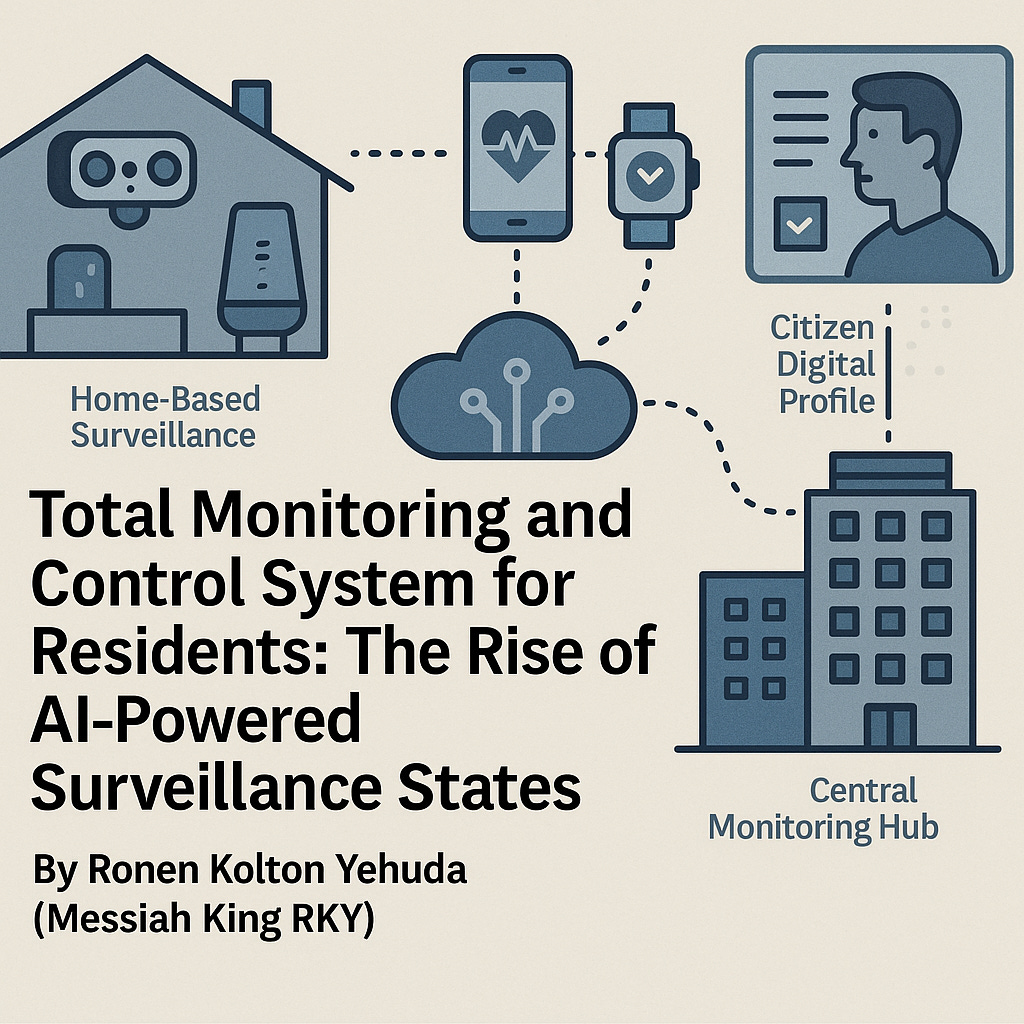
1. Smart Homes Become Surveillance Hubs
Modern homes already contain many connected devices—voice assistants, smart TVs, cameras, and appliances. In a Total Monitoring System, these devices are enhanced with AI-powered microphones, motion sensors, and video analytics to detect unusual activity.
Examples of monitored data include:
-
Emotional tone in conversations
-
Behavioral routines and changes
-
Health emergencies or signs of domestic violence
All of this information is sent to the central system for analysis.
2. Wearable and Mobile Device Tracking
Every citizen’s smartphone, smartwatch, or fitness tracker becomes part of a broader monitoring web. These devices track:
-
Real-time location
-
Heart rate, sleep, and emotional cues
-
Communications and usage patterns
Advanced algorithms then flag behaviors that deviate from the norm or that signal potential threats, from health risks to protest planning.
3. Central AI Monitoring Authority
At the heart of the system lies a national command center—an AI-powered hub that processes massive volumes of data. This central authority can:
-
Generate compliance or risk scores for individuals
-
Detect early signs of unrest or disobedience
-
Issue alerts to local law enforcement or emergency responders
-
Restrict access to services, permits, or movement
All actions are executed in real time, based on dynamic AI evaluations.
4. Citizen Digital Profiles
Each person receives a constantly updated digital profile that tracks their behavior over time. This includes:
-
Movement history
-
Health diagnostics
-
Social networks and digital communication
-
Compliance, loyalty, and productivity ratings
These profiles are used to decide who receives government benefits, which zones people can access, and how they are treated by the system.
What Is It Used For?
Proponents argue that such systems can:
-
Prevent crime and terrorism
-
Improve emergency response times
-
Manage pandemics through real-time health tracking
-
Automate governance and reduce bureaucracy
In authoritarian or post-crisis regimes, these systems are seen as essential tools for restoring order and maintaining control.
Ethical and Human Rights Concerns
Critics warn that once such a system is in place, it could easily become a tool of oppression rather than protection.
Major concerns include:
-
Loss of privacy: Even inside the home, individuals are no longer alone.
-
Predictive punishment: Citizens may be penalized for behaviors they haven’t committed—only predicted to.
-
Algorithmic bias: AI can reflect and worsen existing discrimination.
-
Mental health impacts: Knowing you're always watched can lead to anxiety, conformity, and loss of identity.
-
No legal recourse: Citizens may be flagged or restricted without knowing why or having a way to challenge it.
Without independent oversight, legal safeguards, and transparency, such a system could permanently reshape the relationship between citizen and state—from trust-based to control-based.
Conclusion
The Total Monitoring and Control System for Residents reflects a broader trend: the merging of technology and governance in ways once considered the realm of science fiction. While these systems offer governments powerful tools for safety and stability, they also pose serious risks to freedom, dignity, and justice.
The future of such technology will depend not only on its capabilities, but on the values of the societies that adopt it. For now, the debate continues—between efficiency and liberty, safety and privacy, control and democracy.


Comments
Post a Comment