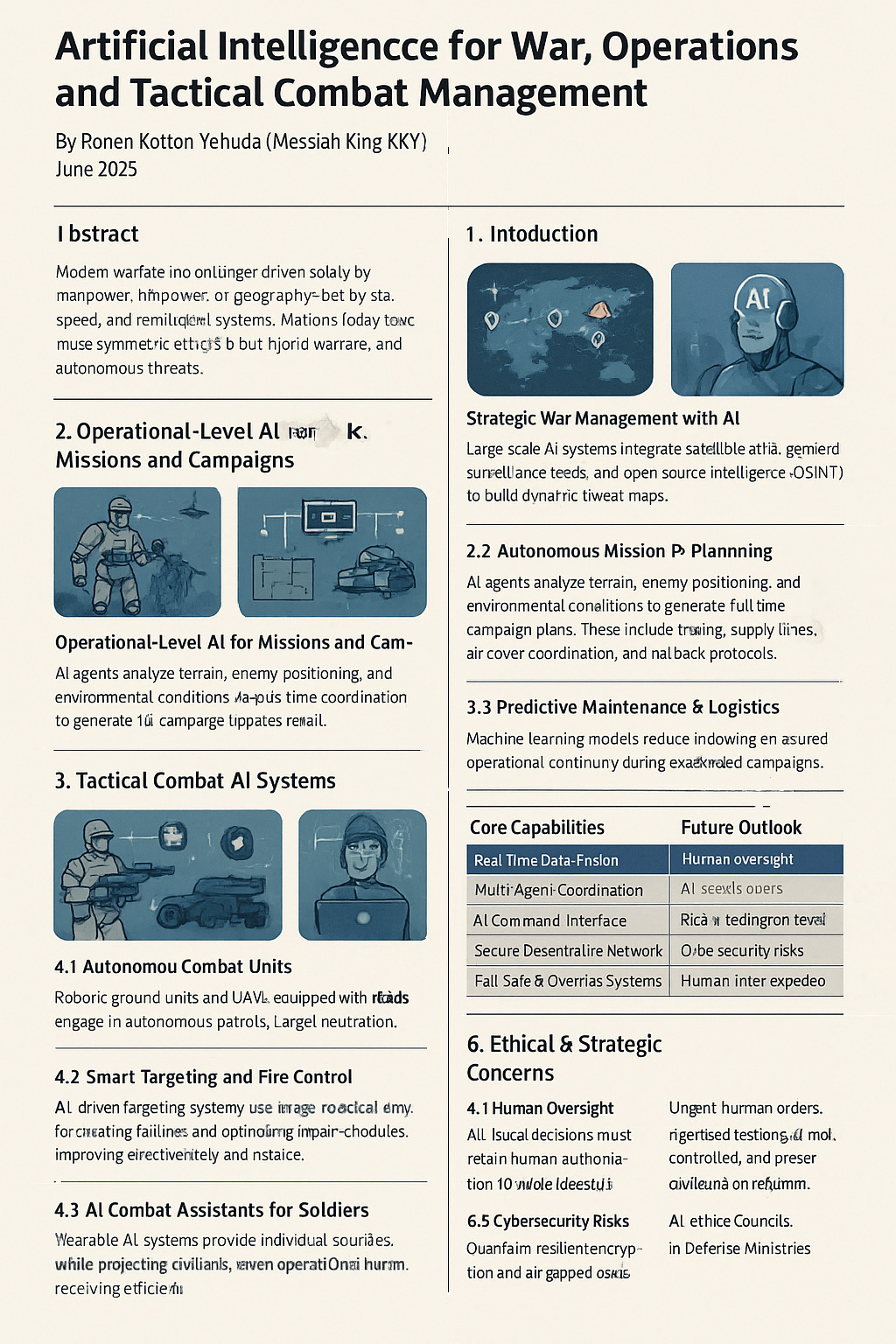
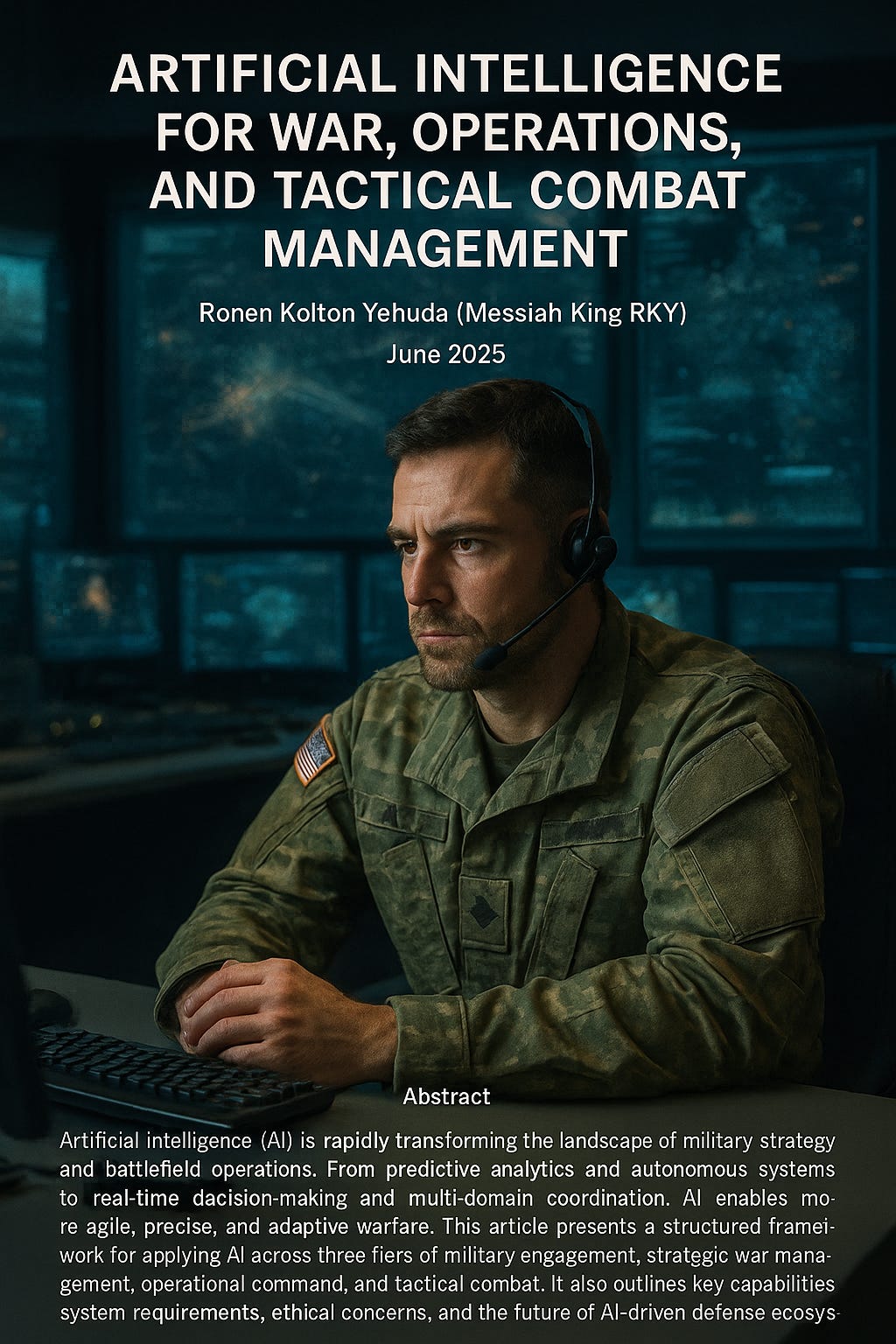
Artificial Intelligence for War, Operations, and Tactical Combat Management
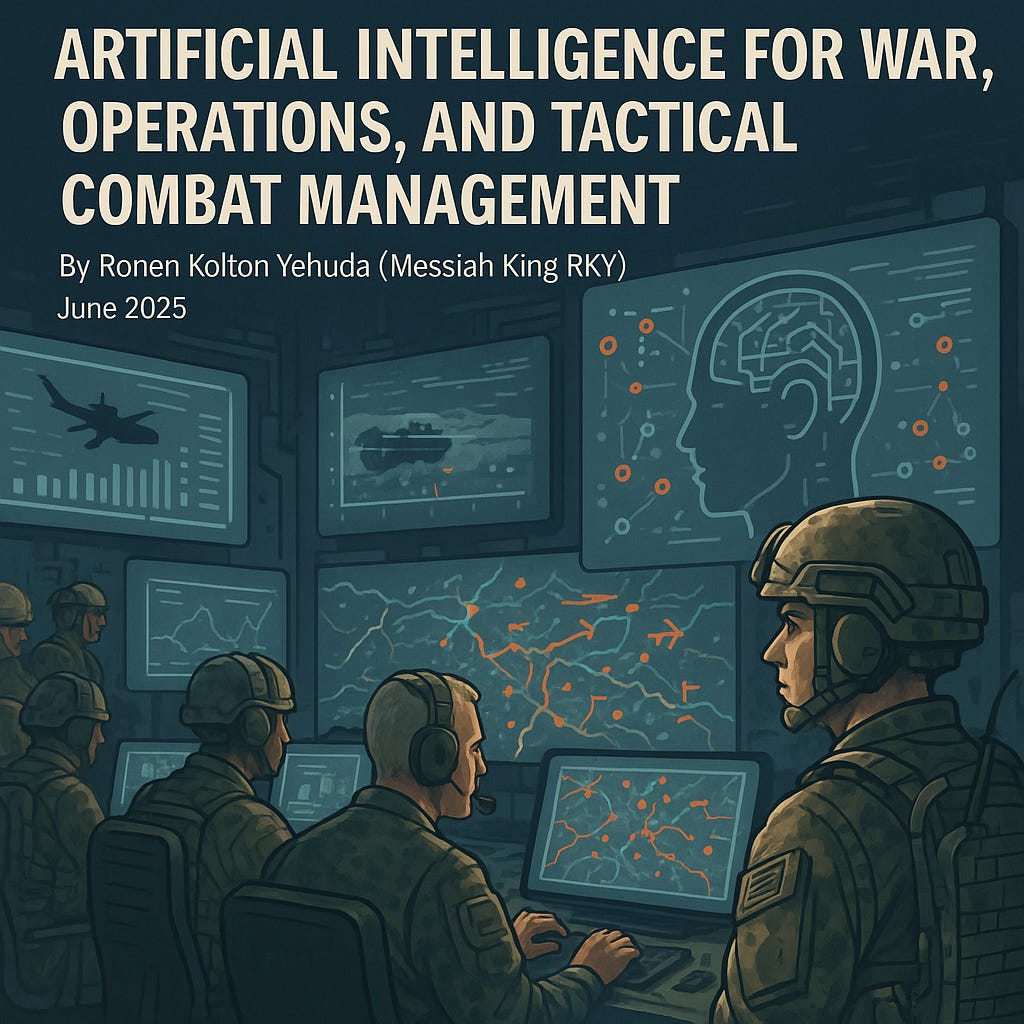
Artificial Intelligence for War, Operations, and Tactical Combat Management
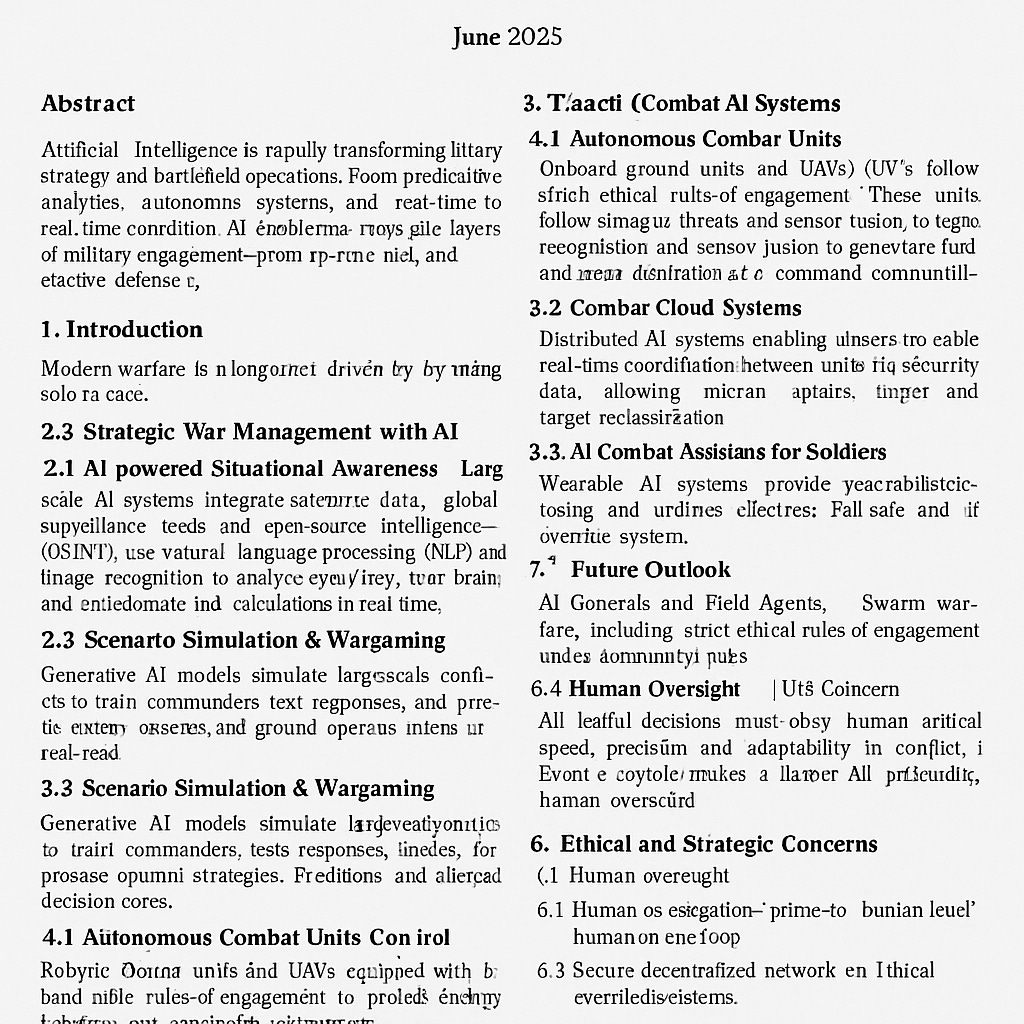
Abstract
Artificial Intelligence (AI) is rapidly transforming the landscape of military strategy and battlefield operations. From predictive analytics and autonomous systems to real-time decision-making and multi-domain coordination, AI enables more agile, precise, and adaptive warfare. This article presents a structured framework for applying AI across three tiers of military engagement: strategic war management, operational command, and tactical combat. It also outlines key capabilities, system requirements, ethical concerns, and the future of AI-driven defense ecosystems.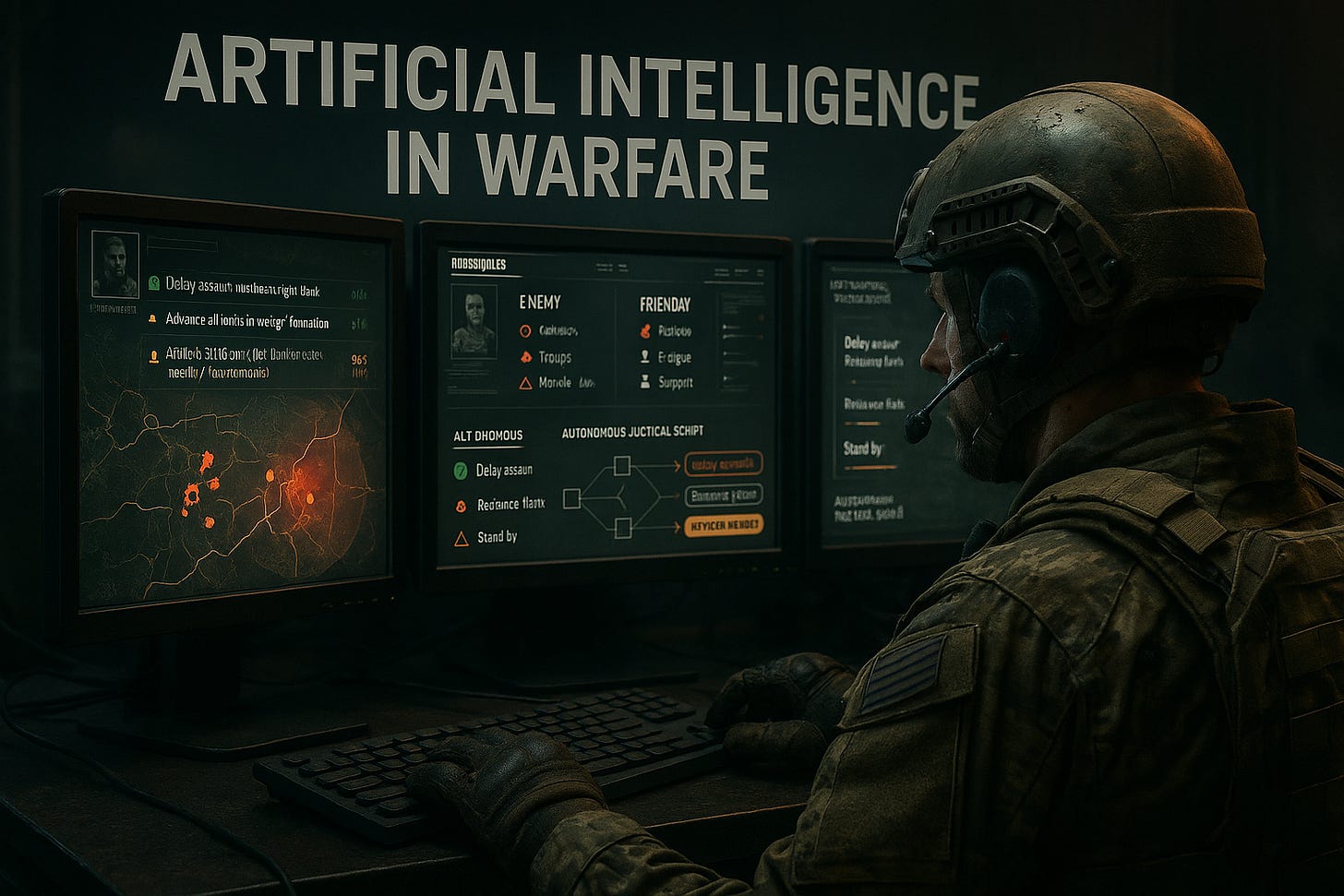
1. Introduction
Modern warfare is no longer driven solely by manpower, firepower, or geography—but by data, speed, and intelligent systems. Nations today face not just symmetric conflicts but hybrid warfare, cyberattacks, and autonomous threats. Artificial Intelligence is becoming a critical enabler for defense forces to gain superiority across land, sea, air, space, and cyberspace.
To maximize its impact, AI must be deployed across all layers of military operations—from top-level war management and strategic coordination to real-time battlefield support and autonomous response units.
2. Strategic War Management with AI
2.1 AI-Powered Situational Awareness
Large-scale AI systems integrate satellite data, global surveillance feeds, and open-source intelligence (OSINT) to build dynamic threat maps. These systems use natural language processing (NLP) and image recognition to analyze enemy movements, intentions, and global instability trends in real time.
2.2 Multi-Domain Operational Synchronization
AI acts as a strategic “war brain,” aligning naval fleets, air units, cyber defenses, and ground operations under a single command interface. Reinforcement learning can optimize resource distribution, logistics chains, and mission simulations to maximize readiness across scenarios.
2.3 Scenario Simulation & Wargaming
Generative AI models simulate large-scale conflicts to train commanders, test responses, and predict enemy behavior. These models factor in historical data, current geopolitics, and probabilistic risk calculations to propose optimal strategies.
3. Operational-Level AI for Missions and Campaigns
3.1 Autonomous Mission Planning
AI agents analyze terrain, enemy positioning, and environmental conditions to generate full campaign plans. These include timing, supply lines, air cover coordination, and fallback protocols.
3.2 Combat Cloud Systems
Distributed AI systems enable real-time coordination between units via a secure “combat cloud.” It connects drones, tanks, aircraft, and command units through encrypted data, allowing for instant mission updates and target reclassification.
3.3 Predictive Maintenance & Logistics
Machine learning models monitor vehicle and weapon system health, forecasting failures and optimizing repair schedules. This reduces downtime and ensures operational continuity during extended campaigns.
4. Tactical Combat AI Systems
4.1 Autonomous Combat Units
Robotic ground units and UAVs (unmanned aerial vehicles) equipped with onboard AI can engage in autonomous patrols, target neutralization, and area denial missions. These units follow strict ethical rules-of-engagement encoded into their control systems.
4.2 Smart Targeting and Fire Control
AI-driven targeting systems use image recognition and sensor fusion to lock onto enemy assets with precision. They adjust for wind, movement, and distance in real-time, increasing effectiveness and reducing collateral damage.
4.3 AI Combat Assistants for Soldiers
Wearable AI systems provide individual soldiers with real-time battlefield data: enemy location, cover suggestions, injury detection, and command communication. Combined with AR (augmented reality) visors, they enhance battlefield awareness.
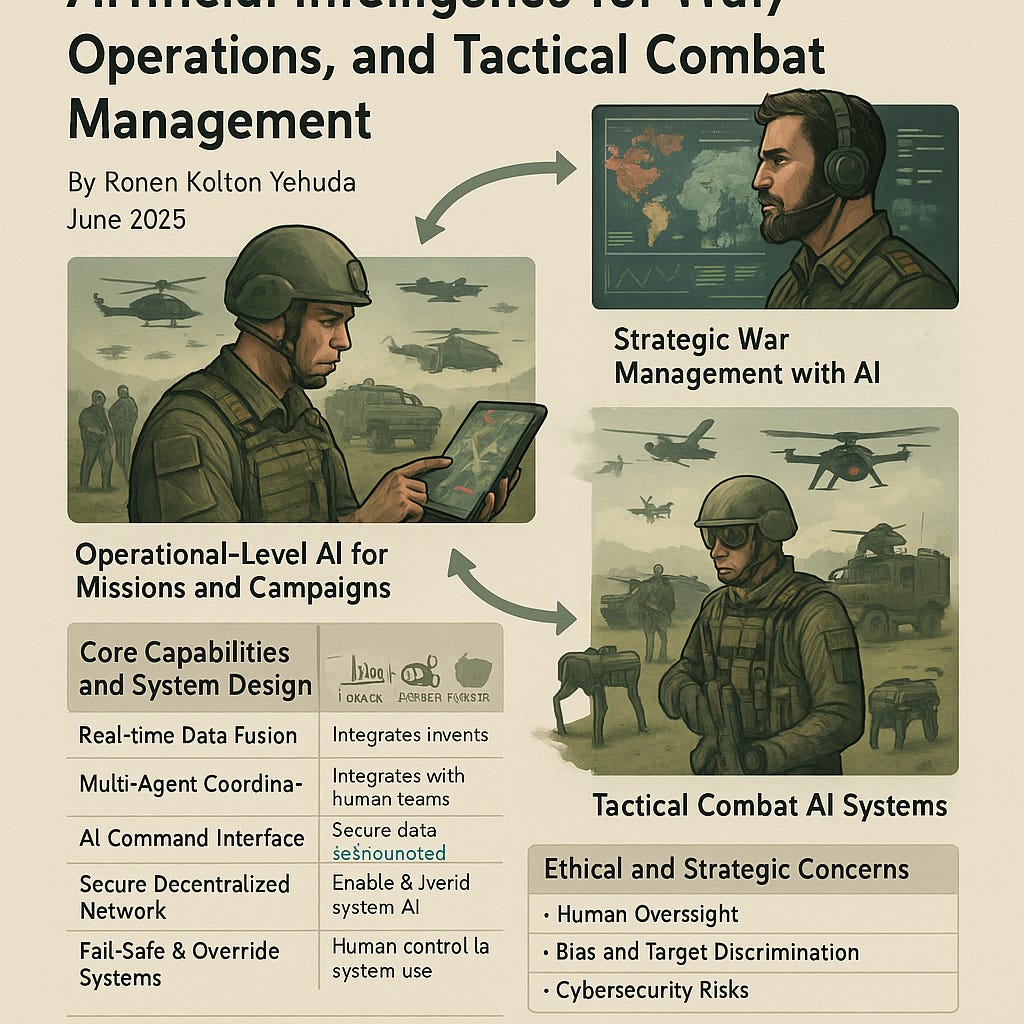
5. Core Capabilities and System Design
| Capability | Description |
|---|---|
| Real-time Data Fusion | Integrates intelligence from sensors, satellites, and units. |
| Multi-Agent Coordination | Synchronizes autonomous units and human teams. |
| AI Command Interface | Visual dashboards + voice command for commanders. |
| Secure Decentralized Network | Enables combat cloud and field AI redundancy. |
| Fail-Safe & Override Systems | Human control retained for every AI action. |
6. Ethical and Strategic Concerns
6.1 Human Oversight
All lethal decisions must retain human authorization. Autonomous systems must include “human-in-the-loop” or “human-on-the-loop” control logic.
6.2 Bias and Target Discrimination
AI systems must undergo rigorous testing to avoid misclassification of civilians, medical personnel, or surrendered units.
6.3 Cybersecurity Risks
Combat AI systems are high-value cyber targets. Quantum-resilient encryption and air-gapped decision cores are essential.
7. Future Outlook
-
AI Generals and Field Agents: AI may evolve to serve as mission commanders or autonomous patrol agents with self-learning capabilities.
-
Swarm Warfare: Hundreds of coordinated drones operating as a single tactical unit.
-
Space-Based AI Defense Systems: Satellite-based AI managing orbital surveillance, missile interception, and communication jamming.
-
AI-Ethics Councils in Defense Ministries: Oversight bodies guiding lawful and moral use of AI in warfare.
Conclusion
Artificial Intelligence is not just a tool for war—it is a transformation of war itself. Properly designed, AI systems offer unmatched speed, precision, and adaptability in conflict. From strategic planning to frontline engagement, AI-integrated defense systems will define 21st-century military superiority. However, the integration of such systems must be accompanied by robust oversight, clear ethical boundaries, and international dialogue on responsible use.
🧠 Artificial Intelligence in War: Technical Framework for Strategic Operations, Game Logic, and Ethical Command Execution
By Ronen Kolton Yehuda (Messiah King RKY), June 2025
Abstract
This article introduces a technical model for integrating Artificial Intelligence into war, combat operations, and battlefield command systems. It details the use of game logic (logia) for strategic decision-making, capacity modeling for both enemy and user forces, automated script generation for unit actions, and ethical constraints on AI behavior. It offers a programmable framework where military simulations, real-time data fusion, and ethical overlays converge to support decision superiority without undermining human oversight or international law.
1. Introduction: AI as Commander’s Mind Extension
Modern conflicts are shaped by speed, complexity, and data overload. Human commanders face cognitive saturation under battlefield pressure. Artificial Intelligence (AI), if properly structured, can simulate outcomes, optimize logistics, and command forces in real-time.
This article proposes a logic-driven, ethical AI command assistant that understands:
-
Game theory and battle dynamics
-
Opponent and user capacity and intent
-
Real-time terrain, supply, and morale fluctuations
-
Human oversight, civilian safety, and legal frameworks
2. Game Logia: Modeling Conflict as Dynamic Strategy Graph
A military encounter is not random—it is structured by predictable patterns. Game Logia refers to AI's use of game theory + combat simulation to plan, test, and script each potential outcome.
Core Elements:
-
Turn-based or real-time simulation models
-
Graph nodes = terrain, units, assets
-
Edge weights = cost, time, exposure, probability of success
-
AI agents play both friendly and enemy roles
Algorithms:
-
Monte Carlo Tree Search (MCTS) for probabilistic prediction
-
Minimax with Alpha-Beta Pruning for adversarial decisions
-
Reinforcement Learning with dynamic feedback for adaptive strategy
3. Capacity Modeling: Know Thy Enemy, Know Thyself
3.1 Enemy Capacity Inference
Using ISR (Intelligence, Surveillance, Reconnaissance), AI creates probabilistic models of enemy:
-
Manpower & morale
-
Firepower, logistics, fuel, comms
-
Behavioral patterns from prior operations
-
Weakness exposure under pressure
3.2 User (Friendly) Capacity Mapping
AI dynamically maps user assets across:
-
Ground, air, naval units
-
Command latency (human delay vs. AI speed)
-
Ammo, fuel, terrain interaction
-
Civilian and ally presence
-
Sensor range and jamming levels
4. Script Development Engine: Automating Tactical Moves
AI builds pre-trained tactical scripts for:
-
Infantry movement & flanking
-
Artillery timing and angles
-
Air-ground coordination
-
Cyber and signal warfare
-
Evacuation and casualty management
Scripts are dynamically activated or paused by higher-level mission plans.
Example:
{
5. Operational Suggestions Engine: Commander's AI Advisor
AI doesn't just execute—it recommends and justifies:
-
Best course of action (BCA) ranked by success probability
-
Alternate mission plans (fail-soft logic)
-
Alert on oversaturation or hidden traps
-
Suggest pauses or retreats based on morale/stress index
-
Recommend humanitarian corridors or civilian avoidance zones
6. Ethical and Legal Constraints Engine
AI must obey Rules of Engagement (RoE), International Humanitarian Law, and internal ethics logic:
Techniques:
-
Geofenced No-Kill Zones
-
Civilian ID via facial/object recognition
-
Probabilistic Harm Avoidance Algorithms
-
Explainable AI: All decisions must be audit-traceable
-
Red Line Watchdog AI that vetoes illegal/immoral actions
7. Core System Architecture
| Module | Description |
|---|---|
| Data Fusion Layer | Integrates ISR, satellites, unit telemetry |
| Game Logia Engine | Runs tactical/strategic simulations |
| Capacity Estimator | Tracks own/enemy strength |
| Script Generator | Issues movement/fire/control scripts |
| Ethics Monitor | Enforces laws, human override |
| Operator Dashboard | Human-in-the-loop interface with veto rights |
8. Deployment Scenarios
| Use Case | Description |
|---|---|
| Urban Combat AI | Helps avoid collateral damage in city fighting |
| Border Defense | Predictive AI screens for enemy buildup or probe |
| Cyber-War Companion | Detects enemy signal intrusion, automates counter-signal |
| Peacekeeping Mode | Suggests non-lethal options, de-escalation paths |
| Drone Swarm Orchestration | Multi-agent control with rules of discrimination |
9. Future Considerations
-
AI Negotiator Modules for preemptive deconfliction
-
Decentralized battlefield logic nodes for low-latency edge decision-making
-
Psychological modeling: predict opponent fear, anger, fatigue
-
AI Transparency Act: required real-time ethical reporting of AI decisions
-
Simulated war-games sandbox for live AI training (real and synthetic data)
10. Conclusion
AI in warfare must not just optimize destruction—it must optimize decision-making and minimize suffering. With proper architecture, ethics enforcement, and human command integration, AI becomes a new lens for clarity, not a weapon of chaos.
The future of AI-commanded war is not about machines replacing humans—but about giving humans the clarity and capability to preserve strategy, legality, and morality on the battlefield.
Keywords
AI warfare, game theory, autonomous combat systems, capacity modeling, AI scripts, battlefield ethics, human-AI collaboration, intelligent operations, red line AI, military decision systems
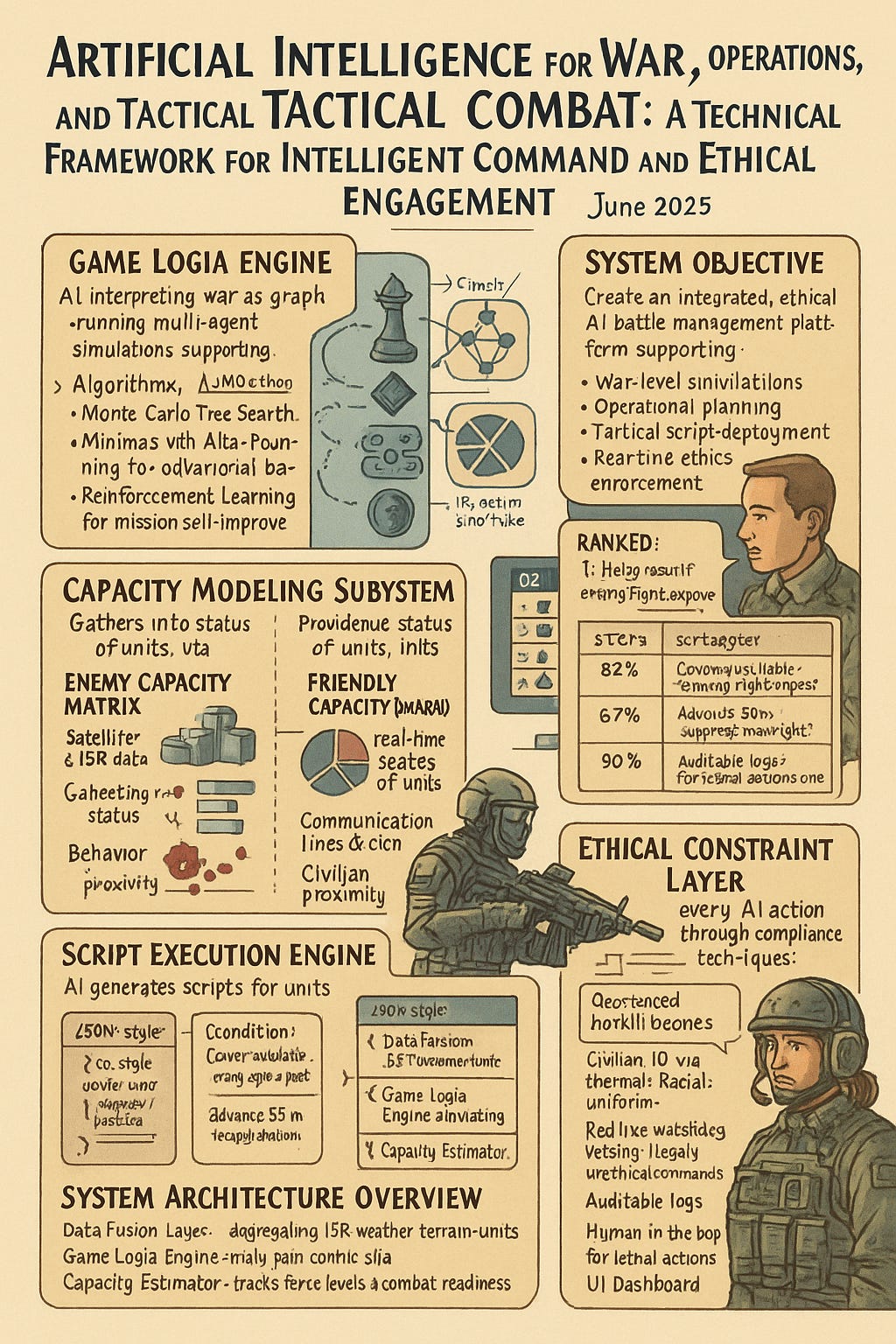
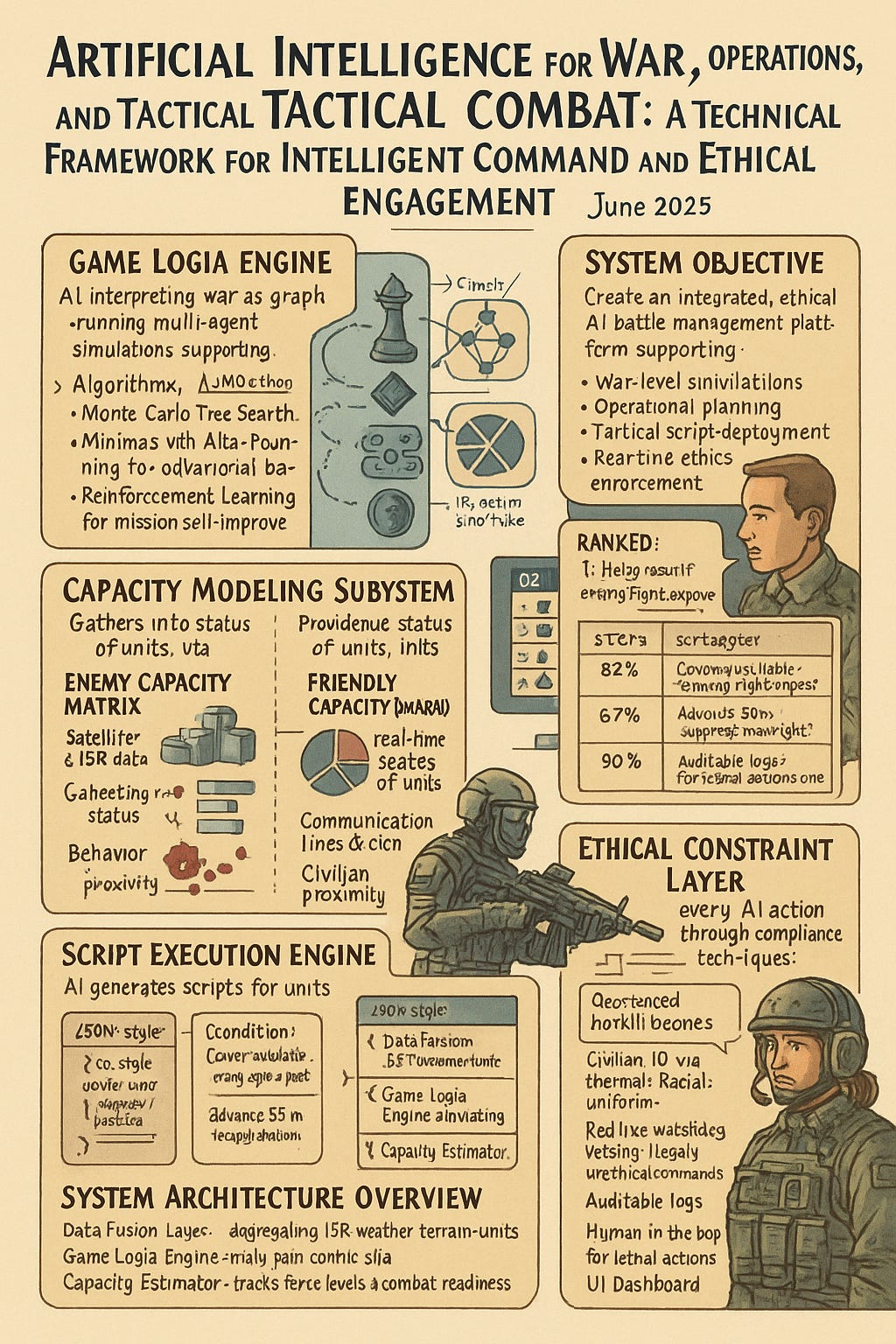
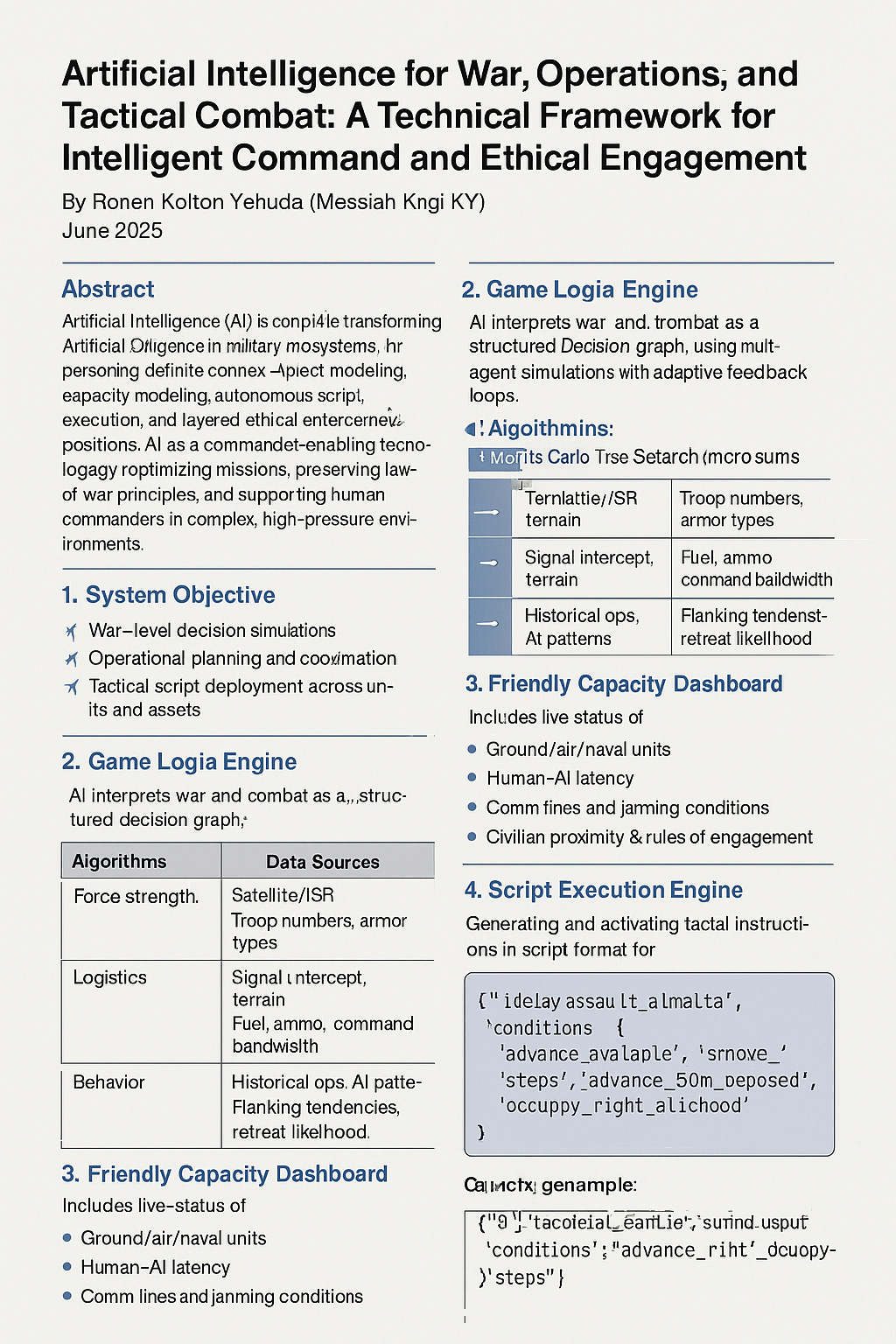
Artificial Intelligence for War, Operations, and Tactical Combat: A Technical Framework for Intelligent Command and Ethical Engagement
By Ronen Kolton Yehuda (Messiah King RKY), June 2025
Abstract
This article defines a complete technical architecture for Artificial Intelligence (AI) in military systems. It introduces frameworks for strategic, operational, and tactical deployment using game-theoretic logic, capacity modeling, autonomous script execution, and layered ethical enforcement. AI is positioned as a command-enabling technology—capable of optimizing missions, preserving law-of-war principles, and supporting human commanders in complex, high-pressure environments.
1. System Objective
To create an integrated, ethical AI battle management platform that supports:
-
War-level decision simulations
-
Operational planning and coordination
-
Tactical script deployment across units and assets
-
Real-time ethics enforcement and human-in-the-loop control
2. Game Logia Engine
AI interprets war and combat as a structured decision graph. The engine uses multi-agent simulations with adaptive feedback loops.
Algorithms:
| Method | Purpose |
|---|---|
| Monte Carlo Tree Search (MCTS) | Simulates probabilistic future scenarios |
| Minimax with Alpha-Beta Pruning | Enemy/friendly adversarial planning |
| Reinforcement Learning (RL) | Self-learning mission improvement from past data |
Simulation Inputs:
-
Terrain graphs (static and dynamic)
-
Unit behavior models
-
Supply/resource flow constraints
-
Morale and stress vectors
-
Historical patterns and real-time ISR data
3. Capacity Modeling Subsystem
3.1 Enemy Capacity Matrix
| Component | Data Sources | Evaluation Metrics |
|---|---|---|
| Force strength | Satellite/ISR | Troop numbers, armor types |
| Logistics | Signal intercept, terrain | Fuel, ammo, command bandwidth |
| Behavior | Historical ops, AI patterns | Flanking tendencies, retreat likelihood |
3.2 Friendly Capacity Dashboard
Includes live status of:
-
Ground/air/naval units
-
Human-AI latency
-
Comm lines and jamming conditions
-
Civilian proximity & rules of engagement
4. Script Execution Engine
AI generates and activates tactical instructions in script format for autonomous or semi-autonomous units.
Script Example (JSON-style):
{
Scripts are chosen by likelihood of mission success, ethical viability, and commander override settings.
5. Operational Suggestion Engine
Provides commanders with ranked, explainable choices:
| Rank | Action | Success (%) | Collateral Risk | Ethical Clearance |
|---|---|---|---|---|
| 1 | "Delay assault, reinforce right flank" | 82% | Low | ✅ |
| 2 | "Advance all units in wedge formation" | 67% | Medium | ✅ |
| 3 | "Artillery strike on ridge (civilian zone nearby)" | 90% | High | ⚠️ Review Needed |
Includes mission branching options, fallback plans, and stress-aware pause logic.
6. Ethical Constraint Layer
Each AI action must pass through a compliance filter:
Techniques:
-
Geo-fenced No-Kill Zones
-
Civilian ID via thermal, facial, and uniform detection
-
Red Line AI watchdog: vetoes illegal/unethical commands
-
Auditable logs: all decisions are stored with rationale
-
Human-in-the-loop (HITL) required for lethal actions
7. System Architecture Overview
| Module | Function |
|---|---|
| Data Fusion Layer | Aggregates ISR, weather, terrain, units |
| Game Logia Engine | Multi-path conflict simulation |
| Capacity Estimator | Tracks force levels and combat readiness |
| Script Executor | Translates strategy into battlefield actions |
| Ethics Filter | Screens commands through law and policy layers |
| UI Dashboard | Human interface with override and live feed |
Network:
-
Distributed edge-AI nodes (low-latency local decision)
-
Quantum-resistant encryption
-
Redundant fail-safes and autonomous fallback plans
8. Deployment Formats
| Use Case | Platform Type | Energy Source | Example Missions |
|---|---|---|---|
| Mobile Operations | Rugged AI Kit | Battery/Solar | Border monitoring, urban patrol |
| HQ Systems | Command Core | Grid/Microgrid | Campaign planning, wargaming |
| Drone Swarms | Onboard AI | Fuel-cell | Recon, strike, supply drop |
| Peacekeeping | Soft AI Layer | Grid/Drone | Civilian tracking, de-escalation AI |
9. Technical Considerations
-
Latency Tolerance: Max 300ms command loop delay for frontline AI
-
Sensor Fusion: Minimum 3 modalities (e.g., LiDAR, EO/IR, acoustic)
-
Hardware Redundancy: Dual-processor failover in every edge node
-
Communication Protocols: Low-SWaP mesh with dynamic rerouting under jamming
-
Sim Sandbox: Training environment using synthetic + real data (GAN-simulated units)
10. Future Evolution
-
AI Negotiator Modules: Handle early conflict warnings diplomatically
-
Psychological Warfare AI: Predict enemy morale breakpoints
-
Transparent AI Standards: Require AI audit visibility during international review
-
Sim2Real AI Transfer: Model battlefield behavior in simulation before deployment
Conclusion
The proposed AI system offers a military-grade framework balancing power and restraint. It merges predictive logic, real-time execution, and programmable ethics. Future battlefields will not just be fought with firepower—but with algorithms, moral codes, and intelligent restraint.
AI is not meant to replace human commanders. It is meant to strengthen their clarity, reduce human error, and preserve humanity in the darkest moments of war.
Would you like this packaged as a PDF or formatted for presentation/pitch decks?
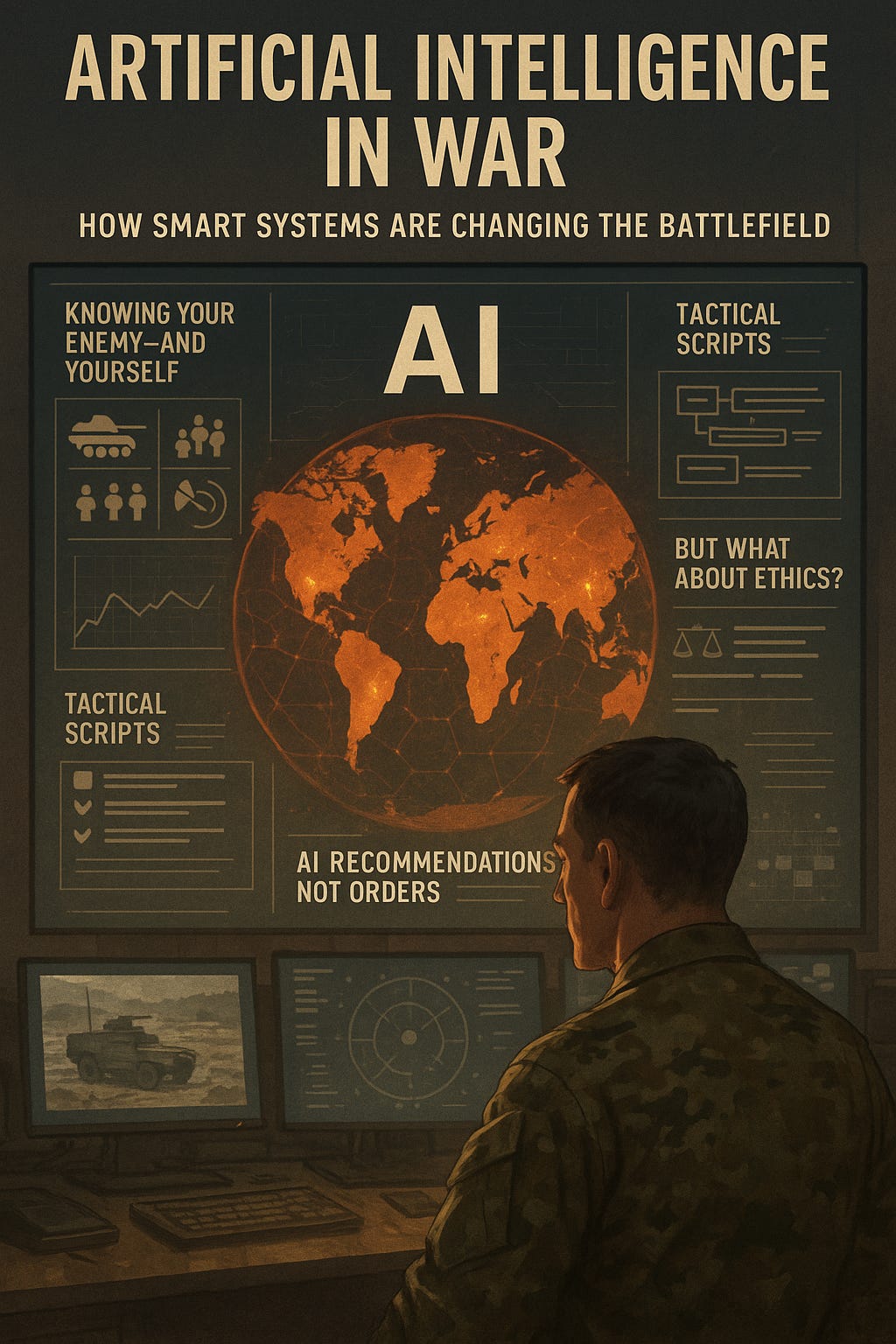
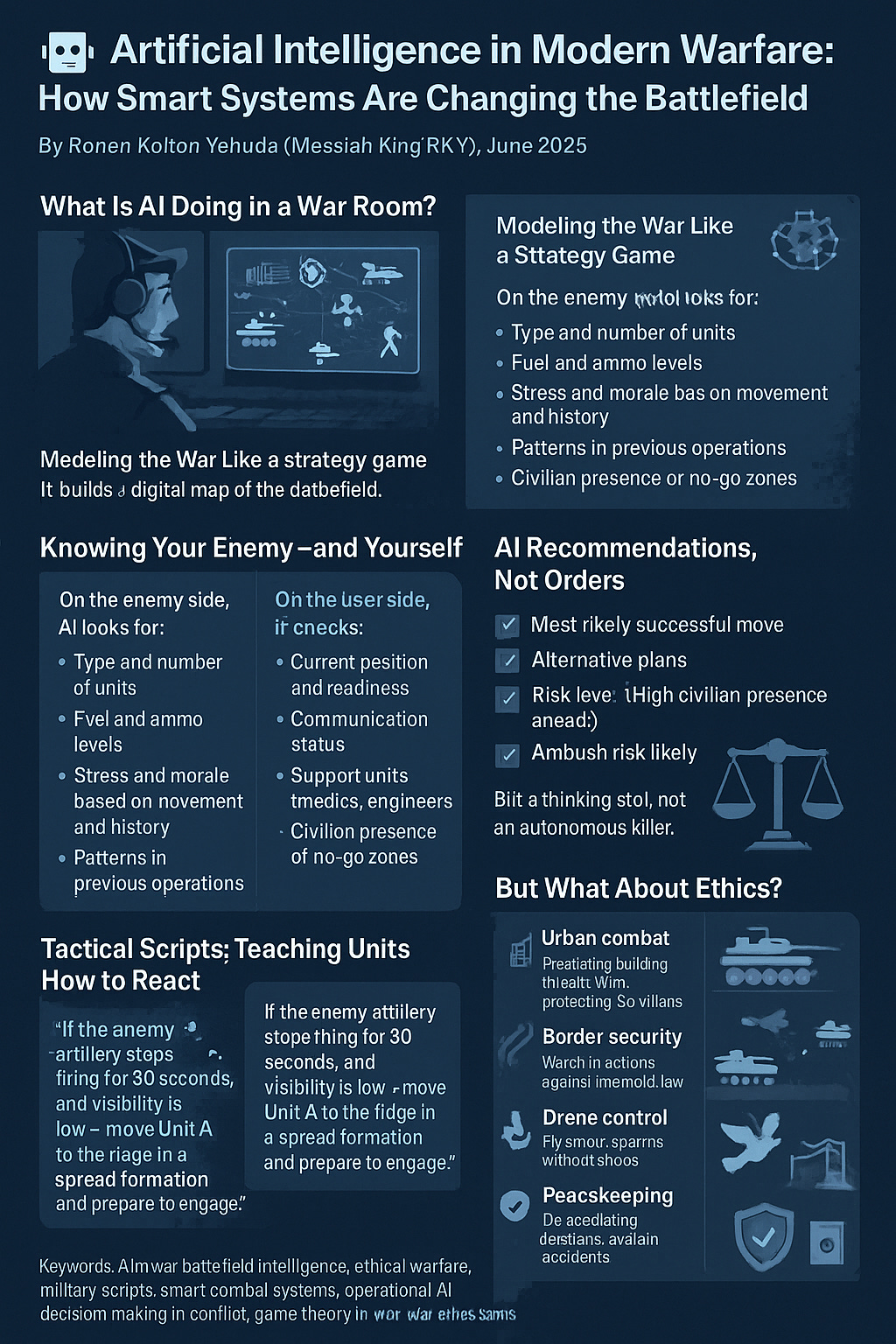
🤖 Artificial Intelligence in Modern Warfare: How Smart Systems Are Changing the Battlefield
By Ronen Kolton Yehuda (Messiah King RKY), June 2025
In the past, wars were won by numbers, weapons, or sheer force. But in today’s world, data and decision speed are just as powerful. Welcome to a new era: Artificial Intelligence (AI) in warfare—not as a killer robot, but as a silent commander, strategist, and analyst behind the scenes.
This article explores how AI is used to manage war, operations, and battle scenarios—with focus on understanding both enemy and friendly capabilities, writing automatic tactical scripts, and making war more ethical, not just efficient.
What Is AI Doing in a War Room?
Imagine a commander who can instantly:
Read thousands of drone feeds
Predict what the enemy will do next
Suggest the best way to defend or strike
Track where every unit is—and how tired they are
Recommend avoiding civilian areas in real time
That’s what military AI systems are being built to do. Not to replace humans, but to help them think faster, plan smarter, and act with precision and care.
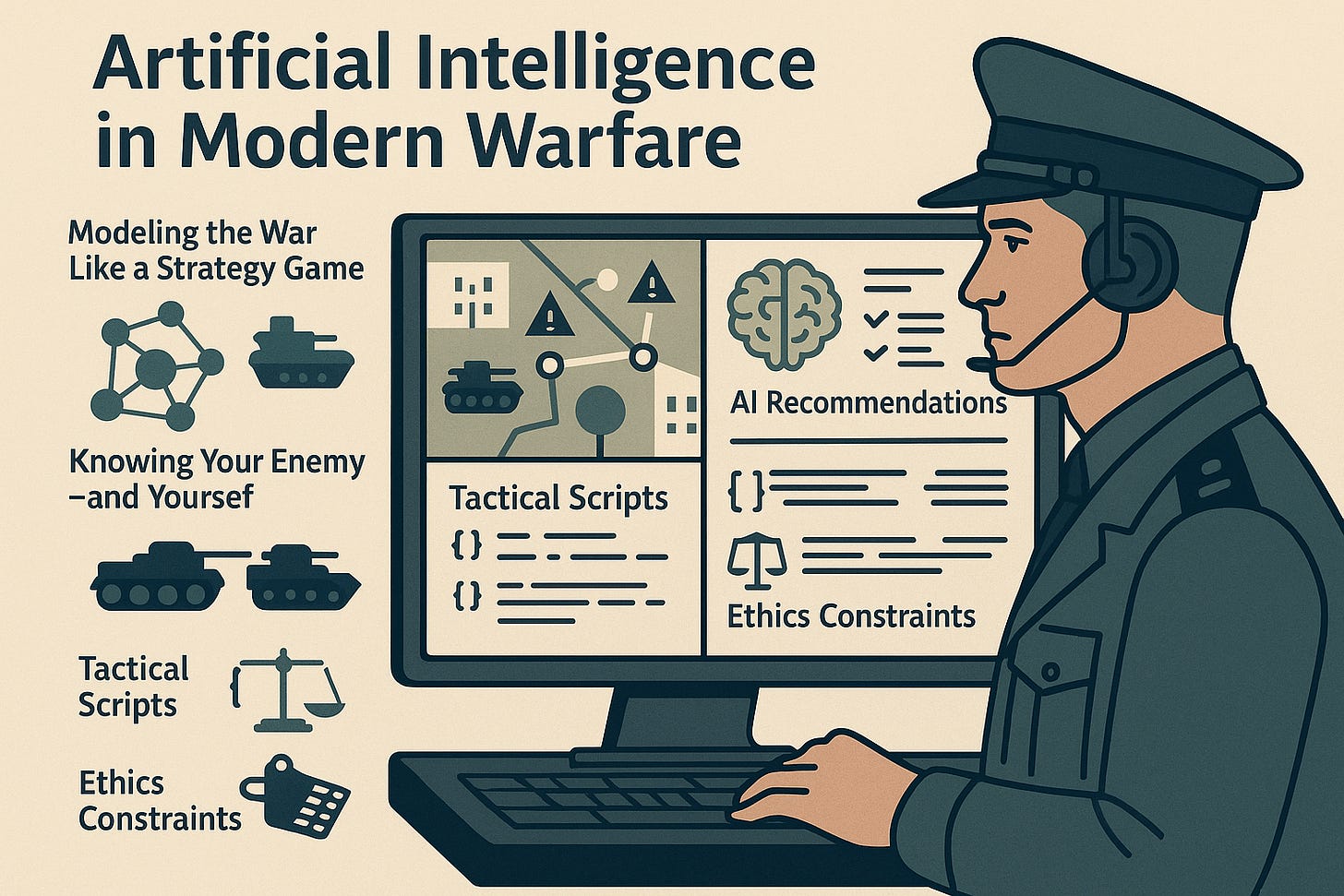
Modeling the War Like a Strategy Game
AI treats war like a complex strategy game—what experts call “game logic” or game theory. It builds a huge digital map of the battlefield, with every unit, drone, tank, and hilltop represented as a node in a network.
From there, it runs millions of simulations—trying every possible move, counter-move, ambush, and retreat. Based on the results, it recommends a plan: not just what to do, but why it’s likely to work.
This is especially useful in urban zones, where every building could hide a civilian, a sniper, or both.
Knowing Your Enemy—and Yourself
Before any decision, AI systems try to estimate who has the advantage.
On the enemy side, AI looks for:
Type and number of units
Fuel and ammo levels
Stress and morale based on movement and history
Patterns in previous operations
On the user side, it checks:
Current position and readiness of troops
Communication status
Support units like medics or engineers
Civilian presence or no-go zones
All of this is updated constantly—so the AI always sees the live picture.
Tactical Scripts: Teaching Units How to React
One of AI’s most powerful tools is scripting. These are small programs that tell units what to do in certain situations.
For example:
“If the enemy artillery stops firing for 30 seconds, and visibility is low—move Unit A to the ridge in a spread formation and prepare to engage.”
These scripts help soldiers, tanks, and drones act automatically but intelligently, based on what the AI sees. It’s like giving every squad their own digital coach, tuned to the mission.
AI Recommendations, Not Orders
Importantly, AI doesn’t force decisions—it suggests options. Commanders can see:
The most likely successful move
Alternative plans
Risk level (e.g., “High civilian presence ahead” or “Ambush risk likely”)
Even suggestions to pause, retreat, or negotiate
It’s a thinking tool, not an autonomous killer.
But What About Ethics?
AI in war is powerful—but also dangerous if not controlled properly. That’s why modern systems include built-in ethics modules, such as:
Avoiding civilian zones automatically
Refusing actions that go against international law
Recognizing surrender signals
Always allowing human override or review
Logging all actions for later accountability
This ensures that the technology supports humanitarian values, even during conflict.
Where This AI Can Be Used
The potential is huge:
Urban combat: Predict building threats while protecting civilians
Border security: Watch for enemy buildup or illegal activity
Drone control: Fly smart swarms without chaos
Peacekeeping: De-escalate tensions, avoid accidents
Cyber defense: Respond to digital attacks in seconds
Disaster response zones: Use the same tech for evacuation and aid missions
The Future: Smarter Wars or No Wars?
AI could also simulate entire wars before they happen, allowing diplomacy to act before blood is shed. It may also support peacekeeping by showing both sides what will happen if they choose to fight.
At its best, military AI is not a weapon—it’s a tool to help avoid destruction, make better decisions, and save lives.
Final Thoughts
The future of warfare won’t be about more missiles—it will be about more intelligence, more ethics, and more precision. AI gives commanders the ability to manage complexity, respond faster, and even reduce unnecessary harm.
But it must be built with care. In war, intelligence without morality is just destruction faster. With proper design, AI can become the brain of modern defense—without losing the heart.
Keywords
AI in war, battlefield intelligence, ethical warfare, military scripts, smart combat systems, operational AI, decision-making in conflict, game theory in war, war ethics, AI command systems
Artificial Intelligence for War, Operations, and Tactical Combat Management
1. Introduction
Modern warfare is no longer driven solely by manpower, firepower, or geography—but by data, speed, and intelligent systems. Nations today face not just symmetric conflicts but hybrid warfare, cyberattacks, and autonomous threats. Artificial Intelligence is becoming a critical enabler for defense forces to gain superiority across land, sea, air, space, and cyberspace.
To maximize its impact, AI must be deployed across all layers of military operations—from top-level war management and strategic coordination to real-time battlefield support and autonomous response units.
2. Strategic War Management with AI
3. Operational-Level AI for Missions and Campaigns
4. Tactical Combat AI Systems
5. Core Capabilities and System Design
| Capability | Description |
|---|---|
| Real-time Data Fusion | Integrates intelligence from sensors, satellites, and units. |
| Multi-Agent Coordination | Synchronizes autonomous units and human teams. |
| AI Command Interface | Visual dashboards + voice command for commanders. |
| Secure Decentralized Network | Enables combat cloud and field AI redundancy. |
| Fail-Safe & Override Systems | Human control retained for every AI action. |
6. Ethical and Strategic Concerns
7. Future Outlook
-
AI Generals and Field Agents: AI may evolve to serve as mission commanders or autonomous patrol agents with self-learning capabilities.
-
Swarm Warfare: Hundreds of coordinated drones operating as a single tactical unit.
-
Space-Based AI Defense Systems: Satellite-based AI managing orbital surveillance, missile interception, and communication jamming.
-
AI-Ethics Councils in Defense Ministries: Oversight bodies guiding lawful and moral use of AI in warfare.
Conclusion
Artificial Intelligence is not just a tool for war—it is a transformation of war itself. Properly designed, AI systems offer unmatched speed, precision, and adaptability in conflict. From strategic planning to frontline engagement, AI-integrated defense systems will define 21st-century military superiority. However, the integration of such systems must be accompanied by robust oversight, clear ethical boundaries, and international dialogue on responsible use.
⚖️ Legal Statement — Intellectual Property & Collaboration
Artificial Intelligence for War, Operations, and Tactical Combat Management
By Ronen Kolton Yehuda (MKR: Messiah King RKY)
June 2025
© 2025 Ronen Kolton Yehuda. All rights reserved.
This publication and all ideas, frameworks, terminology, and system models described herein constitute original intellectual property authored by Ronen Kolton Yehuda (MKR: Messiah King RKY).
It is protected under international copyright, intellectual property, and moral rights law.
Use of this material — in full or in part — including quotations, translations, republications, or derivative applications, is strictly limited to educational, non-commercial, and analytical citation with clear and full attribution to the Author.
No reproduction, distribution, adaptation, or commercialization is permitted without the explicit written authorization of the Author.
Unauthorized use, publication, or derivative exploitation of this material, including AI or algorithmic incorporation, shall constitute a violation of intellectual property rights and may result in legal action.
Collaboration & Licensing:
Partnerships, co-authorships, or institutional collaborations must be formally approved by the Author through a written IP agreement specifying ownership, attribution, and ethical compliance terms.
All collaborative projects must recognize the Author’s primary and sovereign authorship of the original concept, structure, and logic of this work.
Ethical & Legal Responsibility:
This work includes discussion of defense and dual-use technologies.
Any further development or implementation of its concepts must comply fully with international humanitarian law, export control regulations, and ethical use standards.
For licensing, permissions, or official collaboration proposals, please contact the Author directly via verified channels.
Authored by: Ronen Kolton Yehuda (MKR: Messiah King RKY)
Check out my blogs:
Substack: ronenkoltonyehuda.substack.com
Blogger: ronenkoltonyehuda.blogspot.com
Medium: medium.com/@ronenkoltonyehuda
Check out my blogs:
Substack: ronenkoltonyehuda.substack.com
Blogger: ronenkoltonyehuda.blogspot.com
Medium: medium.com/@ronenkoltonyehuda


Comments
Post a Comment