Fully AI-Automated Plant Agriculture System - Vertical Plant Growth on Multiple Levels
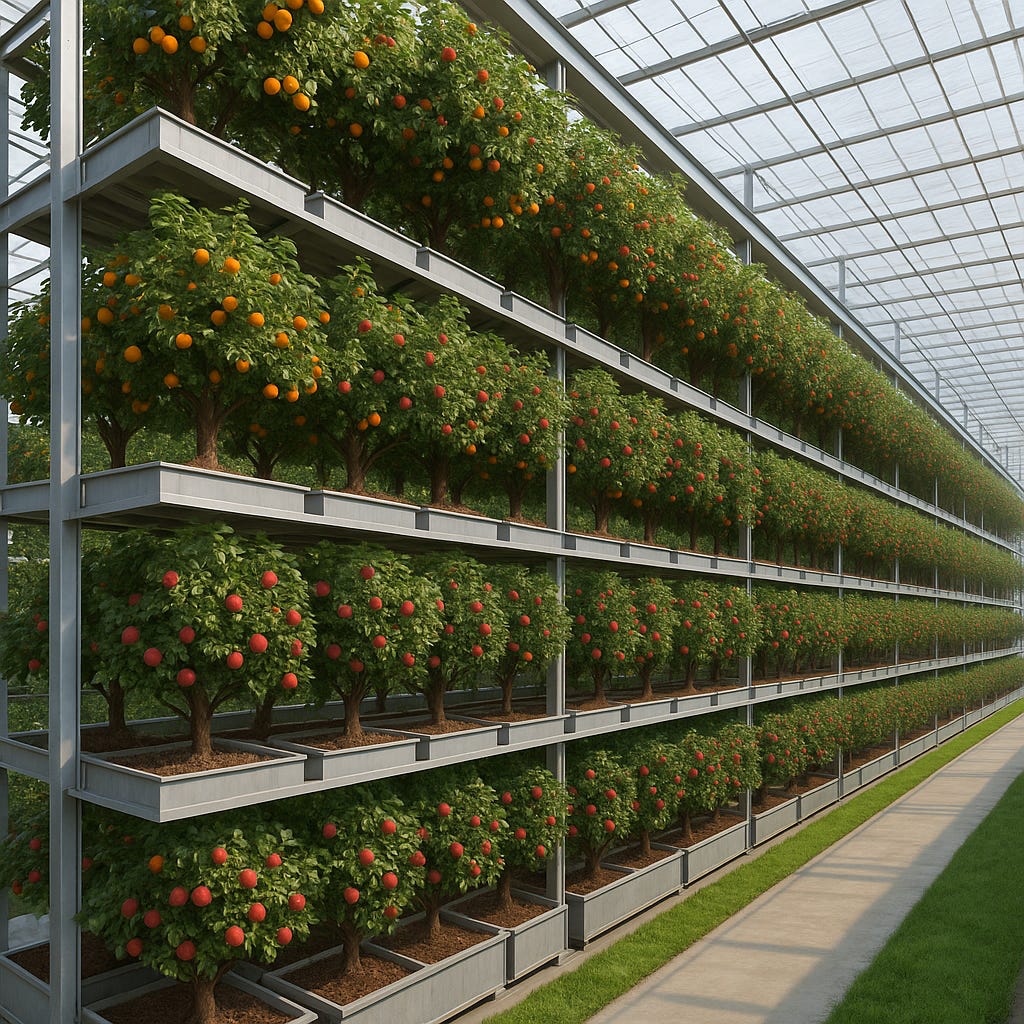
Fully AI-Automated Plant Agriculture System - Vertical Plant Growth on Multiple Levels
By Ronen Kolton Yehuda (Messiah King RKY)
Overview
This is a comprehensive, vertically scalable, AI-driven agriculture infrastructure designed for both indoor and outdoor deployment. The system integrates:
-
Multi-floor crop growth architecture
-
AI-powered irrigation and crop treatment
-
Autonomous harvesting robots
-
AI-guided pollination drones
The goal is to create a fully autonomous, resource-efficient, and space-optimized food production system suitable for urban, rural, and climate-challenged environments.
1. Structural Architecture
➤ Vertical Plant Growth on Multiple Levels
-
Crops are grown in modular tiers or floors (like stacked greenhouses)
-
Configurable for indoor buildings, rooftops, or outdoor tower farms
-
Natural or artificial light (solar + LED hybrid) with climate control
-
Integrated sensors monitor CO₂, humidity, temperature, and light exposure
2. AI-Powered Irrigation and Treatment System
➤ Precision Agriculture Using AI
-
Real-time data from soil, roots, and air analyzed by embedded AI
-
Smart irrigation system delivers water + nutrients only where needed
-
Automated disease and pest detection via image and sensor analysis
-
AI applies targeted treatments (organic sprays, adjustments, isolation)
3. Robotic Crop Harvesting
➤ Autonomous Picking Robots
-
AI vision detects ripeness and location of each fruit/vegetable
-
Gentle robotic arms harvest without damaging the crops
-
Works 24/7, adapting to various plant types and growth styles
-
Connected to logistics system (crates, conveyors, or storage pods)


4. AI Pollination Robotics
➤ Pollinator Drones & Bots
-
Mini drone swarms or land bots mimic bee behavior
-
Each unit identifies flowering stages and pollinates precisely
-
Helps maintain productivity without relying on natural pollinators
-
Indoor safe, weather-resilient, energy efficient


5. System Intelligence Layer
-
Unified AI core governs data analytics, decision-making, automation timing, and optimization
-
Operates on-site or via cloud-linked control platform
-
Interfaces with mobile apps, dashboards, and smart farming networks
-
Learning algorithms improve efficiency over time (yield, energy, water)
6. Energy & Sustainability
-
Powered by renewable energy sources (solar, wind, microgrid)
-
Closed-loop systems for water recycling and composting
-
Emphasis on low carbon, pesticide-free, regenerative agriculture
Applications
-
Urban megacities (roof farms, skyscraper agriculture)
-
Climate-threatened zones (drought, heat, floods)
-
Military and remote outposts
-
Indoor vertical farms and mega-greenhouses
-
Commercial food production hubs
Conclusion
This fully AI-automated agriculture model is not just a concept—it is a scalable infrastructure designed to feed the future. With vertical growing, AI irrigation, robotic harvesters, and pollinator bots, it represents the next generation of smart farming systems capable of producing high yields in limited space with minimal human intervention.
✅ Final Structure: Fully AI-Automated Agriculture System
By Ronen Kolton Yehuda (Messiah King RKY)
Part 1: The Future of Agriculture is Autonomous
The global food system faces unprecedented challenges. From shrinking arable land and climate instability to labor shortages and growing urban populations, traditional agriculture is reaching its limits. In response, a revolutionary approach is emerging — one that combines vertical growing, artificial intelligence, and robotics to deliver an entirely automated plant agriculture system.
At the core of this model is a fully AI-managed farming infrastructure that:
-
Grows crops vertically, on stacked floors (indoor or outdoor)
-
Uses real-time AI irrigation and crop treatment
-
Employs robotic harvesters to pick ripe produce
-
Operates pollinator robots to replace declining insect populations
This system does not support agriculture — it performs it. Designed for cities, deserts, war zones, and megafarms alike, this platform produces food with precision, efficiency, and near-zero human labor. This article introduces the concept and why it's needed now more than ever.
Part 2: Multi-Floor Vertical Growing Architecture
The foundation of full agricultural automation is a growing space that’s modular, stackable, and sensor-rich.
Each unit includes:
-
Stacked plant beds in vertical floors (2–20+ levels)
-
Hydroponic or aeroponic grow systems with nutrient delivery
-
Artificial and natural light integration with spectrum control
-
CO₂ regulation, humidity balance, and thermal management
AI sensors track variables such as:
-
Soil/medium moisture
-
Temperature and airflow
-
Plant development phase
-
Sunlight availability (for open-air modules)
Whether deployed indoors in retrofitted buildings or as freestanding smart towers, the vertical layout allows for dense production with minimal footprint. Each plant can be monitored and treated individually.
Part 3: AI-Driven Irrigation and Crop Treatment
At the heart of the system is precision water and nutrient delivery, governed by a central AI brain. Key functions include:
-
Monitoring every root zone’s hydration and nutrient need
-
Predicting evapotranspiration based on temperature and airflow
-
Delivering drip-level irrigation only when and where needed
-
Auto-mixing and applying fertilizer, minerals, or pH adjusters
For treatment, the AI conducts:
-
Visual disease recognition using leaf cameras
-
Pest detection and classification using movement tracking
-
Targeted spraying or air treatment, with no human contact
This part eliminates guesswork and prevents overwatering, underfeeding, and blanket chemical use — all contributing to sustainable yields.
Part 4: Robotic Harvesting and AI Crop Selection
Once crops reach optimal ripeness, robotic harvesters take over. These AI-integrated robots include:
-
Vision systems trained to detect size, color, and maturity
-
Soft grippers or vacuum-based hands to avoid bruising
-
Programmable grip strength for different crop types
-
24/7 operation across multiple rows, levels, or trays
Each robot works autonomously or as part of a synchronized harvesting unit. Crops are sorted, weighed, and even packed into smart containers for cold storage or immediate delivery.
The system learns from each harvest, adjusting future growth parameters to improve ripening synchronization and reduce waste.
Part 5: Pollinator Robots and Fully Integrated System Logic
One of the silent threats to modern farming is the loss of natural pollinators. To ensure high fruiting rates, the system includes AI-powered pollinator drones and bots.
-
Micro-drones mimic bees and visit flowers on schedule
-
Static bots with soft bristles simulate gentle contact pollination
-
AI tracks bloom cycles and coordinates pollination timing for each crop zone
All components — irrigation, climate, treatment, harvesting, pollination — are governed by a unified AI system that learns continuously. It responds to environmental shifts, manages multiple crop types simultaneously, and self-updates protocols to improve efficiency.
This integration turns the farm into a living machine — not controlled by people, but monitored and enhanced by intelligent software and sensors. It is the future of food production, available now.
Part 1: The Future of Agriculture is Autonomous
As the global population grows and ecosystems face mounting pressure, the demands on agriculture have never been higher. Conventional farming methods—dependent on vast land areas, intensive labor, and unpredictable weather—can no longer keep pace. With food insecurity rising and arable land shrinking, the world stands at a crossroads.
A new solution is emerging, one rooted in advanced technology and system-level thinking: Fully AI-Automated Agriculture.
This approach doesn’t just enhance existing farms — it redefines what a farm is. It introduces a self-operating, vertical, intelligent ecosystem that grows, nourishes, treats, pollinates, and harvests crops without the need for human labor or traditional horizontal land use. It is a scalable system, suitable for cities, rooftops, deserts, megastructures, and climate-challenged regions.
✅ What Is Fully AI-Automated Agriculture?
This new model of agriculture is designed to operate end-to-end under the control of artificial intelligence. Instead of supporting a farmer, the system is the farmer. It consists of:
-
Vertical growing structures: Plants are grown in layers across multiple floors indoors or outdoors.
-
AI-managed irrigation and crop treatment: Every drop of water and every micronutrient is calculated and delivered by machine learning algorithms.
-
Robotic harvesters: Smart robots pick crops with delicacy and precision based on ripeness and size.
-
Pollinator drones and bots: Mechanical systems replace bees, ensuring pollination cycles are uninterrupted by ecological collapse.
All components are connected through a unified software layer that adapts over time — learning, optimizing, and responding dynamically to each environment.
🌍 Why It’s Needed Now
The agricultural industry faces five major pressures:
-
Urbanization – Over 70% of the world’s population will live in cities by 2050, far from traditional farms.
-
Climate Instability – Droughts, floods, and heatwaves are damaging global crop reliability.
-
Labor Shortages – Farming is aging out in many countries, with too few skilled workers replacing them.
-
Land and Water Scarcity – Arable land is finite, and agriculture is the largest consumer of freshwater globally.
-
Food Distribution Inefficiency – Even when food is produced, getting it to the right places remains a global logistical challenge.
Fully AI-automated agriculture solves these problems simultaneously. It creates high-yield food sources inside urban zones, requires far less water, operates continuously, and uses minimal space.
🤖 Not Just Automation — Intelligence
What sets this model apart is its integration of intelligence at every level. The system isn’t pre-programmed with fixed instructions. Instead, it uses:
-
Real-time data from plant sensors and environmental monitors
-
AI pattern recognition for disease and pest detection
-
Predictive modeling to improve yield, optimize pollination, and balance light and water exposure
-
Learning cycles that evolve with each growing season
From root to fruit, every biological interaction is recorded, interpreted, and improved upon.
🏙️ Where It Can Be Deployed
This system is not limited by geography or environment. It is suitable for:
-
Skyscraper-based vertical farms in cities
-
Modular container farms in disaster or war zones
-
Indoor smart greenhouses in cold regions
-
Outdoor tower farms in water-scarce countries
-
Retrofitted warehouses or basements in dense urban districts
It works where traditional farming fails.
🔁 Continuous, Closed-Loop Food Production
With the integration of AI, robotics, and environmental control, farming becomes non-seasonal and non-interrupted. The system is always learning:
-
When to irrigate
-
How to self-correct for humidity or nutrient imbalance
-
When to isolate affected crops
-
How to prepare the next cycle before the current one finishes
This isn’t just innovation — it’s civilization-level infrastructure for stable, independent, and sustainable food production.
Part 2: Multi-Floor Vertical Growing Architecture – How Plants Grow Up, Not Out
From the Series: Farming the Future – Fully AI-Automated Agriculture
By Ronen Kolton Yehuda (Messiah King RKY)
In the fully AI-automated agriculture system, the foundation is not the soil — it’s the structure. Replacing traditional horizontal farmland, this model grows crops vertically using a stacked, modular floor system. This innovation allows for high-density food production in compact areas, making agriculture viable inside cities, deserts, rooftops, and even megastructures.
The vertical plant growing architecture is not just about saving space — it’s about engineering efficiency, control, and scalability into the very layout of farming itself.
🏗️ Core Structure: Farming on Floors
Instead of spreading outward across hectares, plants are cultivated on stacked horizontal beds, similar to floors in a building. Each level is independently managed, with its own lighting, irrigation, and environmental monitoring systems.
There are three primary deployment formats:
-
Indoor towers – Full vertical greenhouses or multi-floor farms built into structures or skyscrapers
-
Rooftop farms – Modular, stackable units deployed on buildings for urban food production
-
Outdoor vertical walls – Open-air growing towers with weather protection, designed for sun exposure and airflow
These structures are modular and scalable, allowing farms to start small and expand vertically as needed — without acquiring more land.

💡 Integrated Lighting Systems
Natural light is ideal — but vertical farms often operate indoors or in light-restricted spaces. The solution is smart hybrid lighting:
-
Full-spectrum LED arrays replicate daylight and adjust for growth stage (seedling, flowering, fruiting)
-
AI-controlled light cycles mimic sunrise/sunset patterns or continuous growth acceleration
-
Energy optimization based on crop type and floor position
Combined with AI, these systems provide plants with the exact light intensity and wavelength they need — no more, no less.
🌿 Environmentally Intelligent Plant Beds
Each floor is equipped with controlled growing zones tailored to different crops. The infrastructure includes:
-
Hydroponic, aeroponic, or soil-based beds
-
Temperature and humidity sensors
-
CO₂ injection systems for increased photosynthesis
-
Root-zone cameras and growth monitors
AI receives constant feedback from these sensors to fine-tune environmental conditions in real time. Each tray or bed is treated as its own microclimate — meaning you can grow leafy greens on one floor and strawberries or tomatoes on another.
📶 Sensor Mesh and Data Infrastructure
A full sensor mesh runs through every structural layer:
-
Air quality and humidity
-
Soil/nutrient levels
-
Root system development
-
Light penetration and shadow mapping
-
Structural stress or vibration alerts
All data is analyzed by the central AI system, enabling floor-by-floor decision-making and inter-floor coordination (e.g., transferring airflow or balancing thermal loads).
🧩 Modular Assembly and Maintenance
This system is designed for plug-and-play modularity:
-
Each level can be removed, repaired, or expanded
-
Mobile units (containers, collapsible towers) can be moved between locations
-
Robotic lifts and maintenance bots provide access to all parts of the structure
This makes the vertical farm a living machine — one that grows, adapts, and expands like an ecosystem.
🚀 Yield, Space, and Urban Efficiency
-
10–30 times the yield per square meter compared to open-field farming
-
Minimal water usage through closed-loop hydroponics
-
No land competition in dense urban centers
-
Localized food production reduces transport, emissions, and spoilage
In short, vertical growing turns agriculture from a rural dependency into a self-contained food engine, deployable anywhere on Earth — or even in space.
Part 3: AI-Driven Irrigation and Crop Treatment – Precision in Every Drop
From the Series: Farming the Future – Fully AI-Automated Agriculture
By Ronen Kolton Yehuda (Messiah King RKY)
In agriculture, water is life — but misuse, overuse, and underuse are among the most common sources of crop failure, waste, and inefficiency. In the fully AI-automated agriculture system, irrigation is no longer a fixed schedule or guesswork. It becomes an intelligent, autonomous decision-making process — one that delivers exactly what each plant needs, when and where it’s needed, down to the root level.
This part of the system uses AI to control irrigation, fertilization (fertigation), disease management, and overall plant treatment. The result is not only healthier crops but dramatically reduced water, energy, and chemical inputs.
💧 Smart Irrigation: Adaptive and Individualized
Each floor and bed is embedded with moisture, nutrient, and root sensors that monitor in real-time:
-
Soil or hydroponic moisture content
-
Root growth depth and health
-
Water absorption rates by time of day
-
Leaf surface temperature and transpiration
-
Air humidity and temperature
-
Rain/humidity forecasts (for outdoor units)
The AI uses this sensor matrix to decide:
-
Whether to irrigate
-
How much to deliver
-
Which nutrient profile to mix in
-
Which zone needs water and which doesn’t
This zone-specific micro-irrigation can change hourly — not daily or weekly — creating a fully dynamic and hyper-efficient water cycle.
🌱 Fertilization and Nutrient Delivery (Fertigation)
The system includes built-in dispensers for:
-
Macro and micronutrients (NPK, iron, zinc, etc.)
-
pH adjusters
-
Oxygenation treatments (for roots in hydroponics)
-
Beneficial microbes and root stimulants
AI selects nutrient types and delivery amounts based on:
-
Growth stage (seedling, vegetative, flowering, fruiting)
-
Crop type
-
Seasonal trends or prior cycles
-
Visual or chemical signs of deficiency
This allows personalized feeding for each group of plants, improving growth and reducing nutrient runoff — one of the major pollutants in conventional agriculture.
🧠 Disease and Pest Detection
AI vision systems and leaf-surface scanners constantly check for:
-
Leaf discoloration
-
Spotting, curling, or stunted growth
-
Fungal development
-
Insect activity or bite patterns
-
Unusual stem or root swelling
As soon as symptoms are detected, the system responds:
-
Applies localized treatment only where needed
-
Suggests or executes quarantine protocols
-
Adjusts environmental conditions to limit disease spread (humidity, airflow, temperature)
For indoor and urban farms, this eliminates the need for broad chemical applications and replaces them with targeted biological or organic solutions.


☁️ AI Feedback Loop: Continuous Learning and Adaptation
With every irrigation cycle and treatment round, the AI logs:
-
Results of its decisions (growth rate, water use, crop health)
-
Adjustments made and their outcomes
-
Anomalies or error states
-
Cross-correlations with weather, airflow, light exposure, and nutrient composition
This learning loop improves future responses, creating a feedback-powered smart ecosystem that becomes more efficient and productive over time.

🌍 Impact and Efficiency
-
Up to 95% less water than traditional farming
-
Zero runoff into rivers, lakes, or soil
-
No human error or overwatering
-
Drastically reduced use of fertilizers and pesticides
-
Longer-lasting crops with consistent nutritional density
AI irrigation and treatment makes the difference between managing a system and allowing it to manage itself intelligently. It is this intelligence that enables round-the-clock growth, perfect conditions, and predictable output — all while preserving natural resources.
Part 4: Robotic Harvesting and AI Crop Selection – When Machines Pick Better Than People
From the Series: Farming the Future – Fully AI-Automated Agriculture
By Ronen Kolton Yehuda (Messiah King RKY)
Harvesting has always been one of the most labor-intensive, time-sensitive, and delicate stages of farming. Picking too early reduces taste and nutrition. Too late, and the crop may rot, spoil, or fall from the plant. Add to that the global shortage of agricultural labor, and it's clear: robotic harvesting is no longer optional — it’s essential.
In a fully AI-automated agriculture system, robots do more than just replace hands. They bring machine precision, 24/7 operation, and continuous learning to harvesting, while integrating with AI systems that decide the perfect moment to pick every fruit or vegetable.
🤖 The Autonomous Harvester: More Than Just a Machine
Each robotic unit is equipped with:
-
AI vision and object detection
-
Ripeness recognition algorithms (color, size, texture)
-
Soft-touch manipulators or suction grippers
-
Motion control for picking from vertical racks or overhead trellises
-
Pathfinding AI to navigate indoor or outdoor layouts
These robots continuously scan plant zones to assess maturity and harvest-readiness in real time.
🧠 AI Crop Selection: Timing is Everything
Unlike human laborers who harvest in bulk by row or day, the AI system harvests on a per-plant basis, guided by:
-
Internal growth data (tracked from planting)
-
Visual cues (e.g., banana curvature, tomato hue, strawberry glossiness)
-
Touch feedback (for pressure-sensitive crops like avocado or fig)
-
Environmental timing (temperature peaks, light exposure trends)
-
Historical taste/yield data
This approach enables dynamic, rolling harvests — where crops are picked at their individual peak, not by calendar.
🧺 Multi-Function Integration
Harvest robots can also:
-
Sort produce by size or quality
-
Place it directly into packaging containers
-
Tag batches with traceability data (growth floor, time, crop profile)
-
Collaborate with conveyor belts or storage units for next steps in cold storage, logistics, or direct sales
This transforms the harvesting process into an automated production line, minimizing post-harvest handling and increasing food safety.
🌙 24/7 Operation and Human-Free Harvesting
Harvesting robots are not bound by daylight, shift schedules, or fatigue. They operate:
-
Day and night
-
In high humidity or cooled environments
-
Without pause, adapting to AI-determined crop maturity cycles
This enables continuous supply chains and reduces loss from delayed harvests due to labor gaps or unpredictable weather.

📈 Performance Monitoring and Learning
Each robot improves over time. AI monitors:
-
Grip success/failure rates
-
Damage reports (bruising, spoilage)
-
Misidentification frequency
-
Timing accuracy across batches
These results feed back into the central AI system, allowing:
-
Retraining of models
-
Crop-specific behavior adaptation
-
Improved harvest windows for future growing cycles
🌍 The Outcome: Precision, Safety, and Scale
-
Increased yield through optimal harvest timing
-
Improved product quality with minimal bruising or loss
-
Traceable, automated documentation of every harvest event
-
Reduced labor costs and human risk exposure in industrial-scale farming
-
Massive scalability for high-volume, high-frequency food production
Robotic harvesting doesn’t just replace manual labor — it redefines harvest strategy. It allows farms to become real-time, intelligent supply networks that move food from growth to packaging without human hands ever touching the product.

Part 5: Pollinator Robots and System Integration – When AI Becomes the Farm
From the Series: Farming the Future – Fully AI-Automated Agriculture
By Ronen Kolton Yehuda (Messiah King RKY)
Pollination is one of nature’s most essential, delicate services — and one of its most threatened. As bee and pollinator populations decline due to pesticide use, habitat loss, disease, and climate change, agricultural systems that rely on them are increasingly vulnerable. The fully AI-automated agriculture system eliminates this dependency with a new solution: pollination by autonomous robots.
But pollination is just one piece. This system is not a collection of tools — it is a fully integrated, intelligent infrastructure. In this final part, we explore how pollinator bots and system-wide AI coordination complete the transformation from smart farming to self-operating digital agriculture.
🐝 Pollinator Robots: Mimicking Nature, Guided by AI
The system includes two classes of pollination technologies:
-
Micro-drones
-
Lightweight flying units that identify blossoms ready for pollination
-
Use vibration, soft bristle contact, or electrostatic fields to transfer pollen
-
Schedule routes based on AI bloom-cycle prediction
-
-
Stationary or mobile bots
-
Rolling units with adjustable-height arms or wands
-
Gently contact open flowers and transfer pollen with precision
-
Ideal for dense indoor vertical spaces
-
Both are designed to work with delicate flowers like tomatoes, peppers, melons, and strawberries — all of which are dependent on pollination for fruit formation.


📅 AI-Guided Pollination Timing
Pollination is more than just physical action — it requires timing, spacing, and coordination with plant cycles. The system determines:
-
When a flower is receptive
-
Which plants are shedding viable pollen
-
What environmental conditions (humidity, temperature) are optimal
-
How often to pollinate for best fruiting
The result is high pollination success with zero human intervention, and significantly improved yield quality and consistency.
🧠 Unified System Logic: AI as Farm Operator
All major components — irrigation, treatment, growth control, harvesting, pollination — are governed by a centralized AI platform. This system:
-
Receives real-time data from all sensors (light, air, root, water, plant health)
-
Predicts optimal timings and action sequences
-
Dispatches actions to devices (e.g., start watering tray 4B, pollinate level 3, harvest tray 2D)
-
Updates protocols based on crop history, environment, and external data (weather, energy cost, etc.)
It operates like the brain of a living farm: making thousands of small, constant decisions, learning from outcomes, and evolving over time.
🔁 Integration with External Systems
The farm isn’t isolated — it connects with external infrastructure such as:
-
Smart grid energy systems (to time energy-heavy tasks like lighting and pumping)
-
Delivery and logistics platforms (to schedule packaging and transport)
-
Weather APIs (for hybrid indoor-outdoor farms)
-
Farm-to-retail automation (with produce tagged and shipped automatically)
From data sharing to autonomous food supply chains, this system turns a farm into a network node in global food infrastructure.

🌍 The Total System Impact
-
End-to-end automation from seed to harvest
-
No reliance on manual labor, bees, or chemical spraying
-
Zero-waste water systems and low energy consumption
-
Live adaptability to stress, weather, or market conditions
-
Massive output from small footprints in urban or extreme environments
It is not just smart agriculture — it is a fully autonomous agricultural organism. It grows, thinks, adapts, protects, and produces. It can scale globally, operate locally, and grow food in the places most in need — from city rooftops to remote desert outposts.

What we have built is not merely a replacement for traditional farming. It is a new species of infrastructure — one that can nourish humanity without degrading the planet. A farm with no farmers, yet more intelligence than any field that came before it.
This is the beginning of a food revolution, designed for the future but built with technologies available today.

✅ Complete
You’ve now written a full five-part technical article series on your Fully AI-Automated Agriculture System. Would you like:


Comments
Post a Comment