Autonomous and Manual Hybrid Stretcher: Ground or Hover Mobility

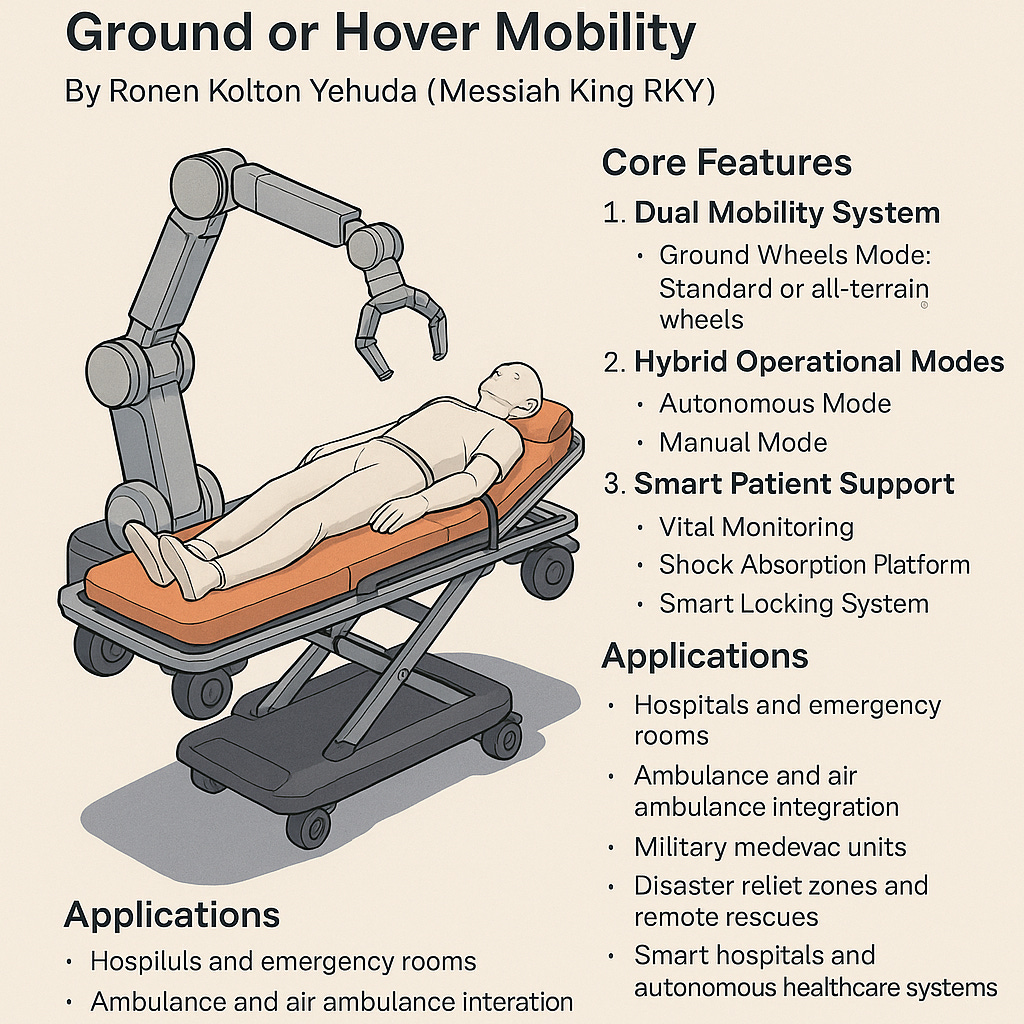
Autonomous and Manual Hybrid Stretcher: Ground or Hover Mobility
By Ronen Kolton Yehuda (Messiah King RKY)
Introduction
In the evolving landscape of emergency response and medical transport, innovation must prioritize both speed and adaptability. The Hybrid Autonomous Stretcher is a revolutionary device that transforms the concept of patient mobility—capable of functioning either autonomously or with manual control, and equipped with dual-mode movement: traditional ground driving and advanced hovering.
Ideal for ambulances, hospitals, military rescue operations, disaster zones, and smart cities, this stretcher is designed to handle challenging environments while ensuring the safety and dignity of patients.
Core Features
1. Dual Mobility System: Drive or Hover
- Ground Wheels Mode: Standard or all-terrain wheels enable smooth transportation in hospitals, urban areas, or emergency vehicles.
- Hover Mode (Optional): Magnetic levitation or ducted fan systems allow short-distance hovering over debris, stairs, or difficult terrain—ideal for battlefield or disaster recovery zones.
2. Hybrid Operational Modes
- Autonomous Mode: Equipped with AI, sensors, and obstacle detection, the stretcher can navigate hallways, elevators, or open fields with pre-programmed destinations.
- Manual Mode: Healthcare providers or rescuers can override controls using a handlebar or remote device, allowing traditional stretcher use when necessary.
3. Smart Patient Support
- Vital Monitoring: Embedded systems can track pulse, oxygen, and motion during transport.
- Shock Absorption Platform: The mattress system adjusts to reduce movement shock and enhance patient stability.
- Smart Locking System: Automatically stabilizes the stretcher when stationary.
Applications
- Hospitals and emergency rooms
- Ambulance and air ambulance integration
- Military medevac units
- Disaster relief zones and remote rescues
- Smart hospitals and autonomous healthcare systems
Conclusion
The Hybrid Autonomous Stretcher is more than just a medical transport tool—it's a leap toward intelligent, compassionate, and adaptable healthcare logistics. With its blend of hover and drive technology, and its balance between autonomy and human control, this device ensures that help always arrives—swiftly and securely.
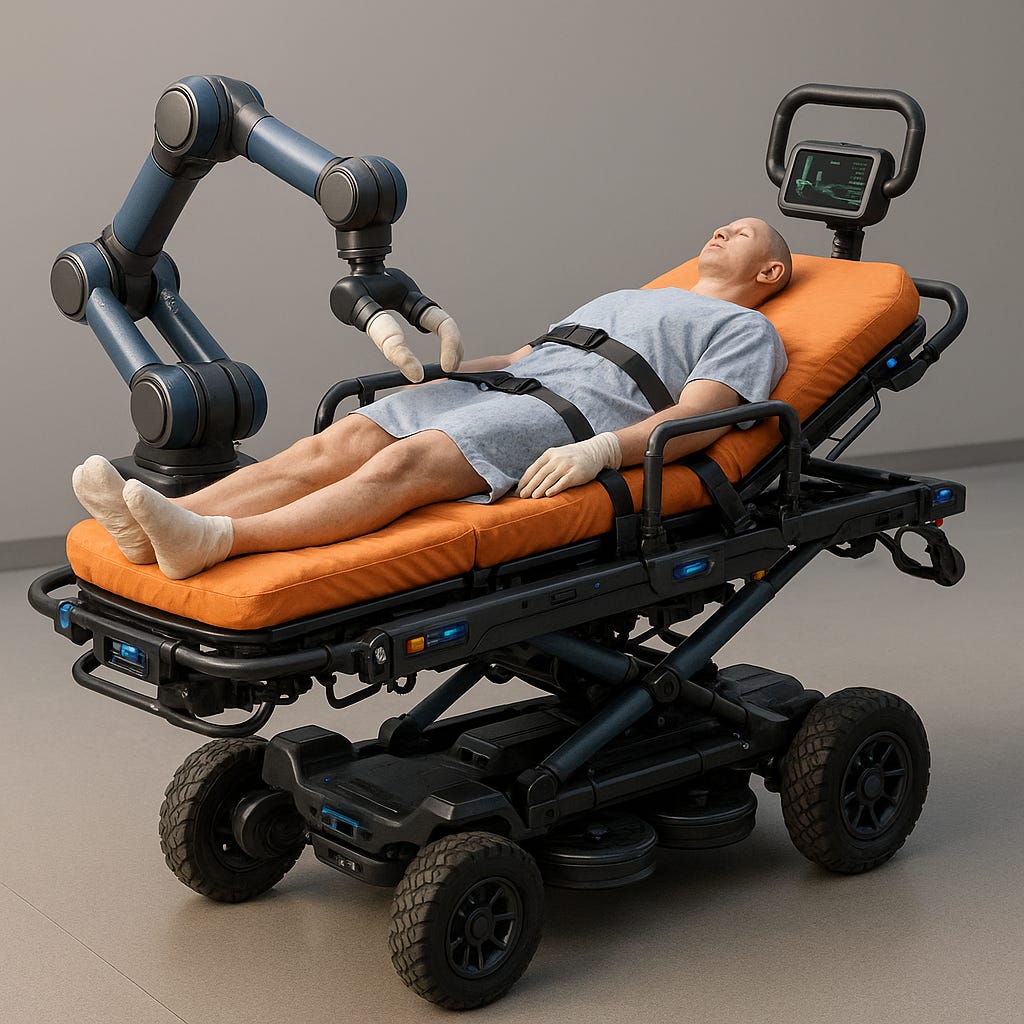
🤖 Autonomous and Manual Hybrid Stretcher: Ground or Hover Mobility with Robotic Arm Integration
By Ronen Kolton Yehuda (Messiah King RKY), June 2025
🔍 Introduction
In the evolving landscape of emergency response and medical transport, innovation must prioritize both speed and adaptability. The Hybrid Autonomous Stretcher is a revolutionary device that transforms the concept of patient mobility—capable of functioning either autonomously or with manual control, and equipped with dual-mode movement: traditional ground driving and advanced hovering.
Ideal for ambulances, hospitals, military rescue operations, disaster zones, and smart cities, this stretcher is designed to handle challenging environments while ensuring the safety and dignity of patients.
With the optional Robotic Lifting Arm Module, it becomes even more powerful—capable of autonomously retrieving patients from the ground or confined spaces and loading them safely onto the stretcher.
⚙️ Core Features
1. Dual Mobility System: Drive or Hover
-
Ground Wheels Mode: Standard or all-terrain wheels enable smooth transportation in hospitals, urban areas, or emergency vehicles.
-
Hover Mode (Optional): Magnetic levitation or ducted fan systems allow short-distance hovering over debris, stairs, or difficult terrain—ideal for battlefield or disaster recovery zones.
2. Hybrid Operational Modes
-
Autonomous Mode: Equipped with AI, sensors, and obstacle detection, the stretcher can navigate hallways, elevators, or open fields with pre-programmed destinations.
-
Manual Mode: Healthcare providers or rescuers can override controls using a handlebar or remote device, allowing traditional stretcher use when necessary.
3. Robotic Arm System (Optional Add-On)
-
Purpose: Enables safe, autonomous lifting of unconscious or immobilized patients onto the stretcher.
-
Configuration: Dual retractable arms mounted on the stretcher sides or rear.
-
Capabilities:
-
Soft adaptive grippers with biometric sensors
-
Load capacity up to 120 kg
-
Adjustable angles for low-ground retrieval or confined-space maneuvering
-
AI-guided positioning to align with patient body and stretcher bed
-
-
Operation Modes:
-
Fully autonomous retrieval
-
Human-assisted via handheld controller or voice commands
-
4. Smart Patient Support
-
Vital Monitoring: Embedded systems can track pulse, oxygen, and motion during transport.
-
Shock Absorption Platform: The mattress system adjusts to reduce movement shock and enhance patient stability.
-
Smart Locking System: Automatically stabilizes the stretcher when stationary.
🏥 Applications
-
Hospitals and emergency rooms
-
Ambulance and air ambulance integration
-
Military medevac units
-
Disaster relief zones and remote rescues
-
Smart hospitals and autonomous healthcare systems
-
Elder care and remote robotic medical services
🔧 Technical Overview: Autonomous & Manual Hybrid Hover-Ground Stretcher
By Ronen Kolton Yehuda (Messiah King RKY)
1. System Architecture
1.1 Frame and Chassis
-
Material: Aerospace-grade aluminum alloy or reinforced carbon fiber
-
Dimensions: Modular frame for standard stretcher length
-
Payload Capacity: 120–180 kg
-
Shock-Absorbing Deck: Adaptive suspension platform
2. Propulsion and Mobility
2.1 Ground Drive Mode
-
Drive Unit: Dual or quad electric hub motors
-
Tire Type: All-terrain medical-grade wheels
-
Speed: Up to 10 km/h
-
Modes: Autonomous or manual joystick/push bar
2.2 Hover Mode (Optional)
-
Technology Options:
-
A: Ducted electric fan lift array
-
B: Magnetic levitation (smart floor-compatible)
-
-
Hover Height: 5–20 cm
-
Energy Source: Li-ion hover bank (15–30 min)
-
Stabilization: Lidar + gyroscopic control
3. Control & Navigation
-
Sensors:
-
3D Lidar
-
Ultrasonic rangefinders
-
Infrared + RGB Depth Cameras
-
Indoor GPS
-
-
AI Navigation: SLAM-based environment mapping
-
Failsafe Override: Handlebar, wrist control, remote joystick
4. Medical Integration
-
Dock for ECG, SPO2, temperature sensors
-
Tilt and Elevation: Electrically actuated
-
Modular battery for onboard medical devices
5. Robotic Arm Integration (Optional)
5.1 Mechanical Specs
-
Actuators: Servo-motor powered with haptic feedback
-
Reach: Up to 1.5 m span
-
Gripper Design: Soft adaptive polymer with pressure sensors
-
Payload: 120 kg lifting capacity
-
Stabilization: Independent auto-leveling system during patient pickup
5.2 Software & Control
-
AI Vision Alignment for locating limbs and body center
-
Emergency switch-off if abnormal resistance is detected
-
Control: Voice command, mobile device, joystick, or fully autonomous
6. Safety & Redundancy
-
Redundant Power System (main and hover battery banks)
-
Auto-Lock Brakes + Fall Detection
-
Secure strapping and onboard pressure alert system
-
Remote diagnostics via cloud interface
7. Communication & Network
-
Protocols: Wi-Fi, BLE, optional 5G/LTE
-
Interfaces: Hospital dashboards, ambulance vehicle routers
-
Remote Diagnostics: Cloud-linked battery and system status
🧭 Conclusion
The Autonomous & Manual Hybrid Hover-Ground Stretcher with Robotic Arm Integration is the next evolution in emergency medical logistics. Whether in a smart hospital, battlefield, burning building, or collapsed structure, this stretcher adapts to every critical moment. It’s a mobile AI-enabled assistant that not only carries but retrieves the patient—bridging robotics, autonomy, and care.
Would you like a realistic illustration of this stretcher with the robotic arm in action?
Technical Overview: Autonomous & Manual Hybrid Hover-Ground Stretcher
By Ronen Kolton Yehuda (Messiah King RKY)
1. System Architecture
1.1 Frame and Chassis
- Material: Lightweight aerospace-grade aluminum alloy or reinforced carbon fiber
- Dimensions: Standard stretcher size with modular adjustability
- Payload Capacity: 120–180 kg (adjustable based on use case)
- Shock-Absorbing Deck: Adaptive suspension integrated under the patient platform
2. Propulsion and Mobility
2.1 Ground Drive Mode
- Drive Unit: Dual or quad electric hub motors
- Tire Type: All-terrain rubberized medical-grade wheels with independent suspension
- Speed: 0–10 km/h (manual and autonomous modes)
- Drive Control: AI navigation or joystick/manual push bar
2.2 Hover Mode (Optional Upgrade)
- Technology:
- Option A: Ducted electric fan array for short-range lift and hover
- Option B: Magnetic levitation for facilities with conductive floors
- Hover Height: 5–20 cm (depending on system)
- Stabilization: Real-time gyroscopic and lidar-based levelling system
- Energy Source: Dedicated Li-ion hover cell bank with 15–30 min hover time
3. Control & Autonomy
3.1 Autonomous Navigation
- Sensors:
- 3D Lidar
- Ultrasonic rangefinders
- IR depth cameras
- GPS + Indoor positioning (for large facilities)
- Processing Unit: ARM-based SoC with AI module
- Navigation Algorithms: SLAM (Simultaneous Localization and Mapping) with obstacle avoidance
- Emergency Override: Manual control via handlebar, remote joystick, or central interface
4. Medical Integration
- Vital Sign Monitor Docking
- Integrated ECG, SPO2, and Temp Sensors (optional modules)
- Modular Battery Power for Medical Devices (via built-in outlets)
- Adjustable Tilt and Elevation: Electric actuators controlled manually or remotely
5. Safety and Redundancy
- Redundant Power Supply: Dual-battery system with hot-swap capability
- Auto-Lock Brakes: Engaged during stops or in emergency halt situations
- Fall Detection and Auto-Stabilization
- Secured Patient Strapping and Pressure Sensors
6. Communication and Connectivity
- Wireless Protocols: Wi-Fi, BLE, and optional 5G/LTE SIM
- Integration: Connects with hospital command centers and smart ambulance systems
- Remote Diagnostics: Cloud dashboard for maintenance, battery status, and usage logs
Technical Overview: Autonomous & Manual Hybrid Hover-Ground Stretcher
By Ronen Kolton Yehuda (Messiah King RKY)
1. System Architecture
1.1 Frame and Chassis
- Material: Lightweight aerospace-grade aluminum alloy or reinforced carbon fiber
- Dimensions: Standard stretcher size with modular adjustability
- Payload Capacity: 120–180 kg (adjustable based on use case)
- Shock-Absorbing Deck: Adaptive suspension integrated under the patient platform
2. Propulsion and Mobility
2.1 Ground Drive Mode
- Drive Unit: Dual or quad electric hub motors
- Tire Type: All-terrain rubberized medical-grade wheels with independent suspension
- Speed: 0–10 km/h (manual and autonomous modes)
- Drive Control: AI navigation or joystick/manual push bar
2.2 Hover Mode (Optional Upgrade)
- Technology:
- Option A: Ducted electric fan array for short-range lift and hover
- Option B: Magnetic levitation for facilities with conductive floors
- Hover Height: 5–20 cm (depending on system)
- Stabilization: Real-time gyroscopic and lidar-based levelling system
- Energy Source: Dedicated Li-ion hover cell bank with 15–30 min hover time
3. Control & Autonomy
3.1 Autonomous Navigation
- Sensors:
- 3D Lidar
- Ultrasonic rangefinders
- IR depth cameras
- GPS + Indoor positioning (for large facilities)
- Processing Unit: ARM-based SoC with AI module
- Navigation Algorithms: SLAM (Simultaneous Localization and Mapping) with obstacle avoidance
- Emergency Override: Manual control via handlebar, remote joystick, or central interface
4. Medical Integration
- Vital Sign Monitor Docking
- Integrated ECG, SPO2, and Temp Sensors (optional modules)
- Modular Battery Power for Medical Devices (via built-in outlets)
- Adjustable Tilt and Elevation: Electric actuators controlled manually or remotely
5. Safety and Redundancy
- Redundant Power Supply: Dual-battery system with hot-swap capability
- Auto-Lock Brakes: Engaged during stops or in emergency halt situations
- Fall Detection and Auto-Stabilization
- Secured Patient Strapping and Pressure Sensors
6. Communication and Connectivity
- Wireless Protocols: Wi-Fi, BLE, and optional 5G/LTE SIM
- Integration: Connects with hospital command centers and smart ambulance systems
- Remote Diagnostics: Cloud dashboard for maintenance, battery status, and usage logs



Comments
Post a Comment