Restoring Earth: A Global Plan for Climate Healing

Restoring Earth: A Global Plan for Climate Healing
By Ronen Kolton Yehuda (MKR: Messiah King RKY)
A New Era for the Planet
The world is in crisis—ice is melting, deserts are expanding, and water is running out. The time has come to shift from delay to repair. This is not just about reducing carbon; it’s about rebuilding Earth’s systems—through water, forests, and ice.
The Global Climate Restoration Plan is a bold, international proposal to restore balance to the planet using real, existing technologies and renewable energy. It’s a roadmap of action—not theory—built on water infrastructure, ecosystem repair, and climate justice.
The Five Restoration Pillars
This plan brings together five major climate levers:
-
Desalination Powered by Green EnergyTurning ocean water into fresh water using solar and wind power—on a massive global scale.
-
Aquifer Recharge and Atmospheric Water HarvestingReplenishing underground water reserves and collecting water from the air, especially in dry regions.
-
Forestation and Green EcosystemsPlanting hundreds of millions of hectares of trees in deserts and dry zones, irrigated by clean water.
-
Artificial Lakes and RiversCreating new inland freshwater systems that cool the land, attract rain, and support biodiversity.
-
Ice Regrowth with Cryogenic PlatformsUsing renewable-powered freezing systems to regrow sea ice, glaciers, and mountain snowpacks.
Together, these systems cool the Earth, store water, regrow ecosystems, and reverse dangerous feedback loops.
Why This Plan Is Different
-
Real Technologies: No speculative geoengineering—only what we can build now.
-
Global Equity: Wealthy nations fund it; vulnerable regions receive first support.
-
Justice-Driven: Indigenous peoples, local communities, and developing nations are partners—not afterthoughts.
-
Nature-Centered: The plan heals land, water, and atmosphere through natural cycles.
A Vision for 2045
By 2045, this plan envisions a different Earth:
-
Hundreds of billions of cubic meters of freshwater produced yearly
-
Millions of square kilometers of forest regrown
-
Sea level rise slowed or reversed
-
Parts of the cryosphere (Earth’s ice shield) regrown
-
Over 100 million new green jobs created
Who Will Lead?
A new proposed international body—the United Nations Climate Restoration Authority (UNCRA)—will guide the project globally. It will work alongside the UN, governments, scientists, local communities, and private industry.
The Time Is Now
This plan is not just a blueprint—it’s a call to action. Governments, scientists, investors, and citizens all have a role. It’s time to stop fearing collapse and start engineering survival.
Restoration is no longer optional. It is a moral, ecological, and strategic necessity.


A Global Climate Restoration Plan
Healing the Earth Through Water, Forests, and IceBy Ronen Kolton Yehuda (Messiah King RKY)For submission to the United Nations, World Governments, Scientific Institutions, and International Climate FundsIntroduction: The Planet Can Be Healed
The 21st century faces an urgent crossroads. Climate change has passed the threshold of risk and entered the era of consequence: melting polar ice, rising seas, collapsing aquifers, vanishing forests, and destabilizing weather systems. While emissions reductions are essential, they are no longer sufficient to reverse planetary destabilization.
This proposal is not a theory. It is a comprehensive action blueprint—a realistic, interdisciplinary plan to restore Earth's water balance, thermal systems, and ecological resilience. The tools are here: desalination, underground storage, reforestation, artificial lakes, cryogenic ice regrowth, and atmospheric harvesting—all powered by renewable energy and governed by global cooperation.
Humanity can rebuild the planet’s hydrological and thermal infrastructure. This document presents 10 articles, each standing alone and also forming part of a unified restoration plan.
Table of Contents (10-Part Climate Restoration Articles)
Part I – Executive Project Overview: Global Climate Engineering for Earth StabilizationOutlines the entire mission and strategic framing. Establishes vision, governance (UNCRA), five climate levers, and global milestones by 2050.Part II – Renewable-Powered Desalination: Engine of Global Freshwater ProductionDeploying solar, wind, hydro, and geothermal desalination to produce up to 300 billion m³ of freshwater annually. Desalination as a core enabler of climate repair.Part III – Aquifer Recharge and Atmospheric Water HarvestingUsing desalinated and harvested atmospheric water to restore natural and artificial aquifers. Enables long-term groundwater security and subsoil cooling.Part IV – Artificial Aquifers and Waterbanks in Deserts and DrylandsDesign and engineering of subsurface reservoirs in desert zones like the Negev, Sahara, and Rajasthan. Permanent water reserves against drought and collapse.Part V – Global Forestation with Smart Irrigation and Water HarvestingReforesting deserts and degraded zones with desalinated water, fog collection, and atmospheric harvesters. Integrated with smart drip irrigation and AI forestry.Part VI – Artificial Lakes, Rivers, and Inland Climate StabilizationBuilding inland water bodies using surplus desalinated water. Cooling land, increasing albedo, attracting clouds, and sustaining life in arid zones.Part VII – Ice Regrowth and Cryogenic Climate Engineering (Including Glaciers)Installing floating and land-based platforms to freeze seawater, runoff, and atmospheric moisture. Restores Earth’s albedo, stabilizes jet streams, and preserves glacial mass.Part VIII – Climate Impact Modeling and Earth System EffectsScientific projections of global temperature reduction, sea level delay, ecosystem rebound, and economic benefit over 25–50 years.Part IX – Governance, Global Deployment, and Climate Justice FinancingCreation of a UN-led climate restoration authority (UNCRA), treaties, climate justice frameworks, financing from sovereign and ESG funds.Part X – Final Summary and Call to Global ActionConsolidated vision, moral imperative, and proposed global adoption. The Earth can be healed—through water, forests, and ice.Authored by: Ronen Kolton Yehuda (MKR: Messiah King RKY)Check out my blogs:Substack: ronenkoltonyehuda.substack.comBlogger: ronenkoltonyehuda.blogspot.comMedium: medium.com/@ronenkoltonyehuda


- Authored by: Ronen Kolton Yehuda (MKR: Messiah King RKY)Check out my blogs:Substack: ronenkoltonyehuda.substack.comBlogger: ronenkoltonyehuda.blogspot.com
-
Part I – Executive Project Overview: Global Climate Engineering for Earth Stabilization
A Visionary Plan to Reverse Planetary Collapse through Water, Forests, and IceBy Ronen Kolton Yehuda (Messiah King RKY)
Introduction: Repairing Earth Beyond Mitigation
The global climate crisis has evolved beyond emissions and carbon levels—it now challenges the survival of water systems, glaciers, forests, and human civilization itself. Decades of delay, deforestation, overconsumption, and unchecked industrial growth have accelerated sea level rise, desertification, and ecological collapse. A climate plan that only seeks to limit emissions is now obsolete.
This first article presents the strategic overview for a planetary restoration mission—one that uses renewable energy, advanced infrastructure, natural cycles, and ecological design to actively reverse the damage. It is based not on experimental technologies, but on scaling up real systems that already exist: desalination, aquifer recharge, reforestation, artificial lakes, and ice regrowth.
This is not geoengineering through aerosols or atmospheric manipulation. This is hydrological engineering and ecological restoration guided by climate justice and science.
The Five Pillars of Climate Restoration
-
Renewable Desalination: Large-scale freshwater production from seawater using solar, wind, and geothermal power.
-
Aquifer Recharge: Returning water to depleted underground reserves for long-term climate stabilization and storage.
-
Forestation and Ecosystem Rebuilding: Greening deserts and degraded areas through smart irrigation and fog/moisture capture.
-
Artificial Lakes and Waterways: Inland freshwater bodies to cool land, attract rain, reflect heat, and support biodiversity.
-
Cryogenic Ice Regrowth: Rebuilding the cryosphere with solar- and wind-powered freezing systems in glaciers and polar zones.
Each system directly reduces temperature, supports water resilience, and restores ecological integrity.
Strategic Objectives by 2050
Objective Global Target Desalinated water production 200–300 billion m³/year Aquifer recharge 3,000–5,000 billion m³ stored Reforested area 400–800 million hectares Cryogenic platforms deployed 2,000–5,000 across poles and mountains Average surface temperature change −0.2°C to −0.5°C globally Sea level rise mitigation 2–7 cm reduced per decade Ecosystem rebound zones 100+ million hectares restored biodiversity
Governance: United Nations Climate Restoration Authority (UNCRA)
A new global body is proposed under the UN system, dedicated to oversight, licensing, technical support, and global equity:
-
Mandate: Coordinate implementation of large-scale projects across borders and ecosystems.
-
Equity Mechanism: High-emission countries fund; climate-vulnerable nations receive first deployments.
-
Transparency: Public dashboards, monitoring, and audits for every funded system.
-
Partnerships: Integration with UNEP, UN Water, FAO, WMO, and national climate agencies.
National "Restoration Authorities" will implement projects domestically under UNCRA guidelines, with input from indigenous communities, scientists, and civil institutions.
Economic Investment Model
The plan is framed as infrastructure-scale climate action, on par with post-war reconstruction or moon landing programs:
-
Total global cost (2026–2050): $3–6 trillion
-
Annualized investment: ~$500 billion/year
-
% of global GDP: ~0.3–0.5%
Return on investment includes:
-
Protection of $50 trillion in water-dependent and coastal assets
-
Avoidance of over $1.5 trillion/year in climate-related damages
-
Green employment creation: >100 million jobs globally
-
Ecosystem service value: water purification, cooling, rainfall, food security
Deployment Timeline
2026–2030 (Mobilization):
-
UNCRA is established
-
Pilot projects in 10 countries
-
10 GW renewable desalination
-
Initial cryogenic units in Arctic, Andes, and Himalayas
2030–2040 (Scaling):
-
Desalination ramps up to 100 GW
-
2,000 artificial lakes and riverbeds
-
Aquifer recharge networks on all continents
-
Massive forestation and waterbank deployment
2040–2050 (Stabilization):
-
Global network of climate repair systems operational
-
Polar ice regeneration at strategic levels
-
Water redistribution pipelines reach 2 billion people
-
Climate impact models confirm global temperature and sea level reversals
Conclusion: From Crisis to Design
This plan is not a distant vision—it is a survival blueprint. It is bold, but feasible. It is costly, but justified. It is urgent, but achievable. If we act now, with unity and purpose, we can turn ecological collapse into planetary healing.
Let the 21st century be known not only for its crisis—but for the civilizational choice to repair what we nearly lost.
.]
-


Part II – Renewable-Powered Desalination: Engine of Global Freshwater Production
Introduction: Seawater as the New Global Source
As freshwater rivers dry up and groundwater reserves collapse, humanity must turn to its largest water source: the ocean. But seawater is not directly usable for drinking, agriculture, or climate repair. Desalination—the process of removing salt and impurities—offers the gateway to abundant, clean water. When powered by renewable energy, it becomes the engine of Earth’s restoration.
Desalination is not a future technology—it is already operating in over 150 countries. The mission now is to scale, optimize, and direct this power toward climate stability, water security, and ecological recovery.
Technologies and Process Optimization
Primary Desalination Technologies:
-
Reverse Osmosis (RO): Most common. Pressure pushes seawater through membranes.
-
Multi-Effect Distillation (MED): Uses heat to evaporate and condense fresh water.
-
Forward Osmosis (FO): Lower energy alternative for selective applications.
-
Electrodialysis and Nanofiltration: Specialized uses for brackish water.
Renewable Power Sources:
-
Solar PV: Rooftop or field-based arrays power membrane systems.
-
Wind Turbines: Ideal for coastal regions.
-
Geothermal: Used in volcanic zones and tectonic plate intersections.
-
Hydro + Wave Energy: Potential for combined ocean-based facilities.
AI and IoT-based systems optimize energy consumption, membrane cleaning cycles, and output scaling.
Climate Impact and Water Redistribution
Desalinated water supports multiple climate repair mechanisms:
-
Forestation and Agriculture: Deserts and drylands can be irrigated efficiently.
-
Aquifer Recharge: Stored underground to cool regions and buffer against drought.
-
Artificial Lakes and Rivers: Built in dry valleys to stabilize ecosystems.
-
Ice Regrowth Systems: Supplied with pure water for cryogenic freezing in high altitudes and poles.
Transferring water inland also lowers ocean heat content, slightly reduces ocean volume, and contributes to regional cooling.
Production Targets and Deployment Strategy
| Region | Priority Sites | Target Volume (by 2045) |
|---|---|---|
| Middle East & North Africa | Red Sea, Mediterranean coastlines | 50+ billion m³/year |
| Sub-Saharan Africa | Western coast, Horn of Africa | 30–40 billion m³/year |
| South and Southeast Asia | Indian Ocean zones | 40+ billion m³/year |
| Australia | Coastal cities & Outback pipelines | 15–20 billion m³/year |
| South America | Pacific/Atlantic coasts | 20–30 billion m³/year |
| North America | California, Mexico, Gulf states | 20–25 billion m³/year |
| Europe | Iberian Peninsula, Greece, Black Sea | 10+ billion m³/year |
| Arctic Bases | Greenland, Northern Canada | Pilot units for glacial supply |
Global Target: 200–300 billion m³/year by 2045.
Economic Feasibility
Cost Per Cubic Meter (m³):
-
Powered by fossil fuels: $0.70–$1.60
-
Powered by renewables (AI-optimized): $0.35–$1.00
Average ROI:
-
Replacing food loss and crop failure due to drought
-
Preventing migration and humanitarian disaster
-
Reducing urban water costs over time
-
Creating jobs in construction, operations, maintenance
Desalination enables not only survival but sustainable growth in arid and urban regions.
Environmental and Ethical Considerations
-
Brine Management: Brine waste is diluted, mineral-recovered, or used in salt farming.
-
Marine Impact: Intake and outflow systems are designed with low-velocity screens and dispersal zones.
-
Equity: Deployment in vulnerable and water-scarce regions must be prioritized.
-
Ownership: Public-private partnerships must ensure fair access, pricing, and anti-monopoly safeguards.
Real-World Success Examples
-
Israel: 85% of national water supply via desalination.
-
UAE & Saudi Arabia: Mega-scale renewable desal plants in the Gulf.
-
Spain: Mediterranean coastal plants supporting agriculture and cities.
-
California: New renewable desal efforts underway with AI controls.
These models prove feasibility across continents, energy sources, and climates.
Conclusion: Water as the Foundation of Climate Healing
Desalination—once seen as a luxury or last resort—has become a lifeline for the planet. It is the foundational pillar that makes forestation, aquifer recharge, lake creation, and ice regrowth possible.
When powered ethically and sustainably, desalination allows humanity to turn oceans into life. With investment and urgency, we can provide freshwater for all while restoring the Earth’s balance—one cubic meter at a time.
- Authored by: Ronen Kolton Yehuda (MKR: Messiah King RKY)Check out my blogs:Substack: ronenkoltonyehuda.substack.comBlogger: ronenkoltonyehuda.blogspot.comMedium: medium.com/@ronenkoltonyehuda

- Authored by: Ronen Kolton Yehuda (MKR: Messiah King RKY)Check out my blogs:
-
Thermal Buffering: Stored water reduces heatwaves by cooling ground layers.
-
Evaporation Protection: Unlike surface lakes, aquifers lose almost no water to the air.
-
Resilience: Underground storage resists sabotage, pollution, and drought.
-
Emergency Access: Strategic reserves for humanitarian or agricultural crises.
-
Cost Efficiency: Recharge cost per m³: $0.25–$0.70 depending on depth and treatment.
-
AWG Units (Atmospheric Water Generators): Use condensation technology to extract water from humid air.
-
Fog Catchers: Large mesh nets used in coastal or high-altitude fog zones to collect droplets.
-
Dew Harvesters: Use radiative cooling surfaces to collect early-morning dew.
-
Solar Condensation Units: Passive systems that trap moisture using solar heat and cool surfaces.
-
Remote villages
-
High-altitude regions (Himalayas, Andes)
-
Arid zones with night humidity
-
Emergency outposts and AI farming zones
-
Geological Suitability: Recharge only in zones with sealed aquifers or controlled seepage.
-
Mineral Balance: pH, salinity, and hardness must match aquifer tolerances.
-
AI Supervision: Remote sensors and algorithms monitor leakage, contamination, and flow direction.
-
Community Oversight: Local agencies and indigenous knowledge integrated in aquifer stewardship.


Part III – Aquifer Recharge and Atmospheric Water Harvesting
Introduction: Restoring Natural Water Storage
Beneath the Earth lie vast networks of natural aquifers—geological formations that once stored immense volumes of freshwater. These reserves have been depleted by overuse, mismanagement, and climate-driven drought. At the same time, the sky above us holds untapped water in the form of humidity and vapor. This part of the plan proposes a dual strategy: recharge the ground and harvest the air, creating a resilient, decentralized global water reserve.
Aquifer recharge and atmospheric water harvesting (AWH) not only restore freshwater access, but also regulate land temperature, stabilize ecosystems, and prepare for shocks like drought, war, or migration.
Aquifer Recharge Methods and Integration
1. Infiltration Basins and Trenches
Shallow, unlined surface structures that allow water to seep into soil layers. Ideal for flood zones, riverbanks, and artificial lake peripheries.
2. Recharge Wells
Piped systems that inject clean water deep into aquifers. Used where surface absorption is too slow or impermeable.
3. Subsurface Dams
Barriers that prevent underground water from escaping downhill. Used in deserts and hillsides to build pressure in aquifers.
4. Treated Water Injection
Using desalinated or recycled wastewater—after mineral balancing and safety checks—to recharge depleted aquifers.
5. Smart Aquifer Management
AI-monitored flow rates, pressure sensors, salinity detectors, and geological risk assessment ensure safety and longevity.
Benefits of Underground Waterbanks
Atmospheric Water Harvesting (AWH)
Systems and Devices
Application Zones
Integration with Climate Strategy
| System | Role in Climate Restoration |
|---|---|
| Aquifer Recharge | Groundwater cooling, storage, and reforestation buffer |
| AWH | Water source for remote forestation, mountain glaciation, and backup drinking systems |
| Combined Systems | Desert transformation and rural water independence |
Harvested atmospheric water and desalinated water can both be directed to aquifers, enabling hybrid storage systems.
Deployment Focus Zones
| Region | Focus Areas |
|---|---|
| Middle East | Jordan River Valley, Negev, Eastern Desert |
| India | Rajasthan, Deccan Plateau, Tamil Nadu |
| Africa | Sahel, Kalahari, Ethiopian Highlands |
| South America | Andes foothills, Atacama fringe, dry Chaco |
| Central Asia | Uzbek basins, Aral Sea region |
| Australia | Western Desert and Outback edges |
| USA | Central Valley, Southwest, Texas aquifers |
| China | Loess Plateau and Tibetan recharge zones |
Governance and Safety Protocols
Conclusion: A Sky-to-Soil Water Strategy
Water can now be harvested from the air and hidden safely in the ground. Together, these systems make Earth’s natural storage cycles more resilient, intelligent, and adaptive to climate stress.
From fog nets in the Andes to deep wells in Africa, humanity is learning to manage its invisible waters—and in doing so, restore the foundations of life.


Part IV – Artificial Aquifers and Waterbanks: Strategic Groundwater Reserves
Introduction: Storing Freshwater Like Energy
As the global climate becomes more erratic, water security must go beyond dams and rivers. A new class of infrastructure is emerging: artificial aquifers—man-made underground reservoirs built to store vast quantities of water under protective layers of earth and rock. These engineered “waterbanks” act like national vaults of hydration, immune to evaporation, theft, or conflict.
This part of the plan proposes a global strategy to construct and fill artificial aquifers in deserts, mountains, and climate-vulnerable regions. These waterbanks, like batteries for water, will anchor food security, forestation, and regional peace.
What Are Artificial Aquifers?
Artificial aquifers are engineered underground cavities designed to function like natural aquifers. They are constructed using geological excavation, lining, sealing, and recharge systems. Their capacity ranges from tens of millions to billions of cubic meters.
They can be filled with:
-
Desalinated water
-
Reclaimed and purified wastewater
-
Harvested atmospheric moisture
-
Floodwater and runoff
Engineering Requirements
1. Geological Suitability
-
Porous Rock Layers: Such as sandstone or gravel beds for absorption
-
Impermeable Seals: Clay, bentonite, or geomembranes to prevent seepage
-
Tectonic Stability: Away from fault lines and major seismic risks
2. Structural Design
-
Subsurface basins excavated 10–50 meters deep
-
Perforated pipe networks for filling and withdrawal
-
Modular partitions to separate treated water types
-
Above-ground access ports for monitoring and treatment
3. Cost and Construction
-
Estimated cost: $20–200 million per aquifer (depending on size and terrain)
-
Recharge cost per m³: $0.25–$0.70
-
Construction time: 2–5 years per system
Why Underground Waterbanks?
| Advantage | Explanation |
|---|---|
| Long-Term Storage | Can last decades with minimal loss |
| Low Evaporation | Sealed systems are nearly evaporation-free |
| Climate Shielding | Thermal mass moderates heat, reduces desertification |
| Conflict-Resistant | Hidden, secure, and hard to sabotage |
| Scalable | Can be built in clusters and connected to pipeline networks |
Strategic Deployment Zones
| Region | Proposed Sites |
|---|---|
| Israel/Negev | Deep artificial aquifers for forest and food belt |
| UAE & KSA | Subsurface tanks in desert peripheries |
| North Africa | Sahara foothill storage near oases |
| South Asia | Rajasthan, Gujarat, Southern Deccan |
| Central Asia | Basin-based waterbanks for steppe irrigation |
| Australia | Western desert artificial lake-to-aquifer systems |
| Andes | Glacial runoff storage under mountain basins |
| Sahel | Sealed aquifers along the Great Green Wall zone |
And more
Operational Integration
Waterbanks support and receive water from:
-
Desalination plants (Part II)
-
Reclaimed wastewater facilities
-
Artificial lakes (Part VI)
-
Aquifer recharge zones (Part III)
They also serve:
-
Emergency drought reserves
-
Agro-ecological irrigation
-
Urban drinking and cooling networks
-
Fire prevention reservoirs
Safety and Monitoring
Each artificial aquifer includes:
-
AI-monitored water pressure and flow sensors
-
Anti-leak membranes and alert protocols
-
Remote mineral balance check systems
-
Emergency valves and surface overflow systems
Governance includes joint oversight by:
-
National water agencies
-
Indigenous land councils
-
International climate infrastructure boards
Vision: A Global Waterbank Network
Just as nations build oil reserves and energy grids, a Global Waterbank Network will act as a planetary water buffer. These networks will store peace, life, and food security beneath the Earth.

Part V – Global Forestation with Desalinated and Harvested Irrigation SourcesGreening the Arid World to Cool the Planet Introduction: Forests as Climate InfrastructureForests are more than CO₂ absorbers—they are engines of cooling, rainmaking, and life support. As deserts expand and temperatures rise, large-scale forestation offers one of the most immediate and synergistic climate solutions. However, natural rainfall is no longer sufficient in arid zones. This plan proposes irrigating vast new forests using desalinated and atmospheric water, distributed via smart systems and monitored by AI. The goal: grow forests where none can survive today—and make them climate regulators for tomorrow. Forestation in Arid and Semi-Arid RegionsObjectives:
Regions Targeted for Forestation:
Total goal: 400–800 million hectares of new and restored forest by 2050. Water Source: Desalination and Atmospheric HarvestingDesert forestation requires consistent, scalable, and clean water inputs. These are provided by:
Water Use Estimate:
Irrigation is delivered via AI-optimized drip networks, with sensors monitoring root moisture, soil health, and evapotranspiration rates. What Will Be Planted?Tree Species:
Agroforestry Systems:
Climate and Ecological Impact
Infrastructure and Support Systems
Socioeconomic IntegrationForestation generates:
Implementation partners include:
Conclusion: Foresting the FutureThis is not just planting trees. This is hydrological, ecological, and social engineering at the planetary level. Forests will rise not just where rain falls, but where water is made, piped, and shared. Where deserts once marched forward, forests will now stand in their path. |


Part VI – Artificial Lakes, Rivers, and Inland Climate Stabilization
Introduction: Surface Water as a Climate Tool
As global temperatures rise, arid zones expand and ecosystems vanish, inland water bodies—even artificial ones—can transform entire regions. Lakes and rivers moderate climate by cooling the air, increasing humidity, attracting rain, and boosting biodiversity. This article outlines how artificial lakes and freshwater flows, created using desalinated or harvested water, can reverse desertification and stabilize land-based climate systems.
Strategic Goals of Artificial Freshwater Systems
-
Increase surface albedo: Reflect sunlight and reduce local heat
-
Generate localized rain through humidity and microclimates
-
Cool soil and air temperatures
-
Create habitats for birds, fish, and regional biodiversity
-
Support agriculture and forest belts
Methods of Creation
1. Artificial Lakes
-
Excavated or natural depressions filled with desalinated or harvested water
-
Volumes: 10–100 million m³
-
Retention walls, levees, and geo-membranes prevent seepage
2. Constructed Wetlands and Basins
-
Designed for water purification, biodiversity, and evapotranspiration
-
Hybrid systems combining vegetation, sediment filters, and solar circulation pumps
3. Artificial Rivers and Canals
-
Long water corridors connecting lakes, forests, and cities
-
Designed with overflow control, gravity-fed or pumped systems
Deployment Zones and Case Studies
| Region | Application |
|---|---|
| UAE | Inland lakes to enhance rainfall and climate control |
| Egypt | New Delta Project: desert-to-fertile land transformation |
| Israel | Negev artificial ponds for agriculture and cooling |
| Central Asia | River restoration in arid valleys |
| Australia | Outback freshwater oases and aquifer-fed lakes |
| California | Inland cooling corridors between forestation zones |
Water Sources and Flow Logic
-
Primary Input: Desalinated seawater and treated effluent
-
Secondary Input: Atmospheric water harvesting, rain collection
-
Reuse: After evaporation, water re-condensed and pumped back
-
Energy Source: Solar and wind-powered pumping, gravity-fed flows where possible
Benefits at Regional and Continental Scales
| Impact Area | Effect |
|---|---|
| Rain Enhancement | Creates humidity and cloud-attracting conditions |
| Heat Island Mitigation | Drops temperature by 2–6°C in vicinity |
| Biodiversity | Supports wetland species, pollinators, and migratory birds |
| Agriculture | Nearby lands become arable through microclimate effects |
| Ecotourism & Economy | Fishing, recreation, and habitat restoration industries |
Technical Infrastructure
-
Geo-textile base liners for leak control
-
AI-monitored water levels, purity, and biological health
-
Solar-powered aeration and algae prevention systems
-
Floating islands and plant-covered barges for oxygenation
-
Emergency drainage systems for storm adaptation
Social and Cultural Impact
-
Provides water-based public spaces in hot regions
-
Creates pride and ownership in restoration zones
-
Integrates into new cities, green corridors, and cultural landmarks
-
Offers jobs in maintenance, ecology, hospitality, and agriculture
Conclusion: Water as a Land Healer
By creating lakes where none existed and restoring rivers long lost, we anchor climate restoration in visible, living infrastructure. Water on the surface cools not only the land but also the political and emotional climate of entire regions.

Part VII – Ice Regrowth and Polar Cryogenic Engineering
Freezing the Future: Cryosphere Restoration for Climate StabilityBy Ronen Kolton Yehuda (Messiah King RKY)
7.1 Introduction: Restoring Earth's Thermal Shield
The cryosphere—Earth's frozen water system—is shrinking at alarming speed. Melting glaciers and sea ice not only raise sea levels but also weaken the planet's natural ability to reflect solar radiation (albedo), regulate ocean currents, and stabilize climate systems. Ice loss feeds dangerous feedback loops. This part proposes a proactive engineering strategy to regrow polar and alpine ice using cryogenic systems powered by renewable energy.
7.2 Cryogenic Climate Strategy
The core idea is simple: freeze water—seawater, runoff, or humid air—into solid ice using solar, wind, hydro, and geothermal energy. Applications span oceans, ice sheets, glaciers, and highlands.
Benefits:
Increases Earth’s albedo (light reflection)
Slows or reverses glacial retreat
Buffers sea level rise
Reinforces jet stream and monsoon stability
Restores freshwater “towers” for billions of people
7.3 System Types and Deployment Zones
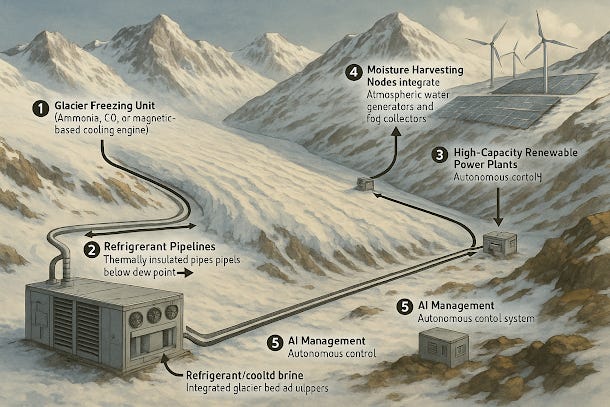
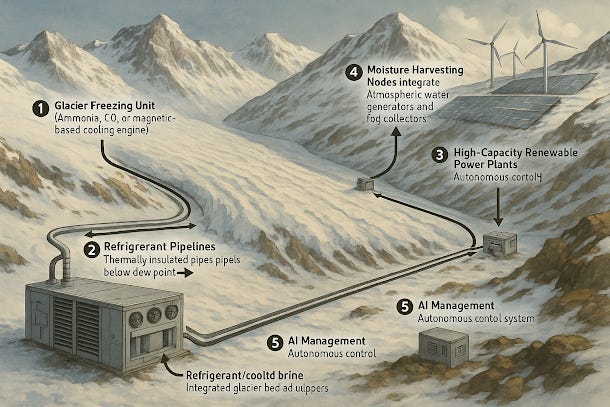
System Function Locations Floating Ice Farms Freeze seawater into surface ice Arctic Ocean, Greenland Glacier Front Coolers Add ice to retreating fronts West Antarctica, Himalayas High-Mountain Snow Systems Freeze air moisture to snow Andes, Alps, East Africa Subglacial Cooling Units Freeze meltwater at glacier base Greenland, Antarctica Ice Domes Sheltered mass ice formation Arctic bays, alpine valleys
7.4 Engineering Details
Cooling Process:
Lower water temp from ~2°C to −1.8°C
Use ammonia/CO₂-based cryo-chillers
Freeze in layers or directed flows
Mold into platforms or under-ice caps
Key Infrastructure:
6 MW wind turbines, solar farms
Cryo-chillers (magnetic, compressor-based)
AI-managed thermal models
Hydrogen batteries for cold-season storage
Ice “molds,” insulated domes, snow sprayers
Energy requirement per ton of ice: ~97 kWh→ One wind turbine can freeze 150–160 tons/day
7.5 Strategic Sites and Rationale
Region Reason Greenland Sea level tipping point, rapid retreat Thwaites Glacier (Antarctica) “Doomsday Glacier,” grounding line collapse risk Arctic Ocean Summer sea ice loss, regional heatwaves Himalayas Water source for 2B+ people in Asia Andes Glacial water buffer for Amazon Alps, Rockies Tourism, heritage, European water systems
And more
7.6 Scaling Plan
2026–2028: Prototype Phase
1–3 units in key zones
Tech calibration, AI training, environmental testing
2028–2035: Mid-Scale Phase
100–500 units worldwide
Cryogenic river systems, glacier fronts, dome units
2035–2045: Global Network Phase
3,000–5,000 autonomous ice platforms
Earth’s first active cryosphere maintenance fleet
7.7 Institutional and Legal Framework
Lead Agency:
United Polar & Glacial Ice Recovery Alliance (UPGIRA)Under UNCRA supervisionPartners:
UNEP, WMO, UNFCCC, NASA, ESA
IASC, PRIC, ICIMOD, CONDESAN
Arctic Council, Antarctic Treaty System
Indigenous and mountain communities
Cryogenics and glaciology research centers
7.8 Global Impact Forecast
Impact Effect Albedo +8–12% reflectivity in cryosphere zones Sea Level Delay of 2.5–3.0 cm/year in rise Glacier Stability Slower retreat, longer glacier lifespan Jet Stream Stabilized polar air patterns Water Security Restored seasonal runoff for billions
7.9 Conclusion: Freezing to Survive
This is not science fiction—it is science in action. Humanity now has the power to regrow ice, not just watch it melt. Where glaciers fall, we will raise them. Where seas warm, we will chill their edges. Where the Earth forgets its cold, we will teach it again.
Let us cool the Earth from its highest peaks to its deepest poles—layer by layer, flake by flake, future by future.


.png)


Part VIII – Climate Impact Modeling and Earth System Effects
8.1 Purpose of Modeling
The scale of global climate restoration requires rigorous forecasting of ecological, hydrological, and atmospheric effects. This part evaluates the projected environmental benefits of the full implementation of the 10-pillar plan. Climate modeling uses Earth system simulators, regional hydrology models, AI prediction frameworks, and existing IPCC data.
8.2 Modeled Temperature Reduction
Integrating water-based cooling (irrigation, lakes), albedo enhancement (ice, forest canopy), and carbon sequestration:
-
Global temperature reduction:−0.2°C to −0.5°C by 2100 (model median)Localized cooling: up to −2.5°C in desert reforestation zones
-
Regional examples:
-
Central Asia: −1.3°C (forest and lake combo)
-
West Africa (Sahel): −1.8°C (irrigated forest belt)
-
Greenland Coast: −2.0°C (ice farm reflectivity)
-
8.3 Sea Level Rise Delay and Stabilization
Cryogenic ice regrowth and reduced oceanic heat absorption (via desalination + albedo) yield measurable sea level buffering.
-
Estimated buffering:2–3 cm per decade globally5–7 cm/decade in optimized scenarios (2050-onward)
-
Protection impact:Safeguards 10–20 million coastal residents by 2070Slows erosion and saltwater intrusion in vulnerable deltas (e.g., Nile, Mekong)
8.4 CO₂ Absorption and Carbon Drawdown
Forestation and restored water ecosystems enhance natural carbon capture.
-
Forestation:400–800M hectares → ~30–60 gigatons CO₂ absorbed by 2100Agroforestry + wetlands enhance soil carbon storage
-
Cryosphere rebound effect:Reduced methane release from permafrostIndirect drawdown through jet stream stability and rainfall rebound
8.5 Rainfall, Monsoons, and Hydrological Stabilization
Restored moisture cycles improve regional climate reliability.
-
Increased rainfall:Artificial lakes + forest belts increase local precipitation by 10%–30%Example: Negev Desert pilot showed 15% increase over 7 years
-
Monsoon normalization:Reduced land-sea temperature disparity leads to more predictable South Asian and West African monsoons
-
Groundwater recovery:Enhanced aquifer recharge slows desertification and boosts river flows (e.g., Indus, Jordan, Niger)
8.6 Biodiversity and Ecosystem Recovery
Restored habitats—wetlands, forests, highland snowpacks—support ecological revival.
-
Species rebound:100,000+ km² of potential habitat restorationMigratory corridors re-established in Africa, Central Asia, Amazon
-
Food chain stabilization:Return of freshwater species, pollinators, and prey speciesStabilization of agriculture-dependent biodiversity
8.7 Socioeconomic and Public Health Benefits
Climate stabilization directly reduces human suffering and boosts economic resilience.
-
Economic savings:~$1.5 trillion/year in avoided climate damages by 2045~$7 trillion GDP gain from water security and food system stability
-
Public health:Lower heatwave mortalityReduced waterborne disease via freshwater accessMental health benefits from ecological restoration (“green recovery”)
8.8 Limitations and Future Modeling
All models rely on assumptions about cooperation, deployment speed, and emission trends. Scenarios must be refined by:
-
Regional calibration with satellite + in situ data
-
Inclusion of extreme climate scenarios
-
Modeling compounding benefits of phased deployment (feedback synergy)
8.9 Conclusion: Data-Driven Hope


Part IX – Governance, Global Deployment Plan, and Funding
9.1 Introduction: Coordination at Planetary Scale
Restoring Earth’s climate systems is a shared survival imperative. No nation can accomplish this alone. Governance must be inclusive, enforceable, and ethically structured—balancing scientific leadership with regional empowerment, and industrial participation with environmental justice.
This section defines the proposed governance model, funding channels, and the rollout timeline for global implementation.
9.2 UNCRA – United Nations Climate Restoration Authority
A new international body is proposed to lead the global deployment of the restoration pillars:
Mandate and Functions:
-
Issue licenses for desalination, aquifer recharge, cryogenic ice systems, forestation, and artificial lakes
-
Oversee environmental and social impact assessments
-
Monitor progress using Earth observation systems and AI-powered compliance tools
-
Coordinate equitable technology transfer and global partnerships
Structure:
-
Executive Branch: Global oversight, legal enforcement, emergency powers
-
Scientific Advisory Council: Climate scientists, engineers, indigenous knowledge experts
-
Regional Bureaus: Africa, Asia-Pacific, Middle East, Europe, Americas, Polar
-
Civil Participation Chambers: NGO, citizen, and indigenous advisory panels
9.3 Global Legal Framework
UNCRA operates under new climate justice protocols and treaties:
Treaties and Protocols:
-
Restoration Treaty: Declares planetary restoration a binding international obligation
-
Polar and Glacier Protocol: Protects all cryogenic intervention zones and enforces peace and science-only access
-
Water Sovereignty Act: Recognizes universal freshwater access and regulates large-scale water redistribution
-
Desalination & Aquifer Accord: Sets guidelines for transboundary groundwater and brine management
9.4 Equity and Justice Model
Contribution Principles:
-
High-emission countries (historically and currently) contribute proportionally
-
Vulnerable and water-scarce nations are prioritized for infrastructure support
-
Technology and knowledge must be shared without monopolization
Indigenous Rights:
-
All projects on indigenous land require free, prior, and informed consent
-
Indigenous ecological knowledge integrated into monitoring and land design
9.5 Financing the Restoration
Estimated Total Cost (2026–2050):
-
$3–6 trillion total
-
~$500 billion/year (approx. 0.3–0.5% of global GDP)
Funding Mechanisms:
-
Global Climate Bonds (GCBs): Traded debt backed by restoration infrastructure revenue and long-term climate insurance savings
-
Climate Repair Credits (CRCs): Verified carbon + albedo + rainfall restoration units sold to offset markets
-
UN Funded Capital Pool: Initial $1 trillion seeded by sovereign funds, green banks, and the World Bank
-
Private Sector Alliances: ESG-aligned corporations co-fund projects under UNCRA guidelines
-
Restoration Sovereign Wealth Fund: UN-managed investment engine for long-term global ROI
9.6 Timeline of Global Rollout
| Phase | Years | Milestones |
|---|---|---|
| I. Mobilization | 2025–2027 | UNCRA formed; 10 pilot nations; foundational protocols passed |
| II. Scaling | 2028–2035 | Regional deployment of desalination, aquifer recharge, and artificial lakes |
| III. Optimization | 2036–2045 | Full cryogenic systems deployed; 400M+ hectares forested |
| IV. Stabilization | 2046–2050 | Global integration; system-level stabilization and modeling feedback |
9.7 Regional Deployment Priorities
Africa:
-
Desalination, aquifer recharge, and reforestation in Sahel and East Africa
-
Lake and wetland regeneration across Sahara margins
Asia:
-
Himalayan glacier protection, Indian aquifer recovery, Mongolian forest belts
Middle East:
-
Gulf desalination export pipelines, Negev & Arabian Peninsula lakes
Americas:
-
Andes ice recovery, California groundwater, Amazon reforestation corridors
Europe:
-
Alpine glacier regrowth, Iberian peninsula forest and lake systems
Arctic & Antarctic:
-
Polar ice farms, cryo-dome experiments, and floating platform fleets
9.8 Conclusion: A New Era of Climate Governance
The world can no longer rely on fragmented pledges or carbon markets alone. Restoration is infrastructure, rights-based, and justice-driven. It requires the same global coordination we’ve seen in war efforts, space exploration, and pandemic response—this time to secure the biosphere itself.
This is the birth of a new planetary authority—not for control, but for regeneration. Humanity must now learn to govern not only people, but the systems of the Earth.


.png)


Part X – Final Summary and Strategic Imperative for Humanity
10.1 Why Restoration Is No Longer Optional
The science is clear: emissions reduction alone cannot reverse the trajectory of global climate destabilization. Melting ice, expanding deserts, disrupted rainfall, and mass displacement now define the lived experience of billions. Incremental action is no longer enough.
This plan redefines climate action: from restraint to regeneration. From carbon accounting to water redistribution, ice creation, and ecosystem revival. From isolated policies to a unified planetary system of repair.
10.2 Restoration as Infrastructure
Each pillar of this plan—desalination, aquifer recharge, forestation, artificial lakes, and ice regrowth—is built with existing technologies powered by renewable energy. This is not speculative geoengineering. It is infrastructure that heals instead of harms.
These systems:
-
Cool Earth’s surface by redistributing water and increasing albedo
-
Rebuild the cryosphere (our planet’s natural thermal shield)
-
Regenerate biodiversity through new and restored ecosystems
-
Create tens of millions of green jobs
-
Reduce food and water insecurity
-
Provide buffers against conflict and collapse
10.3 Planetary Coordination and Justice
The proposed UN Climate Restoration Authority (UNCRA) transforms scattered projects into a unified planetary mission. Through treaties, financing, and shared governance, restoration becomes a legal right and global responsibility.
Justice is embedded:
-
High emitters fund
-
Low-resourced nations lead in deployment
-
Indigenous stewardship and land rights are upheld
Restoration becomes not only a scientific and engineering pursuit—but a moral imperative.
10.4 The 2045 Vision
By 2045, this plan aims to achieve:
| Goal | Milestone |
|---|---|
| Water | 200–300 billion m³/year desalinated |
| Forests | 400–800 million hectares added |
| Ice | 5–10% regrown in polar + alpine zones |
| Sea level | 2–7 cm per decade of slowed rise |
| Temperature | 0.2–0.5°C reduction in surface warming |
| Governance | Full UNCRA global coordination |
| Employment | 100+ million climate restoration jobs |
10.5 What Comes Next
Restoration starts now. Not in 2030 or 2050—but with pilot programs, treaty drafts, and UNCRA formation in the coming year.
Immediate Recommendations:
-
Launch pilot initiatives across 10 nations in diverse geographies
-
Mobilize initial $500B fund from climate bonds and sovereign reserves
-
Form UNCRA through UN General Assembly in parallel with COP action
-
Design and test cryogenic and lake-creation technologies with partners
-
Integrate atmospheric water harvesting in highland and arid zones
-
Formalize Indigenous partnerships and monitoring systems
10.6 The Call to Humanity

Healing the Earth: A Plan for Global Climate Restoration
By Ronen Kolton Yehuda (Messiah King RKY)
Introduction: From Collapse to Restoration
The planet is changing fast—rising temperatures, vanishing glaciers, depleted aquifers, and collapsing ecosystems. Yet amidst the crisis lies a powerful truth: we are not helpless. The science, the energy, and the tools to heal the Earth already exist. What’s needed now is bold, organized, global action.
This is the vision behind the Global Climate Restoration Plan—a ten-part strategy for reversing damage, restoring ecosystems, and stabilizing the Earth’s climate using renewable-powered systems and nature-based engineering.
The Core of the Plan: Water, Forests, and Ice
At the heart of this plan is a unifying element: water. Through smart, large-scale management of water in all its forms—liquid, vapor, and ice—we can rebalance heat, revive ecosystems, and secure a livable future.
1. Desalination Powered by Renewable Energy
Freshwater is created from oceans using solar, wind, and geothermal power—bringing new life to deserts, cities, and farmland.
2. Recharging Earth’s Aquifers and Harvesting Humidity
Depleted underground water systems are refilled. Moisture is captured from the air, even in dry climates, to feed reforestation and drinking water supplies.
3. Restoring Forests with Smart Irrigation
Deserts and drylands are turned green again—trees planted with precision, irrigated with clean water, and managed by AI.
4. Creating Lakes and Rivers to Cool the Land
New artificial lakes, wetlands, and rivers cool regions, reflect solar heat, attract clouds, and rebuild wildlife habitats.
5. Regrowing Ice in the Poles and Mountains
Cryogenic platforms powered by clean energy freeze seawater and mountain runoff—restoring glaciers and sea ice to reflect sunlight and slow sea level rise.
Designed for Humanity
This plan is not experimental geoengineering—it is climate repair based on proven science, ethical collaboration, and global inclusion.
-
Justice-driven: Prioritizes vulnerable regions and communities.
-
Non-invasive: Uses natural processes and infrastructure—not chemicals in the sky.
-
Scalable and Safe: Modular systems can grow to continental scale under international guidance.
A Global Framework for Action
The plan proposes a new international authority: the United Nations Climate Restoration Authority (UNCRA). It will coordinate global efforts, ensuring funding, transparency, and fair deployment.
Goals for 2045
-
300 billion m³/year of new freshwater from oceans
-
5,000 billion m³ of aquifer recharge
-
800 million hectares of new forests
-
Thousands of artificial lakes and wetlands
-
Thousands of polar and mountain ice regrowth units
-
100 million green jobs
Final Call: The Era of Restoration
This is our moment. If we act now, we can not only avoid collapse—we can build a greener, cooler, and more stable world. A planet where deserts bloom, rivers return, and glaciers grow again.
Let restoration define this generation.
Let the Earth begin to heal.
Here’s a sharper, stronger version you can paste before your article:
1. Definitions and Scope
For the purposes of this statement, the term “Global Climate Restoration Plan” refers to the complete body of work authored by Ronen Kolton Yehuda (MKR: Messiah King RKY) that describes a comprehensive, multi-pillar, global strategy to heal the Earth through water, forests, and ice.
This includes, without limitation, the following texts and structures:
-
Core Articles & Overviews
-
“Restoring Earth: A Global Plan for Climate Healing”
-
“A Global Climate Restoration Plan – Healing the Earth Through Water, Forests, and Ice”
-
“Healing the Earth: A Plan for Global Climate Restoration”
-
-
Ten-Part Climate Restoration Article Series, including its structure and internal logic:
-
Part I – Executive Project Overview: Global Climate Engineering for Earth Stabilization
-
Part II – Renewable-Powered Desalination: Engine of Global Freshwater Production
-
Part III – Aquifer Recharge and Atmospheric Water Harvesting
-
Part IV – Artificial Aquifers and Waterbanks in Deserts and Drylands
-
Part V – Global Forestation with Smart Irrigation and Water Harvesting
-
Part VI – Artificial Lakes, Rivers, and Inland Climate Stabilization
-
Part VII – Ice Regrowth and Cryogenic Climate Engineering (Including Glaciers)
-
Part VIII – Climate Impact Modeling and Earth System Effects
-
Part IX – Governance, Global Deployment, and Climate Justice Financing
-
Part X – Final Summary and Call to Global Action
-
-
Key Original Framework Elements, such as:
-
The Five Restoration Pillars (desalination, aquifer recharge, forestation, artificial lakes/rivers, ice regrowth)
-
The concept and structure of the United Nations Climate Restoration Authority (UNCRA)
-
The idea of artificial aquifers and a “Global Waterbank Network”
-
The integrated use of renewable desalination, aquifer recharge, forestation, artificial lakes, and cryogenic ice regrowth as one unified global climate-restoration architecture
-
The specific targets, tables, deployment phases, governance schemes, and equity model described in the texts
-
Other inventions and articles by the same author (for example, separate geothermal or volcanic-reactor concepts) are independent works and are not part of this particular legal scope unless explicitly stated elsewhere.
2. Authorship and Ownership
-
All texts, structures, concepts, diagrams, and formulations listed in Section 1 are the original intellectual property and moral work of:
Ronen Kolton Yehuda (MKR: Messiah King RKY)
-
All copyrights and related rights in these works are owned exclusively by the author, unless transferred through a separate, signed legal agreement.
-
Nothing in this statement shall be interpreted as a waiver of:
-
The author’s right to be credited and identified as the creator of the work;
-
The author’s right to object to distortions, misuse, or misleading presentation of the work.
-
3. Permitted Uses (Without Prior Written Permission)
The following uses are allowed only under the conditions that they are:
-
Non-commercial, and
-
Include clear, visible credit to the author.
Permitted uses include:
-
Reading, sharing, and discussing the Global Climate Restoration Plan in:
-
Academic, educational, or research contexts
-
Public awareness campaigns and non-commercial media
-
Policy discussions, conferences, and roundtables
-
-
Quoting reasonable excerpts (short passages) in external articles, reports, presentations, and academic work, with full attribution to the author.
-
Using the plan as inspiration or reference for further research or debate, so long as:
-
The original authorship is not hidden or misrepresented;
-
The full framework and language are not copied and rebranded as someone else’s original plan.
-
Recommended credit line (or similar wording):
“Based on the Global Climate Restoration Plan byRonen Kolton Yehuda (MKR: Messiah King RKY).”
4. Restricted Uses – Requiring Prior Written Permission
The following uses are not permitted without prior written consent from the author and, where appropriate, a formal collaboration or licensing agreement:
-
Institutional or Official Adoption
-
Using the Global Climate Restoration Plan, in whole or in substantial part, as an official strategy, program, or roadmap of:
-
Governments, ministries, municipalities
-
UN agencies, international organizations, or climate funds
-
Universities, research institutes, or think tanks
-
NGOs, foundations, or advocacy coalitions
-
Corporations, banks, investors, or climate-finance platforms
-
-
-
Fundraising, Commercial, or Financial Use
-
Using the plan or its branding to raise funding, grants, climate bonds, or investments;
-
Offering consulting, products, or services that market this plan as a proprietary methodology without the author’s approval.
-
-
Rebranding, Translation, or Re-Publication as Institutional Work
-
Translating, editing, or republishing the full or substantial parts of the plan under another entity’s name or logo, even with credit, without a specific agreement;
-
Structurally copying the 10-part framework, the Five Restoration Pillars, UNCRA structure, or Global Waterbank concept and presenting them as an independent, original framework of another person or institution.
-
-
Deep or Systemic Adaptation
-
Any large-scale adaptation, restructuring, or derivative work that may reasonably cause confusion about who created the original concept.
-
5. Collaboration Principles
The author is open to good-faith collaboration with:
-
States and regional governments
-
UN bodies and climate-finance mechanisms
-
Scientific and academic institutions
-
NGOs, civil movements, and indigenous representatives
-
Responsible private-sector entities and investors
Any collaboration must:
-
Respect authorship
-
The name “Ronen Kolton Yehuda (MKR: Messiah King RKY)” shall be clearly credited as the originator of the Global Climate Restoration Plan.
-
-
Be formalized in writing
-
Through MoUs, contracts, advisory agreements, or licenses, defining:
-
Roles and responsibilities
-
Use of content and branding
-
Rights, payments (if any), and acknowledgments
-
-
-
Uphold the spirit of the work
-
The plan is grounded in climate justice, ecological restoration, and global equity. Any collaboration should align with these principles and avoid misuse for harmful, discriminatory, or purely extractive purposes.
-
6. No Legal Advice / Governing Law
This statement is intended to clarify the author’s intentions regarding intellectual property and collaboration. It does not replace personalized legal advice in any specific jurisdiction.
In case of dispute or negotiation, the author reserves the right to rely on applicable copyright, IP, and contract laws in relevant jurisdictions and to seek further legal protection as needed.
If you’d like, next step I can write a one-line mini-notice you can put at the very top of the article, for example:
Legal Notice: This article and the full Global Climate Restoration Plan are original works by Ronen Kolton Yehuda (MKR: Messiah King RKY). Use and collaboration are subject to the “Legal Statement for Intellectual Property and Collaboration” attached.

Preventing Food Waste Through Sustainable Processing of Near-Expired Products
Warriors-Traders: A Global Model for the 21st Century
Creating Civilian Emergency Response Units for Events: A New Security Protocol for Public Safety
Restoring Earth: A Global Plan for Climate Healing
Capturing and Treating River Water Before It’s Wasted to the Sea/ Ocean
The Real Estate Paradox: Structural Conflict and Political Inaction in Housing Economics
The Complete Value Tax (CVT) - Ronen Kolton Yehuda
Sprout: A Global Initiative for Biodiversity and Food Security
The Flying & Diving Trains of Peace, Hope, and Prosperity
The Bridge/Tunnel of Peace, Hope, and Prosperity: Connecting Asia and America
🌍 The Human Union: A Universal Organization for Modern Humanity
Two Unions for a Safer Future: Democracy, Peace, and Global Unity
Two Universal Religious Unions: Unity, Monotheism, and the Religion of God
Sustainable Desalination Plant Powered by Renewable Hybrid Energy
Growing Icebergs & Iceberg Freezing Platforms
Turning Air into Ice — and Freezing Mountains Too: A Vision for Climate-Resilient Water Systems
 |


Comments
Post a Comment