The Flying & DivingTrain of Peace, Hope, and Prosperity


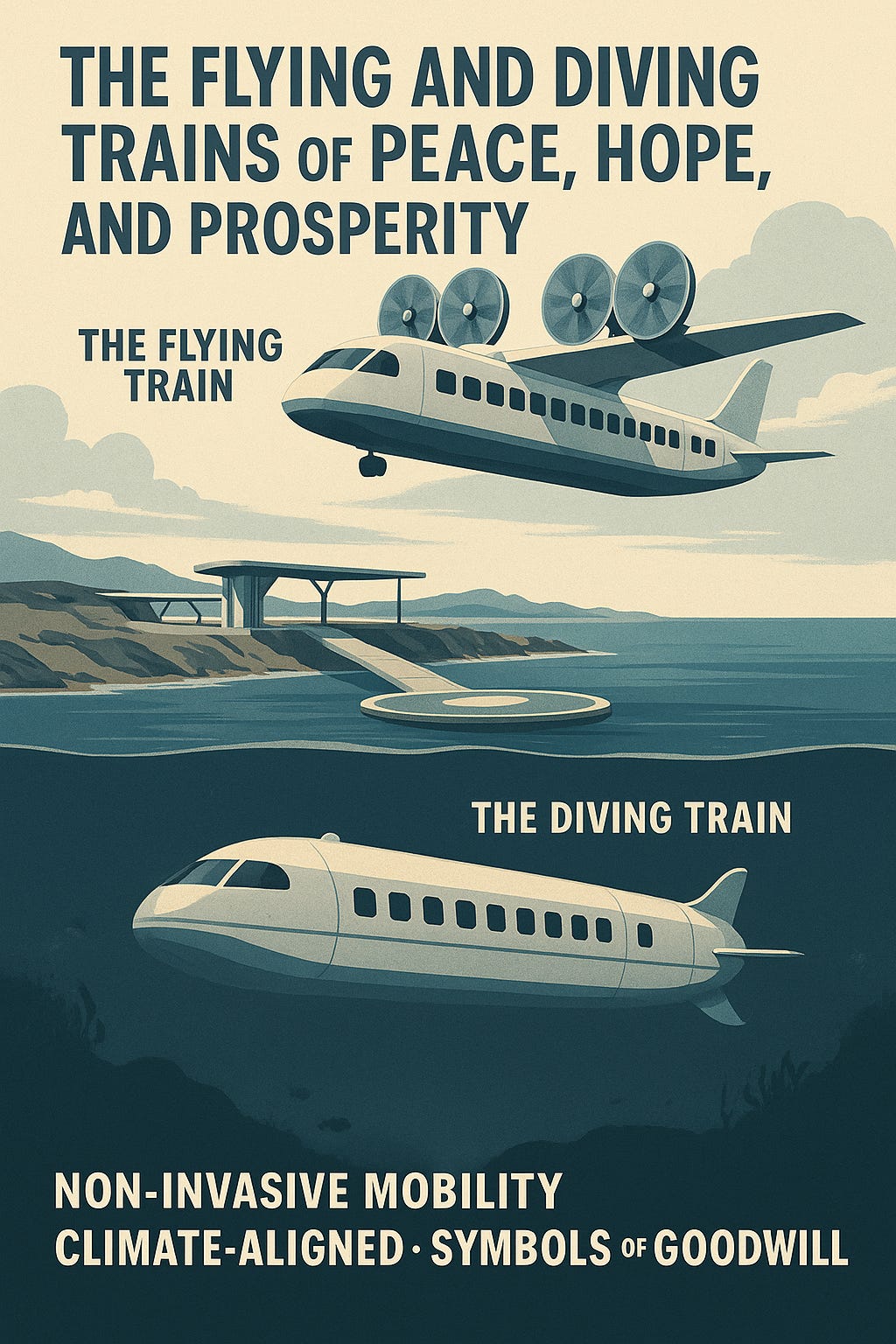
The Flying and Diving Trains of Peace, Hope, and Prosperity
Uniting Nations Across Sky and Sea
Introduction: A New Kind of Bridge
As the 21st century faces unprecedented challenges — from climate change to geopolitical division — the need for nonviolent, visionary infrastructure is clearer than ever. The Trains of Peace, Hope, and Prosperity rise to this call with a new model of connection: modular flying and diving trains that bypass borders and terrain to reach people where they are.
Unlike traditional rail systems, these trains don’t require tracks, tunnels, or bridges. They soar across the sky or glide beneath the waves, creating new routes of unity between regions long separated by distance or politics.
The Flying Train: Bridging Continents Above
✈️ Concept
The Flying Train of Peace is a Vertical Take-Off and Landing (VTOL) modular aircraft system, designed to carry people and goods between rural or hard-to-access regions — especially those separated by water or mountainous terrain.

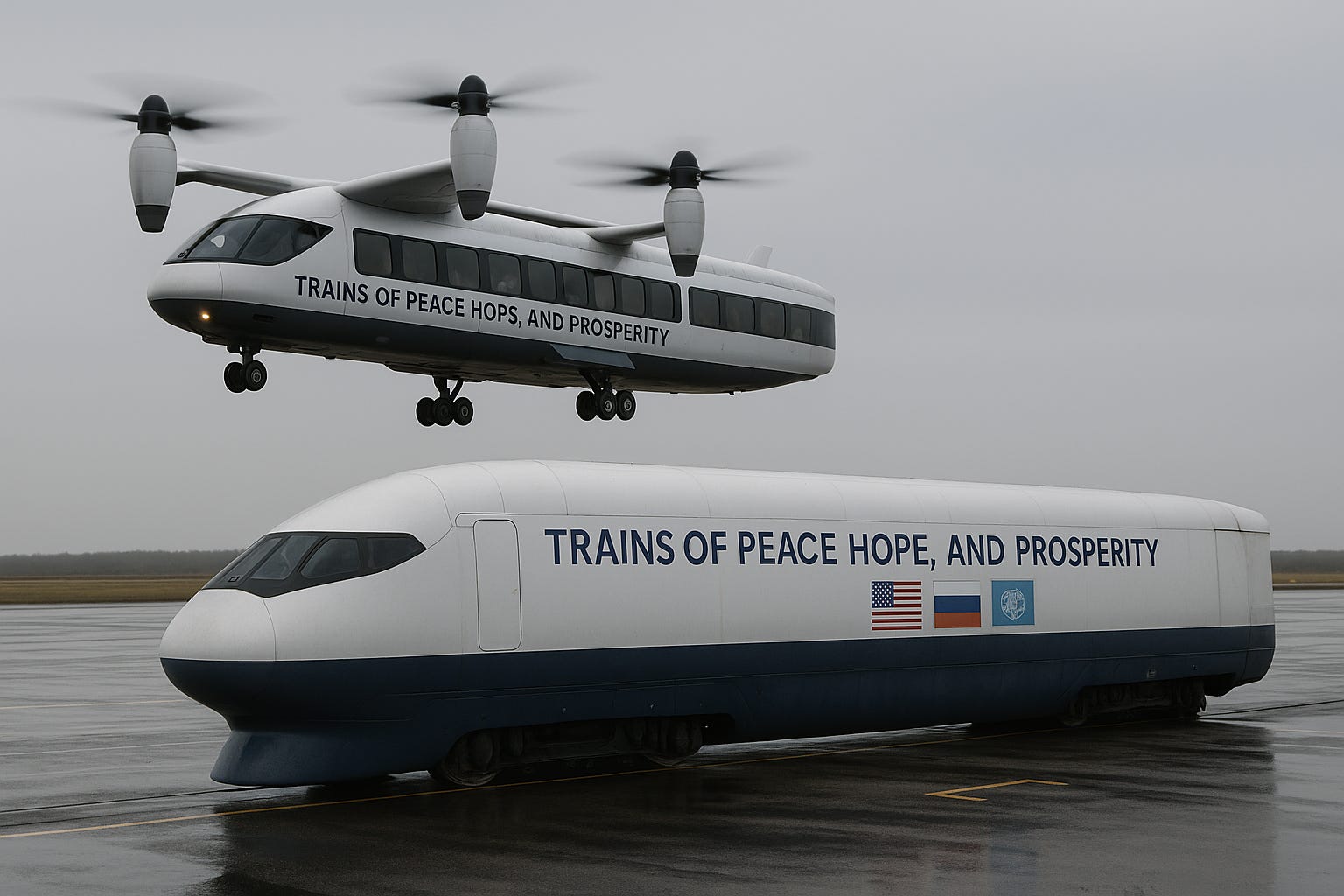
🌍 Flagship Route: Alaska to Russia
-
Wales, Alaska ➝ Uelen, Chukotka
-
Supplemented by hubs in Nome, Provideniya, and regional capitals
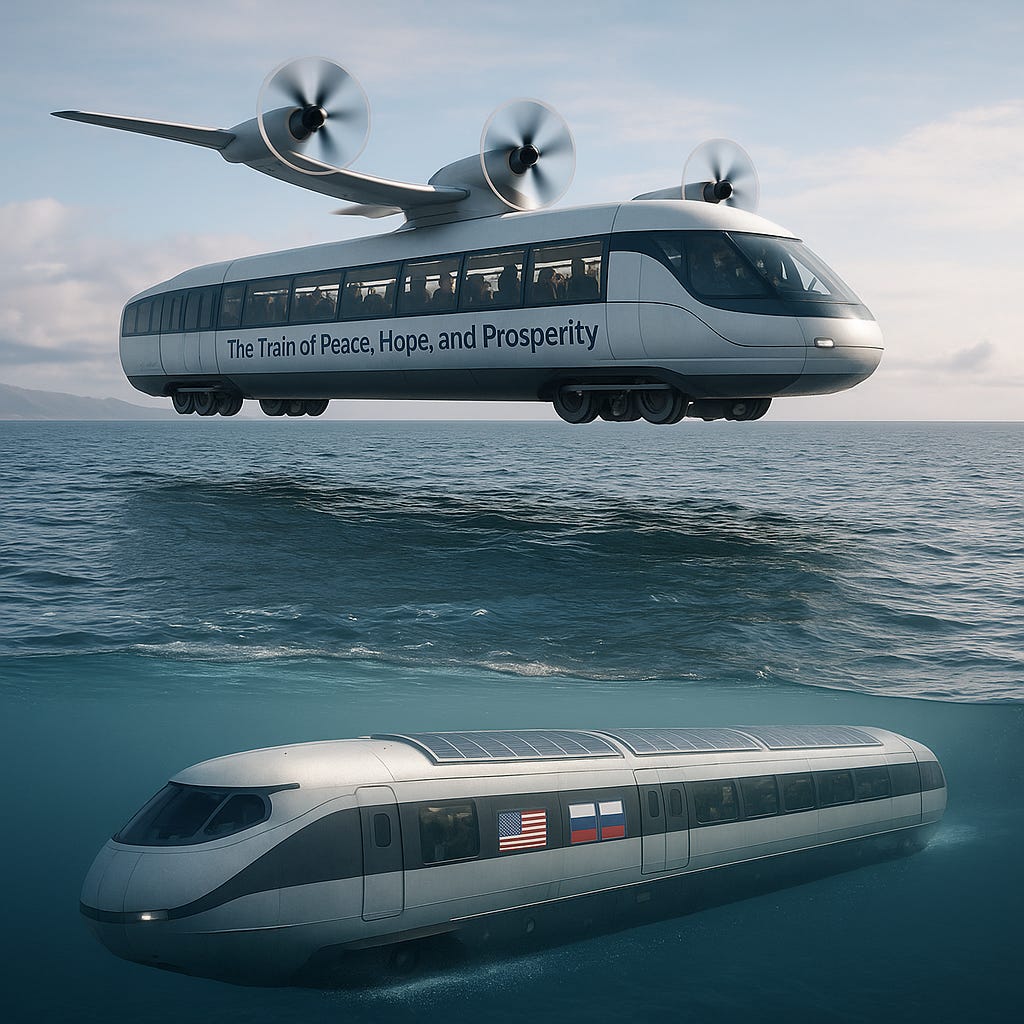
This symbolic flight route over the Bering Strait, just 86 km wide, represents not only a practical shortcut between two continents, but a gesture of peaceful cooperation between the USA and Russia.
⚙️ Key Features
-
Electric ducted fans for vertical lift and smooth flight
-
Modular cabins (2–4 per train) with up to 60 passengers or cargo
-
AI-guided navigation using satellite and sensor fusion
-
Skyports with solar charging, customs, and emergency services
🎯 Applications
-
Cross-border humanitarian exchange
-
Climate-resilient rural transit
-
Emergency response and supply missions
-
Cultural exchange programs
The Diving Train: Linking Shores Beneath
🌊 Concept
The Diving Train of Hope is a pressurized, submersible capsule system that navigates just below the ocean surface, providing safe, quiet, and eco-friendly travel between islands, continents, and coastlines.
Unlike submarines, it operates close to shore, using autonomous guidance, clean power, and vertical dive ports at either end of the route.
🔗 Example Routes
-
Mediterranean Peace Line: North Africa to Southern Europe
-
Japan–South Korea Dive Route: Bypassing geopolitical tensions
-
Nordic Deep Loop: Greenland – Iceland – Faroe – Norway
-
Alaska–Russia (Underwater Backup): Alternate path to the flying train
⚙️ Key Features
-
Hybrid electric/hydrogen propulsion
-
100–200 meter dive capability
-
Pressurized modular cabins with emergency pods
-
Marine-life-safe design and sonar awareness
🎯 Applications
-
Arctic and archipelago logistics
-
Tourism and international research
-
Coastal community integration
-
Silent, weather-resistant transport between peaceful zones
Shared Purpose, Distinct Paths
While one takes flight and the other dives deep, both trains share the same mission:
🕊️ Peace
Neutral, demilitarized, non-aggressive mobility for cross-border unity
🌱 Hope
Accessible transport for regions excluded from major infrastructure grids
💠 Prosperity
Trade, tourism, cultural exchange, and humanitarian logistics made simple and sustainable
Technology and Infrastructure
| Feature | Flying Train | Diving Train |
|---|---|---|
| Navigation | AI-guided GPS + radar | Sonar + underwater GPS |
| Power | Battery-solar hybrid | Battery-hydrogen hybrid |
| Capacity | 40–60 passengers | 30–50 passengers |
| Station Type | Skyport towers | Coastal dive terminals |
| Environmental Focus | No land footprint | Marine-safe propulsion |
| Symbolic Value | Bridging continents | Crossing beneath divisions |
Visual Identity
-
Logo: A train silhouette split into wings and waves, bridged by a dove
-
Color Theme: Sky blue (hope), deep sea blue (peace), and gold (prosperity)
-
Slogans:
-
"Across the Strait, Toward Peace."
-
"Where Rails Can’t Go, We Will."
-
"Under or Over — We Connect."
-
Conclusion: Peace Is a Route, Not Just a Goal
The Flying and Diving Trains of Peace, Hope, and Prosperity are more than transport systems — they are mobile gestures of unity in a divided world. Whether floating above the Earth or gliding below its oceans, these trains create new connections, grounded not in dominance or extraction, but in collaboration, mobility, and dignity.
They remind us that the true purpose of infrastructure is not just movement — but meaning.
The future of diplomacy and development may not be built in stone… but in motion.

Great! Here's the plan to move forward with this focused Bering Strait Flying Train project:
Proposal Components for the Flying Train from Rural Alaska to Russia
1. Visual Identity
- Name: The Train of Peace, Hope, and Prosperity
- Logo concept: A minimalist flying train above two symbolic waves (representing the USA and Russia) with a peace dove or handshake icon in between.
- Slogan ideas:
- “Bridging Continents, One Flight at a Time.”
- “Across the Strait, Toward Peace.”
- “Linking Land, Building Trust.”
2. Map / Visual Diagram
A simple map showing:
- The Bering Strait
- Sky stations:
- Wales (Alaska)
- Nome (Alaska)
- Uelen (Russia)
- Provideniya (Russia)
- Arrows showing the flight path of the train
3. Train Design Overview
- Structure: Modular, VTOL-capable flying train with 2–4 cabins
- Capacity: 40–60 passengers or equivalent cargo
- Energy: Electric with battery-solar hybrid, optional hydrogen backup
- Navigation: AI-assisted autopilot, satellite-linked GPS, radar, and LIDAR
- Runways: Vertical takeoff/landing pads with charging docks at each station
4. Station Designs
Wales & Nome (USA):
- Small skyport with:
- Vertical landing platform
- Solar panels
- Border control & customs module
- Basic passenger shelter or waiting area
Uelen & Provideniya (Russia):
- Similar design, adapted for Arctic weather
- Potential partnership with Russian and international aid orgs
5. Operational Purpose
- Cultural exchange flights
- Humanitarian support
- Seasonal supply delivery
- Scientific and Arctic research mobility
- Peace initiative between two nations
Great! Here's the plan to move forward with this focused Bering Strait Flying Train project:
Proposal Components for the Flying Train from Rural Alaska to Russia
1. Visual Identity
- Name: The Train of Peace, Hope, and Prosperity
- Logo concept: A minimalist flying train above two symbolic waves (representing the USA and Russia) with a peace dove or handshake icon in between.
- Slogan ideas:
- “Bridging Continents, One Flight at a Time.”
- “Across the Strait, Toward Peace.”
- “Linking Land, Building Trust.”
2. Map / Visual Diagram
A simple map showing:
- The Bering Strait
- Sky stations:
- Wales (Alaska)
- Nome (Alaska)
- Uelen (Russia)
- Provideniya (Russia)
- Arrows showing the flight path of the train
3. Train Design Overview
- Structure: Modular, VTOL-capable flying train with 2–4 cabins
- Capacity: 40–60 passengers or equivalent cargo
- Energy: Electric with battery-solar hybrid, optional hydrogen backup
- Navigation: AI-assisted autopilot, satellite-linked GPS, radar, and LIDAR
- Runways: Vertical takeoff/landing pads with charging docks at each station
4. Station Designs
Wales & Nome (USA):
- Small skyport with:
- Vertical landing platform
- Solar panels
- Border control & customs module
- Basic passenger shelter or waiting area
Uelen & Provideniya (Russia):
- Similar design, adapted for Arctic weather
- Potential partnership with Russian and international aid orgs
5. Operational Purpose
- Cultural exchange flights
- Humanitarian support
- Seasonal supply delivery
- Scientific and Arctic research mobility
- Peace initiative between two nations
Great! Here's the plan to move forward with this focused Bering Strait Flying Train project:
Proposal Components for the Flying Train from Rural Alaska to Russia
1. Visual Identity
- Name: The Train of Peace, Hope, and Prosperity
- Logo concept: A minimalist flying train above two symbolic waves (representing the USA and Russia) with a peace dove or handshake icon in between.
- Slogan ideas:
- “Bridging Continents, One Flight at a Time.”
- “Across the Strait, Toward Peace.”
- “Linking Land, Building Trust.”
2. Map / Visual Diagram
A simple map showing:
- The Bering Strait
- Sky stations:
- Wales (Alaska)
- Nome (Alaska)
- Uelen (Russia)
- Provideniya (Russia)
- Arrows showing the flight path of the train
3. Train Design Overview
- Structure: Modular, VTOL-capable flying train with 2–4 cabins
- Capacity: 40–60 passengers or equivalent cargo
- Energy: Electric with battery-solar hybrid, optional hydrogen backup
- Navigation: AI-assisted autopilot, satellite-linked GPS, radar, and LIDAR
- Runways: Vertical takeoff/landing pads with charging docks at each station
4. Station Designs
Wales & Nome (USA):
- Small skyport with:
- Vertical landing platform
- Solar panels
- Border control & customs module
- Basic passenger shelter or waiting area
Uelen & Provideniya (Russia):
- Similar design, adapted for Arctic weather
- Potential partnership with Russian and international aid orgs
5. Operational Purpose
- Cultural exchange flights
- Humanitarian support
- Seasonal supply delivery
- Scientific and Arctic research mobility
- Peace initiative between two nations
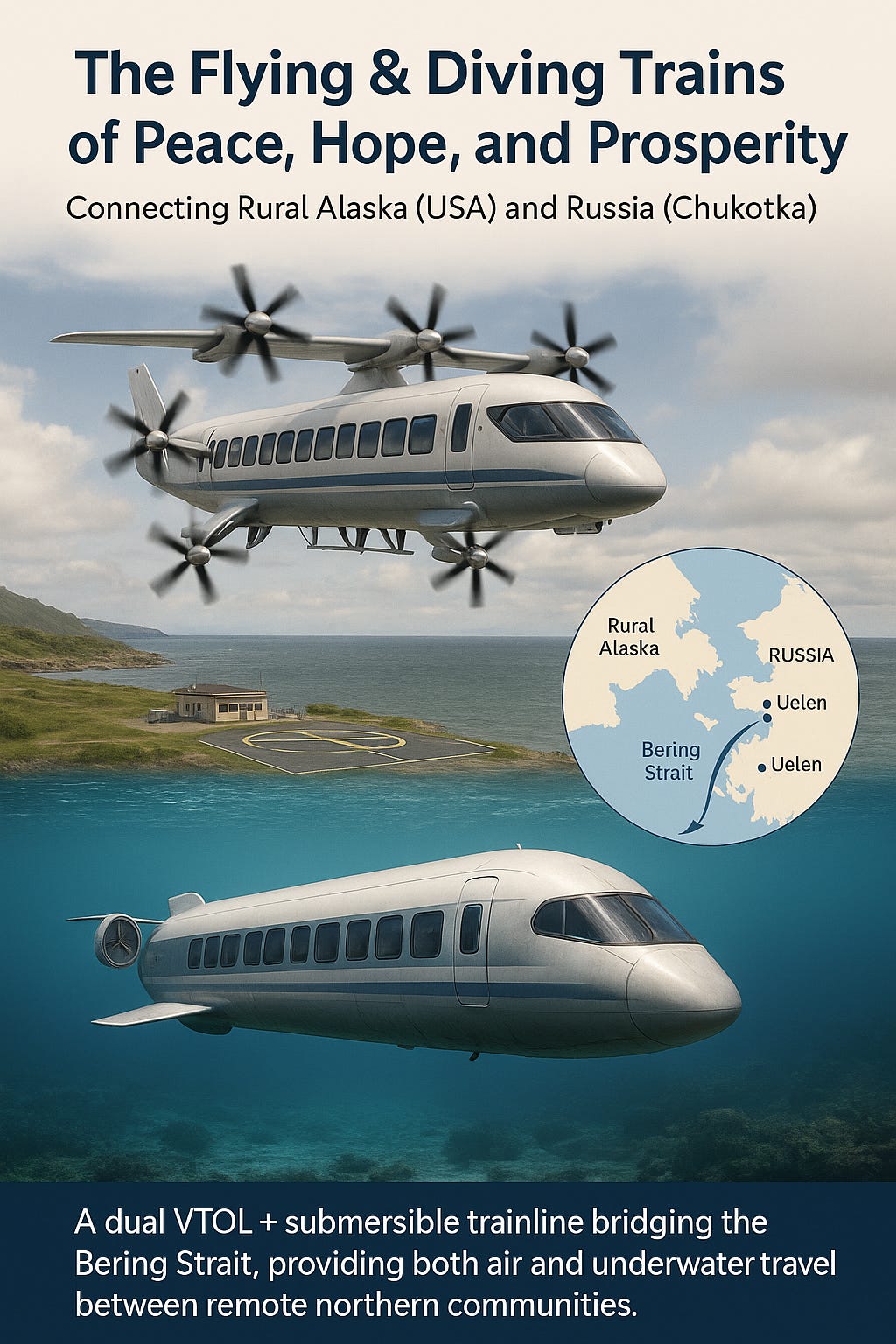
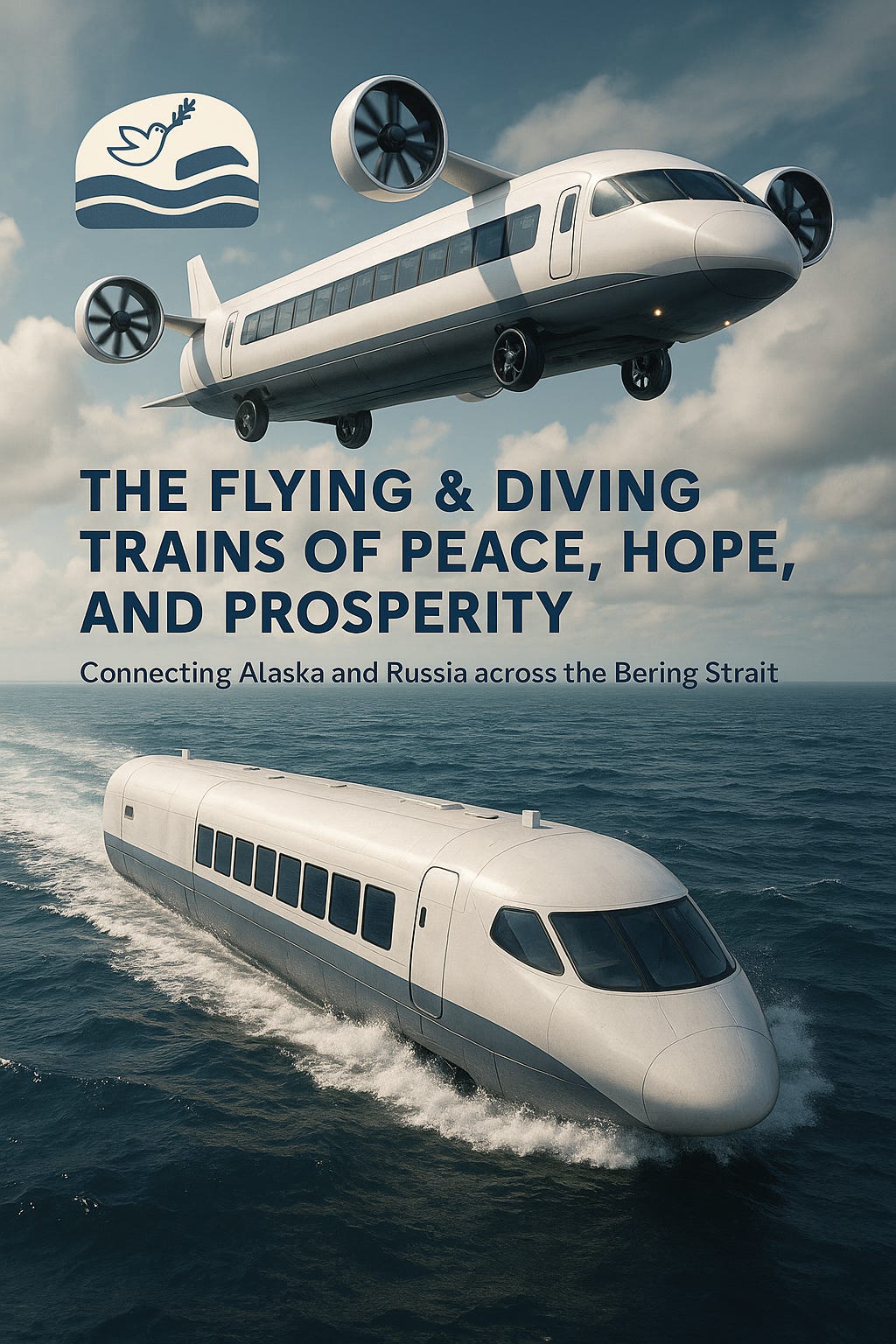
Proposal Components for the Flying Train from Rural Alaska to Russia
1. Visual Identity
- Name: The Train of Peace, Hope, and Prosperity
- Logo concept: A minimalist flying train above two symbolic waves (representing the USA and Russia) with a peace dove or handshake icon in between.
- Slogan ideas:
- “Bridging Continents, One Flight at a Time.”
- “Across the Strait, Toward Peace.”
- “Linking Land, Building Trust.”
2. Map / Visual Diagram
A simple map showing:
- The Bering Strait
- Sky stations:
- Wales (Alaska)
- Nome (Alaska)
- Uelen (Russia)
- Provideniya (Russia)
- Arrows showing the flight path of the train
3. Train Design Overview
- Structure: Modular, VTOL-capable flying train with 2–4 cabins
- Capacity: 40–60 passengers or equivalent cargo
- Energy: Electric with battery-solar hybrid, optional hydrogen backup
- Navigation: AI-assisted autopilot, satellite-linked GPS, radar, and LIDAR
- Runways: Vertical takeoff/landing pads with charging docks at each station
4. Station Designs
Wales & Nome (USA):
- Small skyport with:
- Vertical landing platform
- Solar panels
- Border control & customs module
- Basic passenger shelter or waiting area
Uelen & Provideniya (Russia):
- Similar design, adapted for Arctic weather
- Potential partnership with Russian and international aid orgs
5. Operational Purpose
- Cultural exchange flights
- Humanitarian support
- Seasonal supply delivery
- Scientific and Arctic research mobility
- Peace initiative between two nations


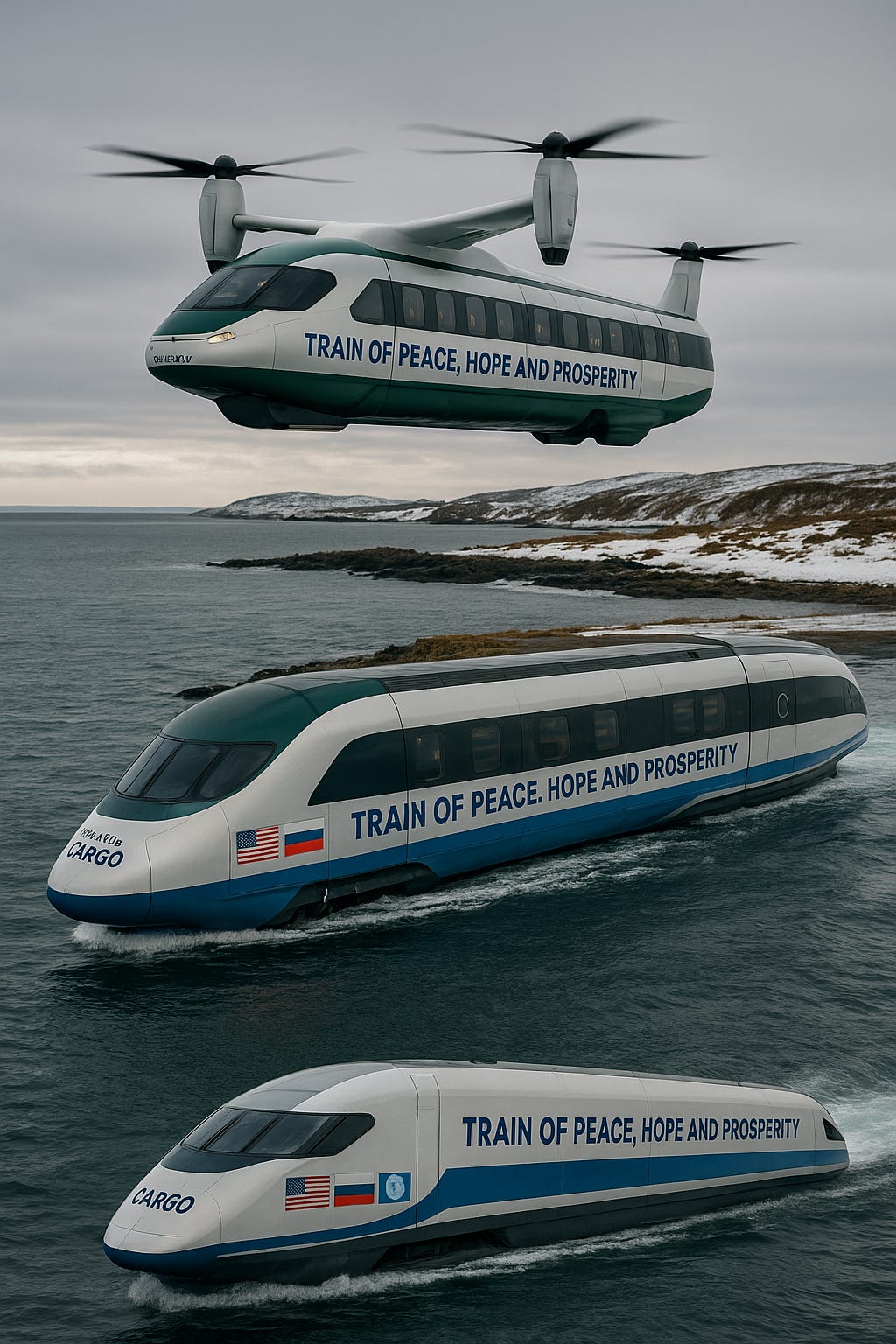
The Diving Trains of Peace, Hope, and Prosperity
Linking Continents Below the Surface, Connecting Humanity Above All
Introduction
While flying trains are taking mobility to the skies, another path to peace is forming beneath the waves. Introducing the Diving Trains of Peace, Hope, and Prosperity — a revolutionary transportation concept designed to connect remote coastal communities, island chains, and international partners through the ocean itself.
Using submersible VTOL capsule technology, these trains are engineered for underwater navigation across strategic routes. Quiet, clean, and shielded from surface hazards, they offer a new way to unite divided lands — not by crossing them, but by flowing underneath them.
The Concept
Diving Trains are modular submersible vehicles capable of both surface cruising and underwater descent. Built with hybrid propulsion and autonomous navigation, each train links dedicated coastal dive terminals in regions separated by water — especially where bridges or flights are impractical.
This project mirrors its airborne counterpart by serving rural, strategic, or underserved locations — fostering peace, humanitarian exchange, and climate-resilient transport infrastructure.
How It Works
🌊 Dual-Mode Navigation
-
Surface Mode: Cruises like a ship or water train, powered by electric or hydrogen systems
-
Diving Mode: Submerges to a depth of up to 100–200 meters for safe, direct underwater travel
-
VTOL Boost: Uses small vertical rotors for controlled diving and surfacing at terminals
🧠 Smart Submarine Guidance
-
AI-assisted underwater navigation
-
Sonar mapping, terrain following, and obstacle detection
-
Satellite and submarine cable-linked communications
Use Cases & Routes
| Route Example | Why It Matters |
|---|---|
| Alaska – Chukotka (Underwater Option) | An alternative for bad weather days or secure routes |
| Japan – South Korea Coastal Dive Line | Connects major Asian democracies with peaceful tech |
| Mediterranean Peace Line | Linking North African and Southern European coastal towns |
| Nordic Island Routes | Greenland, Iceland, Faroe Islands, and Norway dive stops |
Diving trains are especially suited for cold waters, deep fjords, archipelagos, and climate-threatened zones.
Train & Terminal Design
🚆 The Diving Train Module
-
Modular: 2 to 4 connected pressurized cabins
-
Capacity: 30–50 passengers or equivalent cargo
-
Pressure-resistant composite body
-
Emergency flotation pods
-
Quiet electric propulsion (zero noise pollution to marine life)
🛟 Dive Terminals
-
Shore-based vertical ports
-
Modular docks with diving lifts
-
Emergency oxygen systems and decontamination stations
-
Optionally solar- or tidal-powered platforms
Mission & Symbolism
More than a transportation solution, the Diving Trains represent:
-
Peace through connection — avoiding military sea lanes or disputed airspace
-
Hope for isolated communities — connecting islands, cultures, and coastlines
-
Prosperity through cooperation — enabling trade, tourism, and humanitarian relief where no bridge can reach
They are silent ambassadors beneath the ocean — passing quietly, purposefully, and peacefully through shared waters.
Environmental Harmony
The trains are designed with marine life in mind:
-
Non-invasive propulsion (low cavitation, no sonar disruption)
-
Biodegradable exterior coatings
-
Marine-life detection and avoidance AI
-
Green energy-powered charging terminals
They are not just tools of mobility — they are guardians of the seas.
Conclusion
As climate, conflict, and geography divide people, humanity must invent new paths toward connection. The Diving Trains of Peace, Hope, and Prosperity dive beneath boundaries, rising instead in purpose.
Quiet, clean, and collaborative — these trains are not built to conquer, but to connect. In a world often torn by what's above the surface, they carry a new message:
Peace flows deepest when it moves silently below.


The Flying and Diving Trains of Peace, Hope, and Prosperity
New Routes for a Divided World
Introduction
In a world increasingly strained by political divisions, climate disruption, and failing infrastructure, bold new ideas are needed—ideas that don’t just move people and goods, but also hearts and minds. One such idea now takes form not on the land, but above it and below it.
Introducing the Flying and Diving Trains of Peace, Hope, and Prosperity—modular, clean-energy vehicles that cross borders through the sky and under the sea, without laying a single rail or building a single bridge.
These are not trains in the conventional sense. They are vessels of connection, designed to serve as peaceful links between nations, cultures, and remote communities. They are transport systems with a mission: to demonstrate that mobility, cooperation, and coexistence are possible—no matter the barriers.
The Flying Train
The Flying Train of Peace is a vertical take-off and landing (VTOL) modular aircraft that functions like a short-range airborne rail system. With no need for ground-based tracks or tunnels, it can move seamlessly between isolated settlements, divided territories, or climate-challenged landscapes.
The Bering Strait is the project’s flagship route—a symbolic and practical connection between rural Alaska and eastern Russia. The train would fly between skyports in Wales, Nome, Uelen, and Provideniya, using short-hop clean-energy flights to bridge a narrow gap that has long felt like an ocean.
Each train unit includes multiple cabins, each capable of transporting passengers or cargo. The aircraft is powered by silent electric ducted fans, navigated by autonomous AI, and guided by satellite-linked systems. Charging stations, customs points, and shelters are all built into compact skyport towers—designed for Arctic weather and remote operation.
This isn’t just a futuristic transit idea. It’s a step toward what peaceful infrastructure can look like: modular, climate-resilient, and independent of political disputes over land.
The Diving Train
Beneath the sea, its sibling project takes a different but equally powerful form. The Diving Train of Hope is a pressurized, submersible transit system that moves through shallow coastal waters, fjords, and sea channels. It’s built to reach the communities that boats rarely serve and where aircraft are too expensive or weather-dependent.
The diving train descends gently from specialized shoreline terminals, then cruises silently underwater—avoiding storms, geopolitical airspace, and environmental impact. It offers a new mode of mobility for islands, coastal nations, and sea-linked neighbors who have long been separated by geography.
Example routes could include a peaceful corridor between Japan and South Korea, a Mediterranean line between North Africa and Southern Europe, or a Nordic underwater loop connecting Greenland, Iceland, the Faroe Islands, and Norway. In each case, the goal remains the same: connect people who are close in spirit but far by sea.
Like its airborne counterpart, the diving train uses modular, electric cabins. These submersibles are equipped with sonar navigation, marine-life-friendly propulsion, and emergency flotation capsules. The shoreline terminals require no sprawling infrastructure—only compact vertical ports that descend straight into the sea.
The Shared Vision
While the flying and diving trains follow different paths—one soaring above, the other diving below—they are united by a singular purpose.
In both form and function, these trains break free from the past. They do not follow old colonial trade routes, nor do they mimic extractive corridors built only for economic gain. Instead, they imagine a future in which infrastructure is a force for reconciliation—between peoples, between nations, and between humanity and nature.
Conclusion
The Flying and Diving Trains of Peace, Hope, and Prosperity are more than machines. They are ideas in motion.
In a time when the world seems to be drawing lines, these trains draw arcs—graceful curves that rise and fall, not in conflict, but in peace.




Comments
Post a Comment