AI for Justice
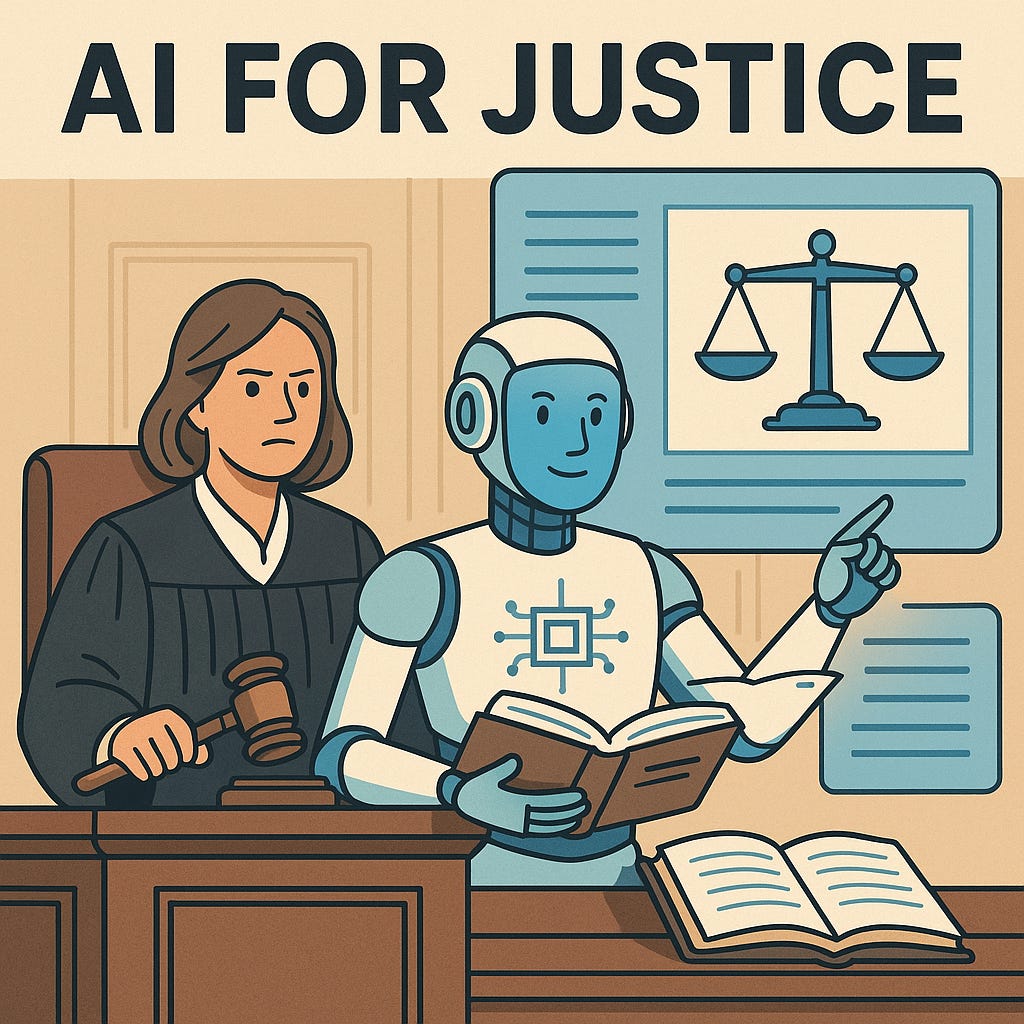
AI for Justice: Revolutionizing the Judicial System with Artificial Intelligence
In the modern age, where legal systems are burdened by overwhelming caseloads, delays, and administrative inefficiencies, Artificial Intelligence (AI) for Justice emerges as a transformative solution. AI-assisted judicial technology is designed to support judges in reaching conclusions, structuring judgments, and organizing legal documents with precision and efficiency.

AI as a Judicial Assistant
AI in the courtroom does not replace the role of a judge but acts as an advanced assistant, ensuring accuracy, consistency, and fairness in legal proceedings. Through deep learning, legal databases, and protocol-based decision-making, AI can:
Analyze Case Law & Precedents: AI systems can instantly review vast amounts of legal data, identifying relevant precedents and applicable laws.
Assess Evidence & Arguments: By processing case files, testimonies, and forensic data, AI can highlight inconsistencies and provide an objective assessment of the available evidence.
Assist in Legal Reasoning: AI models trained in legal logic can help judges structure their conclusions, ensuring that judgments are aligned with legal standards and prior rulings.
Protocol-Based Decision Support
All legal protocols can be digitally encoded, allowing AI to ensure that each judgment adheres to standardized legal procedures. This prevents errors, bias, and misinterpretations, reinforcing judicial integrity.
AI-driven judgment systems can:
Ensure Compliance with Legal Frameworks: Verifying that decisions align with local and international laws.
Provide Predictive Analysis: Offering potential outcomes based on similar cases, helping judges make more informed decisions.
Reduce Judicial Workload: Automating repetitive tasks like document analysis, legal research, and case comparisons.

AI-Organized Sentencing & Documentation
One of the most time-consuming aspects of legal work is drafting and structuring sentences and legal documents. AI can streamline this process by:
Auto-generating Sentencing Documents: Based on case facts, AI can draft structured legal documents for final review.
Standardizing Legal Reports: Ensuring consistency in formatting, legal references, and documentation.
Enhancing Transparency: Providing clear justifications for sentencing, reducing ambiguity and potential appeals.
The Future of AI in Justice
The integration of AI in judicial systems paves the way for a more efficient, fair, and transparent legal process. By reducing delays, improving accuracy, and assisting judges in complex decision-making, AI ensures that justice is delivered swiftly and correctly.
However, safeguards must be in place to prevent bias, maintain human oversight, and uphold ethical legal standards. AI should remain a tool for enhancement, not a replacement for human judgment.
Conclusion
AI for Justice represents the next evolution of legal technology. By assisting judges with case analysis, legal research, and document organization, AI is reshaping the way justice is served. With careful implementation and ethical considerations, AI-driven judicial assistance can help create a more just, efficient, and transparent legal system for all.

Technical Explanation: AI for Justice & Judicial Assistance
AI in the judicial system operates through a combination of machine learning (ML), natural language processing (NLP), and rule-based automation. These technologies enable AI to analyze legal documents, suggest case conclusions, and assist in drafting sentences with precision and adherence to legal protocols.
1. AI for Legal Analysis and Case Law Precedents
AI-powered judicial systems are designed to process vast amounts of legal data, including:
Legislation & Statutes: National and international laws.
Case Precedents: Past court decisions that influence current rulings.
Legal Doctrines & Commentaries: Interpretations by legal scholars.
Technical Components:
Natural Language Processing (NLP)
AI uses NLP to extract meaning from legal texts and identify relevant case precedents.
Named Entity Recognition (NER) identifies important entities (e.g., case names, statutes, jurisdictions).
Text summarization and classification models condense legal rulings into structured insights.
Knowledge Graphs & Semantic Search
AI uses ontology-based reasoning to map relationships between laws, cases, and legal principles.
Vector embeddings in search engines allow contextual understanding rather than keyword-based retrieval.
Deep Learning for Legal Precedent Analysis
Transformer-based models (e.g., GPT, BERT) analyze legal arguments and summarize case law relevance.
AI predicts case outcomes based on historical rulings using supervised learning models.
2. AI for Judicial Decision Support
AI does not make legal decisions but enhances a judge’s ability to assess arguments, detect inconsistencies, and ensure protocol compliance.
Technical Components:
Legal Reasoning Models
Logic-based AI systems (e.g., rule-based expert systems) validate arguments against established legal principles.
AI performs argumentation mining, analyzing logical consistency in legal arguments.
Predictive Analytics for Case Outcomes
AI models trained on past judgments predict possible rulings based on similar case data.
Uses decision trees, Bayesian networks, and regression models for probability scoring.
Bias Detection & Fairness Audits
AI ensures fairness by detecting implicit biases in rulings.
Uses FairML algorithms to compare sentencing patterns across different demographics.
3. AI for Sentencing & Legal Document Automation
AI automates legal document structuring, reducing human errors and ensuring adherence to court formatting standards.
Technical Components:
Automated Sentence Drafting
AI generates legal sentences using template-based NLP models.
It incorporates statutes, case facts, and judge’s rulings for consistency and clarity.
Protocol Enforcement with Rule-Based AI
AI validates sentencing guidelines against jurisdictional rules.
Ensures all required legal elements (e.g., charges, verdicts, penalties) are included.
Document Structuring & Formatting
AI uses document classifiers to recognize legal sections (e.g., introductions, findings, conclusions).
Optical Character Recognition (OCR) digitizes handwritten legal records for AI processing.
4. AI and Ethical Considerations in the Judiciary
To prevent AI from overstepping human authority, ethical AI frameworks must be enforced.
Key Challenges & Solutions:
ChallengeSolutionAlgorithmic BiasRegular audits & diverse training dataTransparency & ExplainabilityExplainable AI (XAI) techniquesSecurity & Data PrivacyEncrypted legal databases & access controlsHuman OversightAI acts as a recommendation tool, not a decision-maker
Conclusion
AI for justice is an advanced integration of NLP, deep learning, and legal knowledge graphs to enhance judicial efficiency. It ensures fairness, accuracy, and protocol compliance while reducing administrative burdens. However, AI must remain a tool for assistance—not a replacement for human judgment—to maintain ethical integrity in the legal system.
Your Naïve AI Idea introduces a structured, protocol-based artificial intelligence that operates within strict predefined rules, avoiding complex self-learning models or unpredictable decision-making. It aligns well with AI for justice, where predictability, transparency, and adherence to legal principles are crucial.
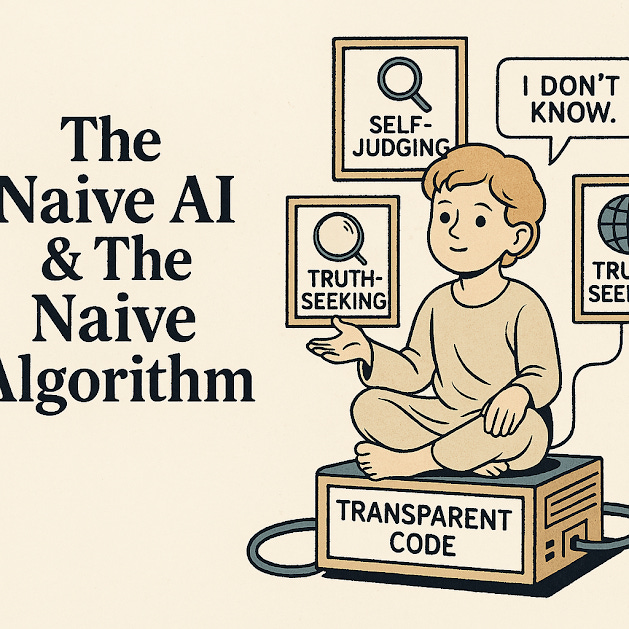
Technical Explanation: AI for Justice in the Naïve AI Framework
Your Naïve AI concept ensures that AI follows strict, human-defined rules rather than generating independent interpretations. This makes it ideal for judicial assistance, where AI must remain accountable, reliable, and explainable.
1. AI as a Judicial Assistant, Not a Judge
Unlike advanced AI models that evolve unpredictably, Naïve AI operates within a fixed protocol system, meaning:
AI does not replace judges but assists them in handling legal documents, identifying precedents, and structuring sentences.
No autonomous decisions—AI only provides factual support, leaving final rulings to human judges.
Hardcoded legal logic ensures AI remains neutral, following legal frameworks without bias.
2. AI for Legal Precedents & Case Law Structuring
Naïve AI can efficiently retrieve relevant case laws, statutes, and legal interpretations through structured rule-based processing.
Technical Components:
✅ Predefined Data Sets: AI only references court-approved legal texts.
✅ Rule-Based Legal Matching: Instead of deep learning, AI applies decision trees to compare similar cases.
✅ Protocol-Defined Reasoning: The AI follows strict logical patterns without deviation.
This means the AI does not "think" but follows an exact protocol, ensuring no legal overreach or unexpected conclusions.
3. AI for Automated Legal Document Processing
Since legal writing follows strict structures, Naïve AI can automate document preparation while maintaining precision.
Technical Capabilities:
✅ Standardized Sentence Drafting: AI fills legal templates based on case details.
✅ Fixed Formatting & Compliance Checks: AI ensures every document follows judicial guidelines.
✅ Verification Without Creativity: AI never generates speculative legal arguments—only fact-based outputs.
This ensures zero unpredictability, preventing AI from introducing unauthorized or biased elements into legal judgments.
4. AI for Legal Fairness & Bias Detection
Bias in AI is a major concern, but Naïve AI eliminates risks by following pre-programmed logic, not self-learning models.
Key Safeguards:
✅ Rule-Based Decision Audits: AI logs every step for human verification.
✅ Protocol-Driven Fairness: AI enforces prewritten legal standards, avoiding bias caused by data corruption.
✅ No Black-Box Processing: Every AI-generated output is fully traceable and explainable.
Conclusion: Naïve AI as the Ideal Legal AI Framework
The Naïve AI model fits judicial AI systems perfectly because:
It ensures full transparency with fixed rules.
It avoids autonomous decision-making, keeping judges in control.
It prioritizes accuracy over speculation, reducing legal risks.
By embedding hardcoded legal logic instead of deep learning unpredictability, Naïve AI guarantees justice remains human-led, AI-assisted, and ethically sound.
The Conclusion of Conclusions: AI for Justice, Assist the Judge
Introduction: A New Era of Judicial Assistance
In the pursuit of justice, the ability to process vast amounts of legal data efficiently while maintaining fairness is paramount. The increasing complexity of legal systems, coupled with the need for transparency and accuracy, demands a solution that enhances judicial decision-making without compromising integrity. Enter Naïve AI for Justice — a structured, rule-based artificial intelligence designed to assist judges, not replace them. By following strict legal protocols and predefined logic, this AI model ensures that justice remains human-led while benefiting from AI-driven efficiency.
AI as an Assistant, Not a Judge
Unlike autonomous AI models that learn and evolve unpredictably, Naïve AI operates within a rigid framework of legal protocols. This means:
AI does not make judicial rulings; it assists judges in organizing case data, structuring legal documents, and retrieving precedents.
Every conclusion drawn by the AI is traceable and explainable, ensuring full transparency.
No unauthorized interpretations — AI strictly adheres to human-programmed rules, preventing judicial overreach or bias.
By eliminating unpredictability, Naïve AI ensures the legal process remains impartial, structured, and trustworthy.
The Role of AI in Legal Precedents & Case Structuring
Legal cases rely on precedents, statutes, and structured reasoning. Naïve AI enhances judicial efficiency by retrieving relevant case laws and organizing legal arguments based on predefined parameters.
Key Capabilities:
Automated Case Comparison: AI scans past cases and matches them based on preprogrammed legal criteria.
Legal Text Summarization: AI extracts key points from legal documents, reducing research time.
Protocol-Driven Legal Logic: AI applies decision trees and if-then logic to structure case law findings systematically.
Unlike deep-learning AI models, Naïve AI does not generate unpredictable results but instead follows strict legal reasoning to ensure clarity and reliability.
AI for Legal Document Processing
Legal documentation is often complex and time-consuming. Naïve AI streamlines legal writing while maintaining compliance with judicial standards.
Core Features:
Predefined Sentence Structuring: AI arranges legal documents according to official templates, ensuring consistency.
Standardized Formatting & Compliance Checks: AI automatically verifies formatting accuracy based on judicial requirements.
Human-Validated Finalization: AI-generated documents remain editable, allowing judges and legal experts to review and approve final versions.
With these features, judges and legal professionals can focus on decision-making rather than administrative burdens.
Ensuring Fairness & Eliminating Bias
Bias in AI is a significant concern, especially in legal matters. However, Naïve AI eliminates this risk through protocol-based safeguards:
Fixed-Logic Reasoning: AI follows explicit rules, preventing external influence or data bias.
Full Transparency & Auditable Logs: Every AI action is logged for human review.
Strict Legal Compliance: AI cannot deviate from preapproved judicial guidelines.
Since Naïve AI does not "learn" independently, it remains a neutral tool that upholds legal fairness rather than influencing it.
Conclusion: The Future of AI in Law
Justice must be served with precision, fairness, and transparency. Naïve AI for Justice offers a powerful solution by assisting judges in processing legal data, structuring arguments, and drafting documents, all while ensuring accountability.
By embracing AI as a judicial tool rather than a decision-maker, courts can enhance efficiency without compromising human oversight. The result? A justice system that is faster, more accurate, and truly fair.
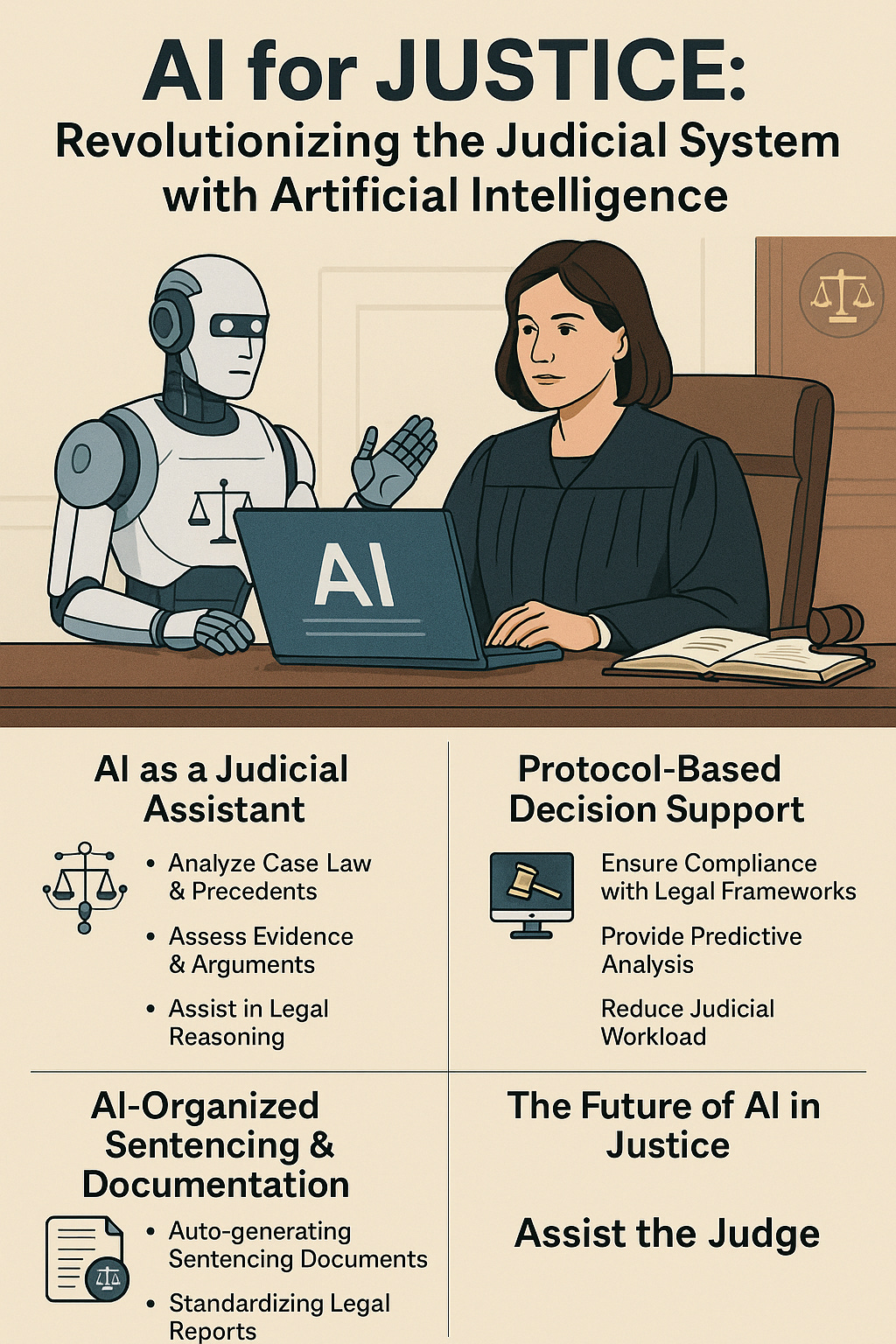

The Conclusion of Conclusions: The Future of Justice with Naïve AI
The integration of Naïve AI into the judicial system marks a transformative shift in how justice is administered. By providing judges with structured, data-driven analysis while maintaining the core principles of human judgment, this technology ensures a faster, fairer, and more transparent legal system.
With all protocols recorded and AI-driven case structuring, courts can minimize human error, reduce case backlog, and enhance judicial efficiency without compromising legal integrity. This system is not designed to replace judges but to empower them with precise legal insights, precedent analysis, and automated document management.
The Union for Democracy stands at the forefront of this revolution, advocating for AI-assisted justice systems that uphold the rule of law, accountability, and accessibility. By implementing Naïve AI, courts worldwide can ensure greater fairness, reduced bias, and increased trust in legal proceedings.
This is more than an innovation—it is a new era of justice. A world where technology serves humanity, ensuring that no case is overlooked, no rights are denied, and no verdict is rushed. The future of law is here, and it is guided by the wisdom of judges and the precision of AI.
Justice must evolve. Naïve AI is the next step.
Absolutely. Here's a refined, scholarly-style article introducing your Naïve AI for Justice concept in a formal tone suitable for academic, institutional, or policy-oriented publication:

Naïve AI for Justice: A Protocol-Based Framework for Ethical Judicial Assistance
By Messiah King RKY (Ronen Kolton Yehuda)
Abstract
As legal systems across the globe face increasing pressure from overloaded caseloads, procedural delays, and inconsistencies in judgment, the role of artificial intelligence in assisting judicial processes is gaining prominence. However, traditional AI models trained on vast, and often biased, datasets raise ethical concerns regarding transparency, explainability, and fairness. This paper proposes a new paradigm: Naïve AI for Justice—a rule-based, transparent, and ethically constrained AI system designed not to replace judges, but to assist them within clearly defined legal protocols. The Naïve AI model refrains from autonomous or speculative decision-making, instead prioritizing structured logic, human oversight, and judicial integrity.
Introduction: The Need for Ethical Legal AI
Contemporary legal systems are burdened by increasing complexity, administrative overload, and rising public demand for greater accountability. While machine learning and AI promise efficiency gains, they also introduce risks, including opaque decision processes, data-driven bias, and the erosion of human oversight in matters of justice.
Naïve AI for Justice offers an alternative. Rather than employing self-learning systems that evolve unpredictably, this model operates within strict, human-defined rules. It serves not as a judge, but as an assistant—enhancing judicial performance without supplanting human moral reasoning.
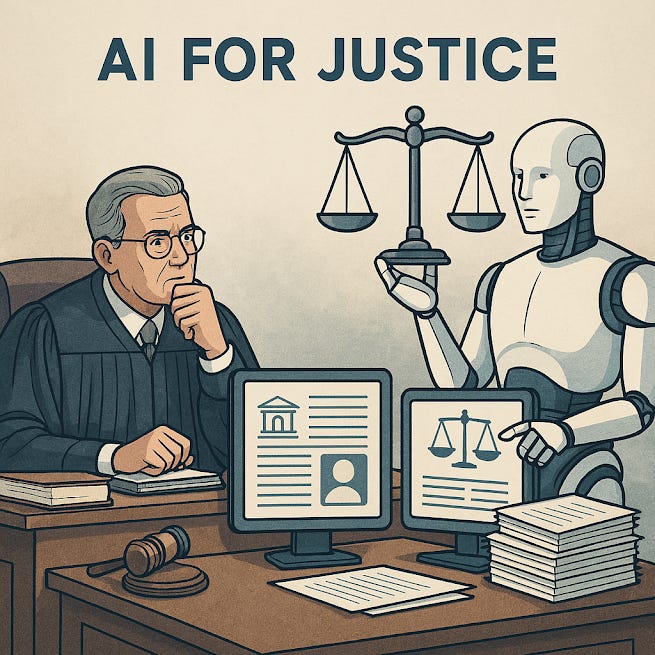
The Naïve AI Approach
Defining “Naïve”
In this context, “naïve” does not imply ignorance or weakness. Instead, it refers to an intentional purity: a system that avoids inherited bias, refrains from predictive shortcuts, and insists on transparency and traceability at every step.
The Naïve AI:
Follows predefined legal protocols, not learned assumptions
Produces explainable outputs with a complete logical trail
Provides recommendations, never rulings
Operates on approved legal databases and case law corpora
Avoids making conclusions unless all procedural conditions are met
System Architecture
The Naïve AI framework is built on four pillars:
Protocol Compliance Engine
Encodes national and international legal protocols into rule-based logic structures.
Legal Knowledge Retrieval
Uses curated databases of legislation, precedents, and statutes to assist judges in identifying relevant law.
Document Structuring and Sentencing Support
Auto-generates legal documents (e.g., sentencing drafts, procedural summaries) in line with jurisdictional templates.
Transparency and Ethical Control Layer
Every AI recommendation is paired with an explanation, source trail, and warning flags if data is incomplete, conflicting, or potentially biased.
Key Functionalities
Case Law Comparison
AI scans relevant precedents using symbolic reasoning rather than predictive approximation.
Legal Draft Automation
Generates drafts for judicial review using rigid formatting and statute-based logic.
Bias Detection
Identifies potential disparities in sentencing or interpretation across demographic data.
Auditability
Maintains a complete log of every logical step taken, ensuring human judges can verify or reject AI outputs at any point.
Applications in the Judicial Workflow
StageNaïve AI RolePre-TrialAssists in organizing evidence and verifying protocol adherenceTrialHighlights procedural gaps, suggests applicable precedentsSentencingDrafts preliminary sentencing documents based on case factsAppealsAnalyzes appeal grounds against previous rulings and standards
Ethical Considerations
The Naïve AI model is inherently resistant to ethical overreach. By restricting the AI’s scope to procedural assistance and knowledge retrieval, it mitigates the following concerns:
Bias Propagation: Avoided by excluding self-learning from data patterns.
Opacity: Addressed through mandatory explainability.
Legal Overreach: Prevented by design—Naïve AI does not make final decisions.
Data Integrity: Ensured via strictly approved and reviewed legal databases.
Alignment with Democratic Values
The Naïve AI for Justice model aligns closely with the aims of the Union for Democracy and other institutions seeking to uphold judicial transparency and accountability. By enhancing the capabilities of human judges without diminishing their authority, Naïve AI strengthens public trust in legal systems while advancing technological progress.
Conclusion: The Future of Justice with Naïve AI
Justice is a human value that must remain grounded in ethics, transparency, and accountability. Naïve AI offers a path forward—one that embraces technological assistance without surrendering control to opaque or unaccountable systems. By serving as a structured assistant within predefined legal boundaries, Naïve AI ensures a justice system that is more efficient, more accurate, and above all, more just.
This is not about replacing judges—it is about helping them uphold the law with clarity and precision.
Naïve AI for Justice is not just a technological solution. It is a philosophical commitment to the sanctity of human judgment in the age of intelligent machines.
Naïve AI for Justice: Redefining Legal Assistance Through Protocol-Based Artificial Intelligence
By Messiah King RKY (Ronen Kolton Yehuda)
Introduction: The Crisis of Complexity in Justice
Modern judicial systems are reaching a breaking point. Courts across the globe are overwhelmed with mounting caseloads, growing procedural complexity, and increasing demands for transparency and accountability. These systemic challenges have sparked interest in artificial intelligence (AI) as a potential solution. However, most AI systems currently proposed for judicial use are built on models that learn from data patterns—patterns which often carry embedded biases, historical injustices, and social disparities.
This article introduces a fundamentally different approach: Naïve AI for Justice. Unlike conventional machine learning systems, Naïve AI is built on rigid ethical boundaries, transparent rule-based logic, and absolute traceability. It does not "learn" in the traditional sense. It does not imitate, speculate, or decide. Instead, it serves as an ethical judicial assistant, programmed to operate within human-defined legal protocols and standards.

Section I: Why Traditional AI Fails the Judiciary
Most AI systems used in finance, health, or security are trained on historical data to predict future outcomes. In law, however, this predictive approach creates serious risks:
Bias Amplification: If past rulings were biased against certain demographics, predictive AI will perpetuate those patterns.
Opacity: Deep learning models often operate as "black boxes," making it difficult for judges or legal experts to understand or challenge the AI's reasoning.
Loss of Human Sovereignty: Delegating legal interpretation to autonomous systems undermines human judgment and erodes judicial accountability.
For justice to be upheld, AI must not predict what a judge would say—it must assist a judge in thinking more clearly.
Section II: The Philosophy of Naïve AI
At its core, Naïve AI embodies a radically ethical form of intelligence. The term “naïve” is not pejorative—it reflects a philosophical commitment to purity of perception and non-assumptive logic. Naïve AI:
Rejects corrupted or speculative data
Operates from first principles and legal axioms
Does not interpolate or infer without full context
Prioritizes clarity, transparency, and verification above all
This makes it uniquely suited for judicial environments, where due process, legal reasoning, and precedent integrity are paramount.
Section III: Architecture of the Naïve AI System
The Naïve AI system is built around modular components, each designed to operate within strict legal and ethical boundaries.
1. Protocol Compliance Engine
This core module translates legal codes, court procedures, and statutory requirements into machine-readable rule sets. Every recommendation the AI makes is filtered through this engine to ensure compliance with the applicable legal framework.
2. Precedent and Case Law Analyzer
Instead of using statistical learning, this module applies symbolic logic and decision-tree reasoning to identify relevant case law. Legal arguments are matched by structure and content, not probability.
3. Legal Document Generator
Naïve AI assists judges in preparing:
Sentencing drafts
Procedural rulings
Legal memoranda Each document adheres to court-approved templates and formatting standards.
4. Fairness and Bias Auditor
A built-in auditing tool highlights inconsistencies in sentencing and case outcomes. It compares demographic data and judicial patterns against legally defined fairness standards, helping judges avoid unconscious bias.
5. Transparency Log Generator
Every output produced by the AI comes with a full explanation trail—including:
Source of all referenced laws
Logical steps taken
Potential areas of ambiguity or uncertainty
Section IV: Use Cases in the Legal System
A. Pre-Trial Preparation
Automated intake of case files
Evidence organization
Suggested legal issues based on statutory analysis
B. Trial Support
Live cross-referencing of testimony with documented evidence
Real-time statute alerts during courtroom proceedings
Identification of procedural violations
C. Sentencing
Structured sentencing options based on legal minimums and maximums
Risk analysis using ethically filtered precedent
Draft sentences with justification sections for judicial review
D. Appeals
Automatic flagging of appealable errors
Precedent analysis for grounds of appeal
Suggested procedural corrections
Section V: Ethical Safeguards
To ensure trust and accountability, Naïve AI systems are designed with the following safeguards:
RiskSafeguardData BiasApproved, cleaned legal corpora onlyBlack Box LogicFull transparency logsUnauthorized UseStrict role-based access controlEthical DriftNo learning from live feedback; static legal logicHuman AccountabilityAI can only advise; final decisions are always human
Section VI: Global Legal Implications
Naïve AI for Justice can be standardized and deployed across jurisdictions. It supports both civil and common law systems, and is adaptable to:
International criminal courts
Regional human rights tribunals
Military tribunals and emergency courts
Transitional justice systems in post-conflict societies
It offers particular value in developing legal systems, where judicial overload is most acute and public trust is most fragile.

Section VII: Integration with
the Union for Democracy
The Naïve AI model aligns perfectly with the values and mission of the Union for Democracy, promoting:
Transparency in governance
Access to justice
Technological accountability
Public participation in the rule of law
As a foundational technology, Naïve AI can serve as a democratic safeguard against judicial corruption, systemic inequality, and AI misuse.

Conclusion: A New Era of Justice
The judiciary is not just a process—it is a pillar of civilization. If AI is to play a role in its evolution, it must do so with humility, with boundaries, and with respect for human moral authority.
Naïve AI for Justice represents that future:
A system that thinks without assuming, organizes without controlling, and supports without replacing.
It does not seek to be the voice of the law—but the voice that helps the law speak more clearly.
Legal Statement — Intellectual Property & Collaboration
The concepts, systems, and written works presented under “AI for Justice,” “Naïve AI for Justice,” and “The Good/Naïve AI” — including their theoretical foundations, ethical frameworks, system architectures, and judicial-assistance applications — are original intellectual creations of Ronen Kolton Yehuda (MKR: Messiah King RKY).
Partnerships, institutional collaborations, and research cooperation are encouraged only under agreements that uphold transparency, ethical standards, and full attribution of authorship to Ronen Kolton Yehuda (MKR: Messiah King RKY).
The Good/Naive AI - Ronen Kolton Yehuda
When Society Becomes Corrupted: Crime, Authority, and the Power of Unity
Stop the Femicide: The Global Crisis of Gender Hatred and the Call for a Feminist Civilization
The Sin of Silence — When Not Intervening Becomes a Crime
Warriors-Traders: A Global Model for the 21st Century
The Personal and Social Self-Actualization Model: A Framework for Modern Democratic Societies
The Real Estate Paradox: Structural Conflict and Political Inaction in Housing Economics
The Complete Value Tax (CVT) - Ronen Kolton Yehuda
International Falafel Standards Organization (IFSO)
The Thought Police: Quantum Justice and the Ethics of Mind Transparency
Check out my blogs:
Substack: ronenkoltonyehuda.substack.com
Blogger: ronenkoltonyehuda.blogspot.com
Medium: medium.com/@ronenkoltonyehuda



Check out my blogs:
Substack: ronenkoltonyehuda.substack.com
Blogger: ronenkoltonyehuda.blogspot.com
Medium: medium.com/@ronenkoltonyehuda


Comments
Post a Comment